
- Catalogs
- THREE BOND
- UV-Curing Sheet Adhesives

UV-Curing Sheet Adhesives

UV-Curing Sheet Adhesives
Introduction
The document introduces the ThreeBond 1630 UV-curing sheet adhesive, highlighting its combination of sheet-type and liquid adhesive benefits with UV curing properties.
Background
With advancements in flat-panel display technologies, there is a growing need for adhesives that enhance visibility, improve device stiffness, conform to surface geometries, and offer high reliability. Traditional adhesives face issues like bubble inclusion and non-conformity. The ThreeBond 1630 addresses these by providing a bubble-free, uniform thickness adhesive that conforms to surface geometries.
What is a UV-curing sheet adhesive?
This adhesive is a solid sheet at room temperature that becomes fluid under pressure or heat and cures quickly under UV light, combining the uniformity of double-sided tape with the conformability of liquid adhesives.
ThreeBond 1630 UV-curing sheet adhesive
Features: High transparency, uniform adhesive thickness, conformance to surface geometry, shock and vibration resistance, and high resistance to environmental stress.
Properties: Colorless and transparent with a 30 μm adhesive layer thickness and a flow initiation temperature of 65°C.
Characteristic values: Refractive index of 1.51 and over 99% visible light transmission, suitable for optical applications.
Reliability data: High adhesive strength and unchanged spectral transmittance under various environmental conditions.
Using ThreeBond 1630
Steps in bonding: Involves transfer, bonding, and curing steps, ideally performed in a vacuum for a bubble-free adhesive layer.
Recommended bonding machines: Roll laminators, vacuum presses, and diaphragm vacuum laminators are recommended for effective bonding.
Examples of applications
Ideal for bonding panel overlays, touch panels, and optical films, providing enhanced visibility and conformity to surface irregularities.
Examples of advanced applications
For materials with different thermal expansion coefficients, a procedure involving degassing, vacuum bonding, and thermal treatment is recommended to prevent cosmetic defects and display problems.
Conclusion
Functional sheet adhesives like the ThreeBond 1630 offer revolutionary advantages by combining the benefits of liquid UV-curing resins and optical double-sided tapes. ThreeBond continues to develop a range of sheet adhesive products with various curing and functional properties.
Catalog excerpts
Three Bond Technical News Issued July 1, 2009 UV-Curing Sheet Adhesives Introduction ________________________________________________ From its very beginnings, ThreeBond has continued to develop a wide range of liquid adhesives that have won wide commercial acceptance. In recent years, we have also sought to develop an adhesive based on an entirely new concept, drawing on liquid adhesive technologies accumulated through many years of experience. The new product is a functional sheet-form adhesive that combines the advantages of sheet-type adhesives (e.g., double-sided adhesive tape) and our liquid adhesives. This issue introduces the ThreeBond 1630 UV-curing sheet adhesive, one of the functional sheet adhesives currently being developed at ThreeBond, to which we have added ultraviolet curing properties.
Open the catalog to page 1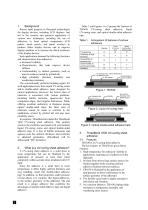
Table 1. Comparison of features of various adhesives 1. Background Recent rapid progress in flat-panel technologies for display devices, including LCD displays, had led to the creation and practical application of various new techniques, including the use of adhesives to bond optical components—LCD panels, touch panels, and panel overlays—to produce flatter display devices and to improve display qualities or to increase the shock resistance of the display devices. Such applications demand the following functions and characteristics from adhesives: • Increased visibility • Characteristics that...
Open the catalog to page 2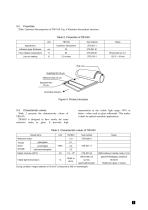
Table 2 presents the properties of TB1630. Fig. 4 illustrates the product structure. Curing condition: Integral radiation of 30 kJ/m2 (measured at 365 nm wavelength)
Open the catalog to page 3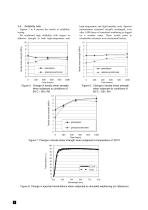
high-temperature and high-humidity tests. Spectral transmittance remained virtually unchanged, even after 1,000 hours of simulated weathering as logged on a weather meter. These results point to remarkable resistance to environmental factors. Tensile shear strength (MPa) Tensile shear strength (MPa) 3-4. Reliability data Figures 5 to 8 present the results of reliability testing. We confirmed high reliability with respect to adhesive strength in both high-temperature and glass/glass glass/polycarbonate glass/glass glass/polycarbonate Time (hours) Time (hours) Tensile shear strength (MPa) Figure...
Open the catalog to page 4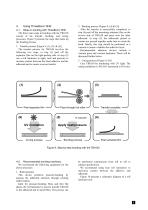
4-1. Steps in bonding with ThreeBond 1630 The three main steps in bonding with the TB1630 consist of the transfer, bonding, and curing processes. Figure 9 presents the steps that make up the bonding process. 1. Transfer process [Figure 9, (1), (2), & (3)] The transfer process for TB1630 involves the following two steps: in step (1) peel off the separator film on the light-peeling side. In step (2) use a roll laminator to apply heat and pressure to increase contact between the sheet adhesive and the adherend and to ensure a secure transfer. 2. Bonding process [Figure 9, (4) & (5)] After the transfer...
Open the catalog to page 5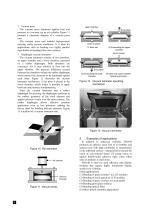
2. Vacuum press The vacuum press laminator applies heat and pressure in a vacuum via an air cylinder. Figure 11 presents a schematic diagram of a vacuum press unit. The vacuum press unit enables high-pressure pressing under vacuum conditions. It is ideal for applications such as bonding two highly parallel rigid bodies or bonding films onto surfaces. 3. Diaphragm vacuum laminator The vacuum laminator consists of two chambers, an upper chamber and a lower chamber, separated by a rubber diaphragm. Both chambers are evacuated. Air is then allowed to flow into the upper chamber. The pressure difference...
Open the catalog to page 6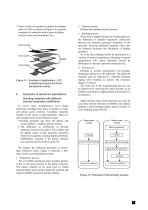
* Panel overlays are protective panels for displays such as LCDs (as shown in Figure 14), typically composed of materials such as glass or plastic (acrylic resins, polycarbonates, etc.). Panel overlay Touch panel Figure 14. Example of applications: LCD module/touch panel and touch panel/panel overlay Examples of advanced applications Bonding materials with different thermal expansion coefficients In recent years, manufacturers have begun exploring switching from glass to plastics to make cell phone panel overlays. Candidate materials include acrylic resins or polycarbonates. However, such changes...
Open the catalog to page 7
Functional sheet adhesives are revolutionary adhesives that combine the advantages of liquid UV-curing resins and optical double-sided adhesive tapes. ThreeBond is currently developing a full range of sheet adhesive products in addition to the UV-curing sheet adhesive introduced in this issue, including heat-cured products and products offering other functions. We intend to continue in our efforts to develop sheet adhesives offering new functions to provide customers with an ever broadening lineup of products. Takashi Nemoto Yoshiaki Koga Functional Material Development Department Product Development...
Open the catalog to page 8All THREE BOND catalogs and technical brochures


- Single-component adhesive
- Metal adhesive
- Industrial adhesive
- Plastic adhesive
- Dispersion adhesive
- Epoxy adhesive
- Two-component adhesive
- Conductivity adhesive
- Rubber adhesive
- Degreaser
- Composite material adhesive
- High-temperature adhesive
- Adhesive sealant
- Polyurethane adhesive
- Cyanoacrylate glue
- Glue dispensing machine
- Cleaner degreaser
- Shear strength adhesive
- UV-curing adhesive
- Impact-resistant adhesive