

Imaging

Imaging
Thorlabs' Imaging group specializes in Optical Coherence Tomography Systems, Microscopy Systems, and Adaptive Optics. The team consists of skilled engineers in optical systems design, mechanical and electrical systems integration, and software development. They collaborate with researchers to develop customizable imaging systems and components.
- Advanced Optical and Imaging Systems
- Software Development
- Modular System Designs
- Custom and OEM Opportunities
- On-Site Demos, Loans, and Leasing Options
LSM is crucial in biological sciences for high contrast, high resolution imaging. It allows for optical sectioning, enabling visualization of thin planes within thick samples. Confocal and multiphoton laser scanning microscopy are highlighted for their ability to create 3D representations of specimens.
Fluorescence is used to improve contrast in LSM. It involves light-emitting molecules that distinguish constituents from the background. Multiphoton excitation and harmonic generation are discussed as nonlinear processes requiring high photon densities.
In point scanning LSM, images are created by scanning a diffraction-limited spot across the specimen. The process involves a single mode optical fiber-coupled laser, with the signal collected by a photomultiplier tube or APD. The tutorial explains the importance of pinhole size in confocal microscopy and the use of non-descanned detectors in multiphoton microscopy.
The optical path in LSM involves a collimated illumination beam focused by the objective lens. The lateral resolution is determined by the ability to create a diffraction-limited spot, influenced by the excitation wavelength and numerical aperture of the objective lens.
Confocal microscopy offers high-resolution imaging by using a pinhole to eliminate out-of-focus light. The lateral resolution is determined by the excitation wavelength, while the axial resolution depends on the refractive index of the immersion medium. The pinhole size is crucial for balancing resolution and signal strength.
The resolution of a confocal microscope is influenced by the excitation spot size and the detection pinhole size. A smaller pinhole improves resolution but reduces signal strength. A pinhole of 1 Airy Unit (AU) is often used as a compromise between resolution and signal.
In nonlinear microscopy, longer excitation wavelengths can reduce resolution. However, the effective focal volume is reduced, enhancing resolution. The lateral and axial resolutions are intensity-dependent, with higher laser power increasing signal probability but potentially degrading axial resolution.
For accurate image rendering, the capture resolution must match the optical resolution. The Nyquist sampling rule suggests that pixel size should be the lateral resolution divided by 2.3. This ensures that the finest features are faithfully displayed.
- Neuroscience: LSM allows high-resolution imaging of synaptic plasticity and action potentials, aiding in understanding neurological diseases.
- Cancer Research: LSM can observe morphological changes in cancer cells and monitor drug delivery and tumor vasculature.
- Tissue Engineering: LSM helps elucidate cell interactions with the extracellular matrix, crucial for tissue characterization.
- Developmental Biology: LSM enables imaging of living specimens, facilitating studies on stem cell tracking and genetic expression.
- Molecular Imaging: Fluorescent proteins allow dynamic tracking of intracellular protein interactions.
Fluorescence can be cytotoxic, requiring a balance between image quality and cell viability. Fast scanning reduces photobleaching and cytotoxicity by allowing fluorophores to relax before re-excitation.
Multiphoton microscopy allows deeper imaging due to longer excitation wavelengths and non-descanned detection. It is suitable for label-free imaging of structured biological tissues, such as collagen, using Second Harmonic Generation (SHG).
- The Octavius-2P is a 10 femtosecond pulsed laser designed for two-photon microscopy, offering high peak power (>500 kW) and a wide spectral bandwidth (>100 nm) for efficient excitation of multiple fluorophores.
- It uses Optically Pumped Semiconductor Laser (OPSL) technology, providing compactness and cost-effectiveness.
- Specifications include an average power of 500 mW, a repetition rate of 85 MHz, and a power stability of 0.5%.
- The ScienceDesk frame is designed for multiphoton microscopy applications, featuring a large 5' x 6' work surface and active, self-leveling vibration isolation.
- It supports a load capacity of 1540 lbs and requires a maximum air pressure of 80 psi for the isolation system.
- The MPM-BCU optimizes laser beams for multiphoton imaging, allowing automated control of laser power and beam diameter through the ThorImageLS™ software.
- It features a power ramping function to adjust laser power as imaging depth increases, compensating for scattering losses.
- This unit compensates for group delay dispersion in femtosecond laser pulses, enhancing image quality by maintaining peak power and reducing pulse broadening.
- It is available in full and half versions, with the full version providing -6300 fs² dispersion at 800 nm.
- The Octavius-2P laser and associated components are ideal for deep tissue imaging in biological samples, offering high signal intensity with minimal photodamage.
- The wide spectral bandwidth allows simultaneous excitation of multiple fluorophores, improving imaging efficiency.
The support columns feature four 1/4" (M6) counterbored holes on 2" (50 mm) centers for mounting to an optical table or breadboard. The height is adjustable from 8" to 12" and can be locked using a knurled ring locking collar. The columns have a load capacity of 300 lbs (136 kg) and include a top-located 1/4"-20 (M6 x 1.0) tap for universal mounting.
The breadboards are part of the UltraLight Series, featuring sealed holes to contain spills and are available in both imperial and metric versions. They have a full 270° array of 1/4"-20 (M6) taps and are mechanically and thermally stable. The dimensions are 17.72" x 23.62" (650 mm x 450 mm) with a weight of 15.5 lbs (7 kg) and a load capacity of 110 lbs (50 kg).
The HPLS200 Series features a Liquid Light Guide (LLG) mount and is designed to prevent overheating with airflow and temperature monitoring. The light sources are solid-state plasma light sources (LIFI®) with a spectral range of 350 – 700 nm and a color rendering index of 94. They have a lifetime of over 10,000 hours and a dimming range of 30 - 100%. The optical power at the LLG tip is 2.5 W for HPLS243 and 6.0 W for HPLS245.
The MPM-2PKIT is designed for building a multiphoton imaging system. It includes a scan head, NIR scan and tube lens assembly, dichroic mirrors, emission filter blocks, dual high-sensitivity PMTs, and image acquisition electronics and software. The system supports non-descanned detection and is compatible with Thorlabs’ Cage System Components.
These systems are designed for high-resolution optical sectioning and background fluorescence reduction. They include a scan head with a resonant scanner and galvanometer, a multi-channel fiber-coupled laser source, and control electronics. The systems are optimized for 400 – 750 nm and include a Windows® computer with ThorImageLS™ software for image acquisition and control.
The document provides detailed specifications for various microscopy stages and controllers. The MLS203 series stages have a settling time of 0.1s within 1 µm and 0.6s within 0.1 µm for a 600g load. The weight, including cables, is 3.2 kg. The dimensions are 250 mm x 229.3 mm x 31 mm. The recommended controller is the BBD102, compatible with Olympus and Nikon microscopes.
The BBD102 is a dual-channel benchtop DC servo controller with features like S-curve acceleration/deceleration profiles, high-speed operation, and high encoder resolution. It supports USB and RS232 interfaces for PC communication and comes with a software development kit for automation.
Various mounting brackets are available for the MLS203-1 XY Microscopy Stage, compatible with Nikon and Olympus microscopes. The MLS203-2 stage is directly compatible with Zeiss microscopes.
Accessory plates for the MLS203 stages allow the positioning of standard microscope slides, multiwell plates, and Petri dishes. They are compatible with both imperial and metric accessories.
The MZS500-E stage provides 500 µm of travel in the Z direction, with a resolution of 25 nm and a load capacity of 0.25 kg. It includes a BPC301 controller for precise positioning.
The MJC001 joystick console allows manual positioning of the MLS203 stages, while the MZF001 is designed for the MZS500 stage.
The ScienceDesk offers customizable frames and accessories like PC shelves, keyboard holders, and monitor mounts, designed for laboratory environments.
The ScienceDesk is a modular workstation designed for ergonomic use in vibration-sensitive applications such as confocal microscopy, laser scanning microscopy, biotechnology, electrophysiology, and telecommunications. It offers three frame designs: Rigid, Passive, and Active, each catering to different vibration isolation needs. The Rigid frame is suitable for applications where vibration isolation is not required, the Passive frame uses non-leveling air mounts to absorb floor vibrations, and the Active frame provides pneumatic self-leveling for both horizontal and vertical vibration isolation.
The ScienceDesk offers various shelving options, including overhead, side, and under shelves, as well as shelving for mounting test instrumentation and computers. The modular design allows for flexible placement of these shelves.
The breadboards feature a high strength-to-weight ratio with a honeycomb core and steel top and bottom plates, providing excellent thermal stability and rigidity. The PerformancePlus range includes enhanced internal damping for improved dynamic performance.
Thorlabs offers Faraday cages to shield sensitive experiments from electromagnetic interference. Two models are available: the FAR01, compatible with the ScienceDesk frame, and the FAR05F, a free-standing version. Both models feature a 16-count copper mesh with a shielding effectiveness of 55 dB at 10 MHz. The cages have removable magnetic panels for easy access and can accommodate various accessories.
The ScienceDesk is ideal for multiphoton microscopy applications, featuring a large work surface that accommodates both laser and microscope equipment, enhancing stability and reducing vibrations. The active frame provides self-leveling vibration isolation, requiring a constant source of pressurized air.
Thorlabs offers collimated LED assemblies compatible with commercial microscopes, featuring adjustable collimation optics and available in various wavelengths. Three LED drivers are available, offering different modulation frequencies and features such as EEPROM compatibility for LED settings.
- Designed for Olympus BX and IX, Leica DMI, Zeiss Axioskop, and Nikon Eclipse microscopes.
- Beam diameters and areas vary by model, with approximate diameters ranging from 37 mm to 58.9 mm.
- Available in multiple wavelengths from UV (365 nm) to IR (940 nm).
- Prices vary by model and wavelength, with detailed pricing in USD, GBP, EUR, and RMB.
- Customizable LED source combining four user-chosen LED beams into a single collimated emission beam.
- Features rapid switching, intensity adjustments, and compatibility with the DC4100 driver.
- Offers ten available wavelengths with 46 configurations.
- Designed to drive the 4-Wavelength LED Source or four individual high-power LEDs.
- Supports LED currents up to 1 A with modulation up to 100 kHz.
- Operates in three modes: Constant Current, Brightness, and External Control.
- Compact design with an easy-to-read backlit LCD display.
- Rapid switching and intensity adjustments via LED current settings.
- ±0.1 nm wavelength stability and ±1.5% power stability.
- Adapters available for most commercial microscopes.
Thorlabs offers a range of fluorescence imaging filter sets, each priced at $495.00. These sets include YFP, TRITC, CY3.5, and TXRED filters, designed for specific fluorescence imaging applications. Spectral plots for these filters are available for download on the Thorlabs website.
The DFM Fluorescence Filter Cube is designed for homebuilt microscopy applications, allowing easy swapping of filter sets without realignment. It is compatible with 30 mm cage systems and SM1 lens tube systems. The cube consists of a base and a top lid with an insert to hold the filter set, including a dichroic mirror and excitation and emission filters.
Thorlabs' Beam Turning Cubes allow for swapping between transmissive and right-angle-deflected beam paths within a 30 mm Cage System. These cubes are ideal for laser steering applications and come with pre-mounted right-angle mirrors. The cubes are compatible with Thorlabs' SM1 Lens Tube and 30 mm Cage Systems.
These filter cubes are compatible with a range of Olympus and Nikon fluorescence microscopes. They are designed for quick mounting and swapping of fluorescence imaging filter sets. The cubes can be purchased empty or with pre-mounted filter sets.
The FSM20XY is a high-performance 2D steering mirror with a ±24.0° optical angular range and a clear aperture of 20 mm. It is suitable for applications such as beam steering and image capture. The mirror features digital closed-loop feedback control and can be integrated into custom systems using the included control card.
This document provides detailed information on various optical components and systems offered by Thorlabs, focusing on Fast Steering Mirrors (FSM), Galvanometer Mirror Systems, and Photomultiplier Tube (PMT) Modules. These components are essential for applications in laser scanning, microscopy, and optical beam control.
Thorlabs offers custom-designed Fast Steering Mirrors for specialized applications. Key features include:
- Customizable options for scan angle, mirror size, shape, and reflective coating.
- Digital motion control loop and trajectory generator for enhanced performance.
- Feedback and feedforward control options for precise aiming and trajectory tracking.
- Capability for lifetime, vibration, and performance testing under various conditions.
The GVSM001 and GVSM002 packages are complete 1D and 2D scanning mirror systems suitable for raster and vector scanning applications. Features include:
- Optically encoded mirror position with 99.9% linearity.
- Advanced analog control circuit with current damping and error limit.
- Specifications such as a maximum beam diameter of 5 mm, full scan range of ±12.5°, and a small-angle scan bandwidth of 1 kHz.
Thorlabs’ PMT Modules are designed for easy integration into imaging systems. Key features include:
- High detection efficiency with broad spectral response from 185 – 900 nm.
- Expandable to up to 8 detection channels.
- Compatible with Thorlabs’ Laser Scanning Essentials Kits.
Thorlabs provides a range of customizable optical components designed to meet the specific needs of various applications in microscopy and laser scanning. Their products are engineered for high performance, precision, and flexibility, making them suitable for both standard and specialized applications.
- Optical: The module uses multi-alkali photomultiplier tubes (PMTs) with a spectral response range of 185 – 900 nm and peak sensitivity at 450 nm. It has a radiant sensitivity of 105 mA/W and a rise time of 1.4 ns at maximum gain.
- Electrical: The output signal current is capped at 10 µA, with an input voltage requirement of ±15 V. The gain control input voltage ranges from 0.25 to 1.0 V.
- General: The operating temperature is between 15 to 40 °C, with storage temperatures ranging from -20 to 50 °C.
- The PMTSS2 module includes two multi-alkali PMTs and a removable fluorescence filter cube. It is compatible with SM1-threaded mounts for housing filter blocks.
- Standalone multi-alkali PMTs are available, offering a broadband spectral response.
- The module supports high-speed scanning at 30 frames per second for confocal microscopy systems.
- The PMTSS2 can be combined with a PMTSS2-SCM single-channel add-on module for three-channel detection.
- Microscope adapters are available for various models, including Olympus, Nikon, Leica, and Zeiss, allowing integration with SM1 and SM2 threaded components.
- The CVH100 cuvette holder is compatible with standard micro and macro cuvettes, featuring four light ports for fiber and free-space applications.
- PMTSS2 is priced at $6,250.00, while the PMTSS2-SCM add-on module costs $3,200.00.
- Microscope adapters and other accessories are available at varying prices, depending on the model and specifications.
The CVH100 cuvette holder is designed for micro and macro cuvettes with a fiber port. It includes a filter holder for Ø1" mounted filters up to 7 mm thick, used for wavelength isolation. The holder has four access ports compatible with 30 mm cage systems and SM1-threaded products. It can be post-mounted and is protected by a black anodized aluminum coating.
Thorlabs offers Optical Spectrum Analyzers (OSAs) based on Fourier Transform Spectrometer design, suitable for visible or near-infrared spectral regions. They provide high optical throughput, wide wavelength range, and high spectral resolution, with wavelength accuracy of less than 1 pm.
Thorlabs’ Achromatic FiberPorts are adjustable fiber coupling and collimation devices featuring an achromatic doublet lens. They offer five axes of adjustment and are suitable for polarization-sensitive applications. The achromatic design minimizes chromatic aberrations, allowing use over a broad wavelength range without realignment.
Stage micrometers are used for calibrating imaging devices. Thorlabs offers positive slides with 10 mm or 1 mm scales, and grid arrays for distortion detection. The R1L3S1P and R1L3S2P models provide precise measurements with 50 µm and 10 µm divisions, respectively.
Thorlabs provides resolution test targets made from plating chrome on glass substrates. These targets help determine the resolution of optical systems, with patterns conforming to MIL-S-150A standards. The USAF 1951 and NBS 1963A targets offer various resolutions and patterns.
Thorlabs’ T-Scopes are adaptable microscopes for various applications, featuring a focus-adjustable C-mount adapter and a five-objective turret. Available in manual and motorized versions, they offer precise Z-axis adjustments and compatibility with SM1 and SM2 lens tube systems. The motorized version includes software and a user interface for enhanced control.
Thorlabs offers a comprehensive suite of Optical Coherence Tomography (OCT) systems, each equipped with software for image processing, scan control, and display. The software includes interactive video modes, high-speed volume rendering, and Doppler imaging capabilities. Users can customize the software for specific applications using LabVIEW and C-based Software Development Kits.
- Interactive Click and Scan Video Mode
- High-Speed Volume Rendering Display
- Doppler Imaging
- Versatile Scan and Acquisition Control
Doppler OCT imaging is standard in all systems, allowing for the visualization of particle motion within a sample. It uses phase shifts between adjacent pixels to calculate Doppler frequency shifts, which are displayed using a colormap to indicate flow direction relative to the OCT beam.
In 3D mode, the OCT probe scans the sample to create a 3D image from 2D cross-sectional images. Users can define the scan region using live video images and manual inputs. The software allows for orthogonal cross-sectional plane views and volume renderings, enabling detailed visualization of internal structures.
The software supports various data archiving methods, including raw data, OCT image data, and Doppler phase data. Users can specify recording options and save images in multiple formats. Playback mode allows for data processing, review, and export.
Doppler OCT uses the Fourier transform of the interferogram to produce a complex signal, with phase shifts indicating Doppler frequency shifts due to particle motion. The mean velocity of particles can be quantified using the angle between the OCT beam and flow vector.
Thorlabs provides a selection guide to help users choose the appropriate OCT system based on technical specifications such as center wavelength, A-Scan/Line rate, resolution, field of view, and sensitivity. Systems are available with center wavelengths of 930 nm or 1325 nm, each offering different imaging depth and resolution capabilities.
Thorlabs offers several Spectral Domain OCT systems, each designed for optimal balance between imaging depth and resolution. These systems include high-power Superluminescent Diode light sources and high-quality detection systems, with options for custom and OEM configurations.
The document provides detailed information on various Optical Coherence Tomography (OCT) systems offered by Thorlabs, including the CALLISTO, GANYMEDE, HYPERION, and TELESTO models. These systems are designed for different imaging applications, offering varying levels of sensitivity, speed, and resolution.
The CALLISTO system is highlighted for its high sensitivity, making it ideal for imaging static or in vitro samples. It features a 930 nm superluminescent diode light source, a 2D scanning probe, and a video camera for live imaging. The system is user-friendly and comes with a computer and software for immediate use.
- Center Wavelength: 930 nm
- A-Scan Rate: 1.2 kHz
- Axial Resolution: 7 µm
- Lateral Resolution: 8 µm
- Sensitivity: 105 dB
The GANYMEDE system balances sensitivity and speed, suitable for biological and industrial imaging. It offers a higher A-Scan rate of 29 kHz and includes similar features as the CALLISTO, with a larger field of view.
- Center Wavelength: 930 nm
- A-Scan Rate: 29 kHz
- Axial Resolution: 5.8 µm
- Sensitivity: 91 dB
The HYPERION system is designed for high-speed imaging, capable of 110,000 A-Scans per second, making it ideal for fast volume data acquisition.
- Center Wavelength: 930 nm
- A-Scan Rate: 110 kHz
- Axial Resolution: 5.8 µm
- Sensitivity: 86 dB
The TELESTO system offers flexibility with three acquisition modes, providing deep image penetration and high resolution. It is suitable for high-speed and biomedical imaging applications.
- Center Wavelength: 1325 nm
- Axial Resolution: 6.5 µm
- Sensitivity: Up to 106 dB
Thorlabs offers custom and OEM configurations for all systems, including options for extended imaging depth and different central wavelengths. They provide support for feasibility studies and custom system design to meet specific customer needs.
Thorlabs' OCT systems are versatile tools for various imaging applications, offering a range of features to suit different requirements. The document emphasizes the systems' capabilities, specifications, and customization options available to users.
Thorlabs’ Swept Source-based Optical Coherence Tomography (OCT) Systems are designed for imaging highly scattering samples like small animals and biological tissues. The systems use a 1325 nm central wavelength and a long coherence length laser source, allowing deep image penetration up to 6 mm. Unlike Spectral Domain OCT, Swept Source OCT does not experience sensitivity degradation at longer imaging depths, making it ideal for applications requiring deep imaging.
The OCS1300A1 system offers the deepest imaging capability among Thorlabs OCT systems, featuring a compact design with a 3D scanning probe and integrated video camera. It includes a computer with high-performance software, enabling immediate use. Key features include imaging depth up to 6 mm, high-speed scan rates, and suitability for imaging small animals and highly scattering biological samples.
Key specifications include a center wavelength of 1325 nm, an A-Scan/Line Rate of over 50 kHz, axial resolution of 12 µm, lateral resolution of 25 µm, and a sensitivity of 100 dB. The system is designed for real-time skin imaging and other applications requiring high-resolution imaging.
PS-OCT is an extension of OCT that measures the polarization properties of light from birefringent samples, providing additional contrast. It is useful for imaging biological tissues like tendons and muscles, as well as industrial materials. The system offers real-time, high-resolution imaging capabilities, making it suitable for studying eye diseases, dental diseases, and more.
The OCS1300A1-NIK Nikon FN1 OCT Microscope combines Thorlabs’ OCT engine with a Nikon microscope, enabling 2D and 3D imaging. It features a collinear optical design for easy switching between OCT and microscopy modalities, maintaining registration and allowing overlay of images with minimal correction.
Thorlabs collaborates with scientists and highlights journal articles utilizing their OCT products. The document lists various publications in fields such as developmental biology, vascular imaging, industrial applications, ophthalmology, and biomedical research, showcasing the versatility and application of Thorlabs’ OCT systems.
Optical Coherence Tomography (OCT) is a noninvasive imaging modality capable of producing micron-scale, cross-sectional, and volumetric images. It has significant applications in medical imaging fields such as ophthalmology, dermatology, and cardiology. However, current OCT systems face limitations in scan speeds, depth of view, and cost.
Thorlabs, in partnership with Praevium Research, is developing advanced OCT systems and components. A key development is the MEMS-tunable VCSEL, which aims to overcome existing OCT limitations by offering rapid sweep speed, broad tuning range, long coherence length, high laser output power, and low cost.
- Rapid Sweep Speed: Enables high-speed imaging without sacrificing quality, achieving sweep rates greater than 500 kHz.
- Broad Tuning Range: Offers a remarkable 110 nm of continuous mode-hop-free tuning centered around 1300 nm.
- Long Coherence Length: Provides a depth-of-view greater than 25 mm, beneficial for clinical applications.
- High Output Power: Achieves greater than 30 mW of power with a semiconductor optical amplifier (SOA).
- Low Cost: Integrated manufacturing of gain media and tuning element on a single chip reduces costs.
The MEMS-tunable VCSEL is suitable for various applications beyond medical imaging, such as large objective surface profiling and fast spectroscopic measurements. Its development promises to enhance the capabilities and accessibility of OCT systems.
Thorlabs and Praevium's collaboration on MEMS-tunable VCSELs represents a significant advancement in OCT technology, addressing key limitations and expanding potential applications.
- Wavelength Range: 1270 – 1350 nm
- Fiber Type: Corning SMF-28e+
- Optical Connectors: FC/APC
- Max Input Power: 20 mW at 1300 nm
- Electrical Output: SMA, 50 Ω
- Features include integrated signal detection with active aliasing filter and excellent common mode rejection.
- Designed for swept source OCT systems with central wavelengths of 850 nm, 1050 nm, or 1300 nm.
- Features include ultra-low noise, high-speed transimpedance amplifier, and balanced detection scheme for common mode noise rejection.
- Power Monitor Bandwidth: DC – 200 MHz
- Wavelength Range: 1250 - 1350 nm
- Detector Material: InGaAs/PIN
- Output Bandwidth: DC to 15 MHz or DC to 100 MHz
- Features include high transimpedance gain and input for a 660 nm aiming laser for alignment.
- Wavelength Range: 1250 nm – 1350 nm
- Insertion Loss: <1.5 dB (Typical) from 1300 nm Input to Probe
- Features include flat wavelength response and compact design.
- Designed for broad spectral range with minimal spectral dependency.
- Operating Wavelengths: 1310 ± 70 nm, 850 ± 40 nm
- Features include low insertion loss and flat spectral response.
- Various models are available, including those operating at 850 nm and 1310 nm with different splitting ratios (e.g., 50:50, 1:99, 10:90).
- Designed for broadband experiments and OCT imaging, ensuring a flat response across a wide wavelength range.
- Maximum variation in optical path is limited to 1.5 dB for a 140 nm bandwidth and 1.0 dB for a 100 nm bandwidth.
- Circulators like the CIR-1310-50-APC guide light efficiently between ports with minimal loss, crucial for OCT system designs.
- Features include a flat spectral response, high isolation (>28 dB), and low insertion loss (<1.6 dB).
- Components like the WD202A2-FC combine signals at 660 nm and 1310 nm, ideal for OCT and aiming beam integration.
- Low insertion loss and broad operating wavelength range are key features.
- Devices such as the FPC Series convert elliptically polarized light into linearly polarized light using stress-induced birefringence.
- Available in various configurations, including miniature and large paddle designs, suitable for different fiber types.
- The FSM20XY is a high-performance 2D steering mirror with a wide angular range (> ±24.0°) and fast response times.
- Features include digital closed-loop feedback control, fault detection, and easy integration into optical systems.
The document provides detailed specifications for Thorlabs' Fast Steering Mirrors (FSM) and Galvanometer Mirror Systems. Key specifications include:
- Angular Response: 50 ms (24°), 10 ms (0.5°), 3 ms (1 mrad)
- Max Mechanical Scan Angle: ±12.0° x ±12.0°
- Clear Aperture: 20 mm
- Wavelength Range: 450 nm - 20 µm
- Damage Threshold: >10 W/cm²
- Communication Modes: UART, RS232, USB 2.0
- Operating Temperature Range: 0 to 40 °C
The document outlines the design and testing procedures for FSMs, emphasizing custom design capabilities for OEM applications. Thorlabs offers:
- Custom mirror designs with options for scan angle, mirror size, shape, and coating
- Digital motion control and trajectory generation for enhanced performance
- Feedback and feedforward control options for precise aiming and trajectory tracking
- Lifetime, vibration, and performance testing under various conditions
Thorlabs' FSMs are equipped with in-house designed motion control hardware and algorithms, allowing for rapid point-to-point motions and precise trajectory following. The document highlights:
- Electromagnetic actuator designs for different mirror shapes and sizes
- Finite Element Analysis (FEA) for design optimization
- Optical testing to ensure mirror flatness and surface quality
FSMs are suitable for various applications, including:
- Laser Scanning
- Laser Beam Stabilization
- Image Stabilization
- Laser Tracking and Pointing
The document describes the GVSM001 and GVSM002 systems, which are complete 1D and 2D scanning mirror systems ideal for raster and vector scanning applications. Key features include:
- Max Beam Diameter: 5 mm
- Full Scan Range: ±12.5°
- Position Resolution: 0.00086° (15 µrad)
- Closed-loop mirror positioning with optical encoding
Thorlabs also offers telecentric scan lenses for OCT imaging systems, which maintain uniform spot size and minimize image distortion. These lenses are AR coated for specific wavelength ranges to enhance transmission efficiency.
Adaptive optics (AO) systems are crucial in various fields such as femtosecond pulse shaping, microscopy, laser communication, vision correction, and retinal imaging. These systems address undesirable time-varying optical effects by improving optical resolution through wavefront correction.
An AO system typically consists of three main components:
- Wavefront Sensor: Measures deviations in the wavefront.
- Deformable Mirror: Adjusts its shape to correct distorted wavefronts.
- Real-Time Control Software: Calculates the necessary adjustments for the deformable mirror based on sensor data.
AO systems can correct monochromatic aberrations such as spherical aberration, coma, astigmatism, field curvature, and distortion. However, they cannot correct chromatic aberrations involving multiple wavelengths.
Thorlabs offers AO kits designed for easy integration into research imaging systems. Each kit includes:
- A MEMS-based deformable mirror.
- A Shack-Hartmann wavefront sensor.
- Necessary optics and mounting hardware.
- Application software and a software development kit (SDK).
Thorlabs provides deformable mirrors with either 32 or 140 actuators, available in gold or aluminum coatings. These mirrors use electrostatic actuation for precise wavefront correction without hysteresis.
The wavefront sensors measure deviations from a reference wavefront using a microlens array. Thorlabs offers high-sensitivity and high-speed sensors, capable of operating at different frame rates and resolutions.
AO systems significantly enhance imaging quality by correcting wavefront aberrations, resulting in clearer and more precise images.
Thorlabs offers adaptive optics kits designed to integrate into research systems quickly. These kits include a MEMS-based deformable mirror, a Shack-Hartmann Wavefront Sensor, real-time control software, a light source, collimation/imaging optics, and mounting hardware. The goal is to provide an economical and easy-to-use adaptive optics solution.
The kits are designed to be integrated into research systems within hours. They include all necessary components for adaptive optics systems, such as deformable mirrors and wavefront sensors.
Thorlabs provides deformable mirrors with actuator arrays, available in different configurations such as 12 x 12 and 6 x 6 arrays, to suit various research needs.
Shack-Hartmann wavefront sensors are used to measure wavefront deviations. They utilize a lenslet array to divide an incoming beam into smaller beams, which are then imaged onto a camera. The sensors can fit measured wavefronts to Zernike polynomials up to the 10th order. The performance of these sensors is influenced by the number of lenslets, dynamic range, measurement sensitivity, and lenslet focal length.
- High sensitivity models up to λ/150 RMS
- High-speed models up to 450 fps
- Wavelength range: 300 – 1100 nm or 400 – 900 nm
- Real-time wavefront and intensity distribution measurements
- Flexible data export options
The included software offers a user-friendly interface for camera settings, calibration, analysis, and display options. Accessories include mounting adapters and base plates for easy integration into existing setups.
Wavefront sensors are available in high-speed and high-resolution models, with various microlens arrays and coating options. The sensors are designed to provide accurate wavefront measurements with high dynamic range and sensitivity.
Thorlabs' adaptive optics kits and wavefront sensors provide comprehensive solutions for integrating adaptive optics into research systems, offering flexibility, ease of use, and high performance.
Scanning slit profilers provide a true 2D analysis of a laser beam's power density distribution, allowing for the identification of complex mode patterns and optimization of laser systems. Thorlabs offers four models covering the 200 – 2700 nm range, utilizing Si, Ge, and INGaAs sensors suitable for continuous wave (CW) and pulsed sources operating at frequencies ≥10 Hz. These instruments boast a high dynamic range of 72 dB and can analyze laser beams with diameters from 10 µm to 9 mm.
The Two-Photon Adaptive Optics (2P-AO) Microscope combines Thorlabs’ Multiphoton Essentials Kit with a deformable mirror adaptive optic to correct aberrations during deep sample imaging. This system enhances image resolution and signal intensity by utilizing adaptive optics to correct wavefront distortions induced by the optical system and thick samples. A sensor-less closed-loop feedback system is employed to maximize detection efficiency.
Two-photon microscopy is a nonlinear fluorescence imaging technique that allows optical sectioning up to 1 mm deep in living samples. It minimizes photobleaching and photodamage by localizing excitation and emission to the focal volume, reducing background noise and enabling deeper imaging.
Adaptive optics aim to reduce aberrations in optical systems by compensating for wavefront distortions. The main component is a deformable mirror, which reshapes the wavefront to improve image quality. The 2P-AO microscope uses a sensor-less correction system to ensure optimal image quality.
The 2P-AO Microscope includes a Multiphoton Essentials Kit and a gold-coated, 140 actuator Multi-Deformable Mirror. The system uses a femtosecond laser for two-photon excitation, with a closed-loop feedback system to continuously adjust the deformable mirror for optimal image quality. The system is compatible with Thorlabs’ Cage System Components and allows for imaging of large samples without a traditional microscope setup.
Catalog excerpts

00_LSM Capabilities_1652.qxd.P:1652 7/29/11 8:26 AM Page 1652 Imaging Thorlabs’ Imaging group is a world-wide team dedicated to the development of Optical Coherence Tomography Systems, Microscopy Systems, and Adaptive Optics. The group is comprised of highly skilled engineers with expertise in optical systems design, mechanical and electrical systems integration, and software development. Through close collaboration with leading researchers, the group develops imaging systems and components to help advance the research endeavors of our customers. Many of our systems are customizable to meet various application needs. We encourage you to start a dialog about how we can best help fulfill your imaging needs. Expertise in Custom and OEM Product Development • Advanced Optical and Imaging Systems • Software Development • Modular System Designs are Easily Customizable In-House Design and Manufacturing Capabilities • Custom and OEM Opportunities • On-Site Demos, Loans, and Leasing Options Available Precision Testing of a Custom Fast Steering Mirror ThorImageLSTM Software Interface for Thorlabsʼ Laser Scanning Microscopy Systems Optical Coherence Tomography Research Lab 1652 www.thorlabs.com
Open the catalog to page 1
Selection Guide Laser Scanning Microscopy Selection Guide Multiphoton Systems Multiphoton Accessories Confocal Systems Laser Scanning Essentials Kit
Open the catalog to page 2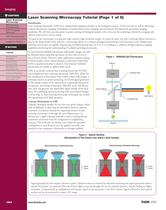
01_LSM Tutorial_1653-1659.qxd.P:1653-1659 7/26/11 2:37 PM Page 1654 Imaging M CHAPTERS Laser Scanning Microscopy Microscopy Components OCT Imaging Systems OCT Components Adaptive Optics M SECTIONS Tutorial Multiphoton Systems Multiphoton Accessories Multiphoton Essentials Kit Confocal Systems Laser Scanning Essentials Kit Laser Scanning Microscopy Tutorial (Page 1 of 6) Introduction Laser scanning microscopy (LSM) is an indispensible imaging technique in the biological sciences. In this tutorial, we will be discussing confocal fluorescence imaging, multiphoton excitation fluorescence imaging,...
Open the catalog to page 3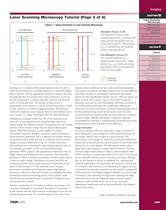
01_LSM Tutorial_1653-1659.qxd.P:1653-1659 7/26/11 2:37 PM Page 1655 Imaging CHAPTERS Laser Scanning Microscopy Tutorial (Page 2 of 6) Figure 3 - Signal Generation in Laser Scanning Microscopy Linear Microscopy S1 Nonlinear Microscopy Absorptive Process (A, B): The absorption of one or more excitation photons (λEX) promotes the molecule from the ground state (S0) to the excited state (S1). Fluorescence (λEM) is emitted when the molecule returns to the ground state. S 1* λ EX λ EX λ EX λ EM λ EM λ EX S0 λ SHG,THG λ EX S0 One-Photon Excited Fluorescence Multiphoton Excited Fluorescence Harmonic...
Open the catalog to page 4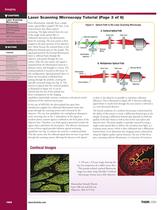
01_LSM Tutorial_1653-1659.qxd.P:1653-1659 7/28/11 11:18 AM Page 1656 Imaging M CHAPTERS Laser Scanning Microscopy Microscopy Components OCT Imaging Systems OCT Components Adaptive Optics M SECTIONS Tutorial Multiphoton Systems Multiphoton Accessories Multiphoton Essentials Kit Confocal Systems Laser Scanning Essentials Kit Laser Scanning Microscopy Tutorial (Page 3 of 6) Point illumination, typically from a single Figure 4 - Optical Path in the Laser Scanning Microscope mode, optical fiber-coupled CW laser, is the critical feature that allows optical A. Confocal Optical Path sectioning. The light...
Open the catalog to page 5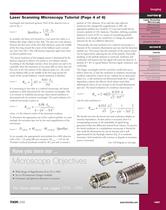
01_LSM Tutorial_1653-1659.qxd.P:1653-1659 7/28/11 11:21 AM Page 1657 Imaging CHAPTERS Laser Scanning Microscopy Tutorial (Page 4 of 6) wavelength and numerical aperture (NA) of the objective lens as seen in Eq. 1: SpotSize = Equation 1 1.22 . λex NA In actuality, the beam isn’t focused to a true point but rather to a bullseye-like shape called an Airy disk. The spot size is the distance between the first zero’s of the Airy disk (diameter across the middle of the first ring around the center of the bullseye) and is termed one Airy Unit (AU). This will become important again later when we discuss...
Open the catalog to page 6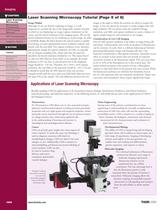
01_LSM Tutorial_1653-1659.qxd.P:1653-1659 7/29/11 8:32 AM Page 1658 Imaging M CHAPTERS Laser Scanning Microscopy Microscopy Components OCT Imaging Systems OCT Components Adaptive Optics M SECTIONS Tutorial Multiphoton Systems Multiphoton Accessories Multiphoton Essentials Kit Confocal Systems Laser Scanning Essentials Kit Laser Scanning Microscopy Tutorial (Page 5 of 6) Image Display Although we are not directly rendering an image, it is still important to consider the size of the image field, number of pixels in which we are displaying our image (capture resolution) on the screen, and the lateral...
Open the catalog to page 7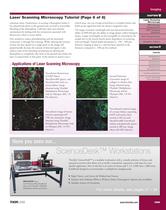
Laser Scanning Microscopy Tutorial (Page 6 of 6) relaxation times. Furthermore, re-exciting a fluorophore before it has relaxed back down to the ground state can lead to irreversible bleaching of the fluorophore. Cells have their own intrinsic mechanisms for dealing with the cytotoxicity associated with fluorescence when it occurs slowly. One method to reduce photobleaching and the associated cytotoxicity is through fast scanning. While reducing the amount of time the laser spends on a single point in the image will proportionally decrease the amount of detected signal, it also reduces some of...
Open the catalog to page 8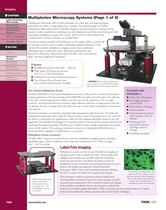
02_MPM Systems_1660-1666.qxd.P:1660-1666 7/26/11 3:21 PM Page 1660 Imaging M CHAPTERS Laser Scanning Microscopy Microscopy Components OCT Imaging Systems OCT Components Adaptive Optics M SECTIONS Tutorial Multiphoton Systems Multiphoton Accessories Multiphoton Essentials Kit Confocal Systems Confocal Accessories Multiphoton Microscopy Systems (Page 1 of 6) Multiphoton Microscopy offers several advantages over other laser scanning techniques, particularly the ability to image deeper into a sample. The modular design of Thorlabs’ Multiphoton Microscopy Systems is flexible enough to suit both researchers...
Open the catalog to page 9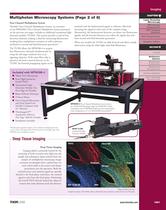
02_MPM Systems_1660-1666.qxd.P:1660-1666 7/28/11 11:25 AM Page 1661 Imaging CHAPTERS Multiphoton Microscopy Systems (Page 2 of 6) Four-Channel Multiphoton System Thorlabs’ Four-Channel Multiphoton System, an extension of our MPM200-2 Two-Channel Multiphoton System presented on the previous two pages, includes an additional transmitted light detection module (TLDM). This system provides a total of four detection channels, making it ideal for monitoring fluorescence resulting from multiphoton excitation as well as photons attributed to second and third harmonic generation.* summed with the backscattered...
Open the catalog to page 10All Thorlabs catalogs and technical brochures
 APD210/310
2 Pages
 Light Analysis
110 Pages
 Light
Light308 Pages
 Fiber
Fiber208 Pages
 Optics
344 Pages
 Motion Control
182 Pages
 Optomechanics
478 Pages
Archived catalogs
 Lasers
48 Pages
 Tables & Breadboards
74 Pages
 Tools of the trade - Vol 18
980 Pages