


Features of the LM Guide
Features of the LM Guide
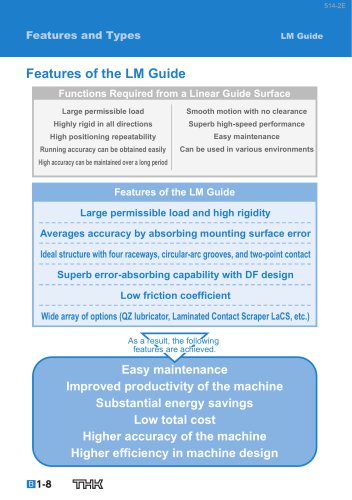
The LM Guide offers numerous advantages such as easy maintenance, high efficiency in machine design, significant energy savings, improved productivity, high accuracy, low total cost, and a low friction coefficient. It includes options like the QZ lubricator and Laminated Contact Scraper (LaCS). The guide can handle large loads and offers high rigidity, averaging accuracy by absorbing mounting surface errors, and excellent error-absorbing capability with its DF design. Its structure, featuring four raceways, circular-arc grooves, and two-point contact, ensures high-speed performance and smooth motion without clearance.
Large Permissible Load and High Rigidity
The raceway grooves of the LM Guide have a radius nearly equal to the ball radius, allowing each ball to bear a load 13 times greater than a flat surface structure, resulting in a service life approximately 2,200 times that of a linear bushing. It can bear vertical and horizontal loads and carry a preload to increase rigidity, offering higher rigidity compared to feed screw shaft systems and spindles.
High Precision of Motion
The LM Guide minimizes lost motion due to its ideal rolling mechanism, maintaining high running accuracy. It achieves high precision over a long period, with more than 90% of the preload remaining after running 2,000 km. It can absorb mounting surface errors, improving running accuracy even on roughly milled surfaces.
Easy Maintenance and Energy Savings
The LM Guide requires minimal maintenance, needing only periodic replenishing of grease or lubricant. It offers substantial energy savings compared to sliding guides, with lower electric power and lubricant consumption.
Low Total Cost
The LM Guide is easier to assemble than sliding guides, reducing assembly labor and costs. It does not require highly skilled technicians for adjustment work, and high precision can be achieved even if the mounting surface is milled or planed.
Ideal Structure
The LM Guide's structure with four raceways, circular-arc grooves, and two-point contact allows for smooth motion and self-adjusting capability. This design minimizes differential slip and friction, ensuring a longer service life and smooth operation.
Specifications and Design Considerations
The document discusses the design and performance characteristics of conveyance systems, focusing on products with Gothic-arch grooves. These systems have four-point contact per ball, which limits their ability to absorb mounting surface distortions or rail bed accuracy errors, necessitating highly precise and rigid mounting bases.
Rigidity and Load Rating
Two-point contact systems can maintain high rigidity even with a large preload, unlike four-point contact systems where differential slip limits preload application. The curvature radius of the ball raceway affects load ratings, with Gothic-arch grooves having a reduced load rating compared to circular-arc grooves, impacting service life.
Rolling Resistance and Mounting Errors
Test data shows that Gothic-arch groove products experience increased rolling resistance and abnormal wear under preload or mounting precision errors. In contrast, LM Guides with circular-arc grooves maintain consistent rolling resistance. Errors in parallelism and level differences between rails significantly affect rolling resistance in Gothic-arch systems.
Error-Absorbing Capability
LM Guides with a DF (front-to-front) design offer superior self-adjusting capabilities, allowing them to handle mounting surface inconsistencies better than DB (back-to-back) designs. This design reduces internal load from mounting errors, enhancing smooth movement and extending service life.
Conclusion
The document highlights the importance of selecting the appropriate groove design and mounting configuration to optimize rigidity, load capacity, and error absorption in conveyance systems.
Catalog excerpts

Features of the LM Guide Functions Required from a Linear Guide Surface Large permissible load Smooth motion with no clearance Highly rigid in all directions Superb high-speed performance High positioning repeatability Easy maintenance Running accuracy can be obtained easily Can be used in various environments High accuracy can be maintained over a long period Features of the LM Guide Large permissible load and high rigidity Averages accuracy by absorbing mounting surface error Ideal structure with four raceways, circular-arc grooves, and two-point contact Superb error-absorbing capability with DF design Low friction coefficient Wide array of options (QZ lubricator, Laminated Contact Scraper LaCS, etc.) As a result, the following features are achieved. Easy maintenance Improved productivity of the machine Substantial energy savings Low total cost Higher accuracy of the machine Higher efficiency in machine design B1-8
Open the catalog to page 1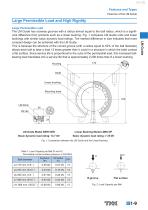
Features and Types Features of the LM Guide Large Permissible Load and High Rigidity Linear bushing Mounting base 165 LM block 34 LM rail Linear Bushing Model LM80 OP Basic dynamic load rating: 14.7 kN Basic dynamic load rating: 7.35 kN Fig. 1: Comparison between the LM Guide and the Linear Bushing Table 1: Load Capacity per Ball (P and P1) Permissible contact surface pressure: 4,200 MPa Ball diameter Flat surface Fig. 2: Load Capacity per Ball Large Permissible Load The LM Guide has raceway grooves with a radius almost equal to the ball radius, which is a significant difference from products...
Open the catalog to page 2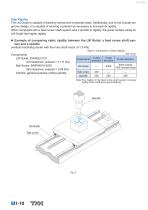
High Rigidity The LM Guide is capable of bearing vertical and horizontal loads. Additionally, due to the circular-arc groove design, it is capable of carrying a preload as necessary to increase its rigidity. When compared with a feed screw shaft system and a spindle in rigidity, the guide surface using an LM Guide has higher rigidity. Example of comparing static rigidity between the LM Guide, a feed screw shaft system and a spindle (vertical machining center with the main shaft motor of 7.5 kW) Table 2: Comparison of Static Rigidity Unit: N/m Components LM Guide: SVR45LC/C0 (C0 clearance:...
Open the catalog to page 3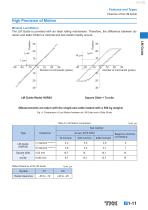
Features and Types Features of the LM Guide High Precision of Motion 10 20 30 Number of commands (pulse) Minimal Lost Motion The LM Guide is provided with an ideal rolling mechanism. Therefore, the dierence between dynamic and static friction is minimal and lost motion hardly occurs. 10 20 30 Number of commands (pulse) Square Slide + Turcite (Measurements are taken with the single-axis table loaded with a 500 kg weight) Fig. 4: Comparison of Lost Motion between an LM Guide and a Slide Guide Table 3: Lost Motion Comparison Test method Type LM Guide (HSR45) Square slide + turcite C1 clearance (see...
Open the catalog to page 4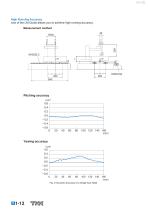
High Running Accuracy Use of the LM Guide allows you to achieve high running accuracy. Measurement method 30 Fig. 5: Dynamic Accuracy of a Single-Axis Table
Open the catalog to page 5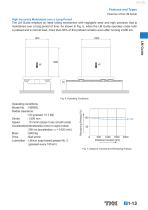
Features and Types Features of the LM Guide High Accuracy Maintained over a Long Period The LM Guide employs an ideal rolling mechanism with negligible wear and high precision that is maintained over a long period of time. As shown in Fig. 6, when the LM Guide operates under both a preload and a normal load, more than 90% of the preload remains even after running 2,000 km. 800 Operating conditions Model No. : HSR65L Radial clearance : C0 (preload: 15.7 kN) Stroke : 1,050 mm Speed : 15 m/min (stops 5 sec at both ends) Acceleration/deceleration time in rapid motion : 300 ms (acceleration: = 0.833...
Open the catalog to page 6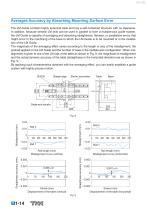
Averages Accuracy by Absorbing Mounting Surface Error The LM Guide contains highly spherical balls and has a self-contained structure with no clearance. In addition, because several LM rails can be used in parallel to form a multiple-axis guide system, the LM Guide is capable of averaging and absorbing straightness, flatness, or parallelism errors that might occur in the machining of the base to which the LM Guide is to be mounted or in the installation of the LM Guide. The magnitude of the averaging eect varies according to the length or size of the misalignment, the preload applied on the LM...
Open the catalog to page 7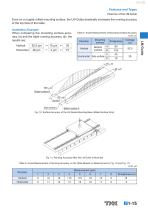
Features and Types Features of the LM Guide Even on a roughly milled mounting surface, the LM Guide drastically increases the running accuracy of the top face of the table. Installation Example When comparing the mounting surface accuracy (a) and the table running accuracy (b), the results are: Mounting surface Bottom surface Horizontal Side surface 105 m Bottom surface B 80 m Side surface D Side surface C Fig. 10: Surface Accuracy of the LM Guide Mounting Base (Milled Surface Only) Fig. 11: Running Accuracy After the LM Guide Is Mounted Table 5: Actual Measurement of Running Accuracy on the...
Open the catalog to page 8
Easy Maintenance Unlike with sliding guides, the LM Guide does not incur uneven wear. As a result, sliding surfaces do not need to be reconditioned, and precision does not need to be altered. Regarding lubrication, sliding guides require forced circulation of a large amount of lubricant so as to maintain an oil film on the sliding surfaces, whereas the LM Guide only needs periodical replenishing of a small amount of grease or lubricant. This makes maintenance simple and also helps keep the work environment clean.
Open the catalog to page 9
Features and Types Features of the LM Guide Substantial Energy Savings As shown in Table 6, the LM Guide has a substantial energy saving effect. Table 6: Comparative Data on Sliding and Rolling Characteristics Machine specifications Single-axis surface grinding machine (sliding guide) Three-axis surface grinding machine (rolling guide) Overall length × overall width Total mass Table mass Grinding area Table guide Rolling through V-V guide Rolling through LM Guide installation No. of grinding stone axes Three axes (5.5 kW + 3.7 kW x 2) Grinding capacity: 3 times greater Table drive specifications...
Open the catalog to page 10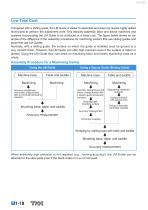
Low Total Cost Compared with a sliding guide, the LM Guide is easier to assemble and does not require highly skilled technicians to perform the adjustment work. This reduces assembly labor and allows machines and systems incorporating the LM Guide to be produced at a lower cost. The figure below shows an example of the difference in the assembly procedures for machining centers that use sliding guides and those that use LM Guides. Normally, with a sliding guide, the surface on which the guide is installed must be ground to a very smooth finish. However, the LM Guide can offer high precision even...
Open the catalog to page 11All THK catalogs and technical brochures
 Models ST / ST-B
2 Pages
 Predicting the Rigidity
5 Pages
 PCT/PC
40 Pages
 Models SHS-C and SHS-LC
2 Pages
 Models SSR-XW and SSR-XWM
2 Pages
 Models SSR-XV and SSR-XVM
2 Pages
 SCR
SCR8 Pages
 LM ACTUATOR GL
20 Pages
 HDR
HDR28 Pages
 RSX
RSX6 Pages
 Fix Stages
4 Pages
 Finite Stroke LM Guide EPF
12 Pages
 LM ACTUATOR GL-N
28 Pages
 LM Actuator TY
16 Pages
 Clean-Room Actuator Model CSKR
20 Pages



Archived catalogs
 Model SSR-XTB
2 Pages
 Catalogue Caged Ball LM Guide
23 Pages
 Low Price Actuator Model VLA
16 Pages
 LM Guide Actuator Model KR
92 Pages
 Ball Spline Series
24 Pages
 Cross-Roller Ring Series
28 Pages
 High-temparature LM Guide Series
28 Pages
 Model HR Separate Type
20 Pages
 LM Actuator Model TY
16 Pages
 Guide Ball Bush LG
8 Pages
 Limited-stroke LM Guide
12 Pages
 LM Actuator Model GL-N
28 Pages
 RoD Actuato
12 Pages
 Product Ordering Guide
8 Pages
 LM Guide Actuator KR
68 Pages


