
- Catalogs
- THERMO FISHER SCIENTIFIC - MATERIALS SCIENCE
- Failure analysis of corroded steel surface


- Company
- Products
- Catalogs
- News & Trends
- Exhibitions
Failure analysis of corroded steel surface
Failure analysis of corroded steel surface
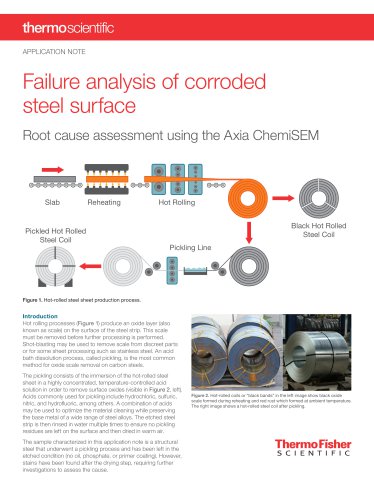
Hot rolling processes create an oxide layer on steel surfaces, which must be removed before further processing. The most common method for removing this oxide scale from carbon steels is pickling, which involves immersing the steel in an acid solution. This document investigates stains found on a structural steel sample after pickling and drying, using the Axia ChemiSEM for analysis.
Methods
The root cause assessment was conducted using the Thermo Scientific Axia ChemiSEM, a scanning electron microscope that provides live quantitative elemental mapping through energy dispersive X-ray spectroscopy (EDS). This allows for real-time elemental analysis without switching techniques.
Discussion
Scanning electron microscopy combined with EDS was used to investigate defects on the steel surface. A foreign particle was identified, and its composition was analyzed. The presence of unexpected chlorine was noted, suggesting improper washing after pickling. The ChemiSEM provided a detailed elemental distribution, highlighting areas with high oxygen and chlorine content.
Region Analyses
Quantitative analysis of the foreign particle and a clean area of the etched steel showed significant differences in oxygen and chlorine content, supporting the hypothesis of contamination by a foreign object.
Conclusion
Pickling is essential for achieving a uniform steel surface. This study identified that improper washing after pickling led to chloride contamination, likely from residual hydrochloric acid. The Axia ChemiSEM effectively characterized the surface contamination, providing insights into the root cause of the stains.
Catalog excerpts
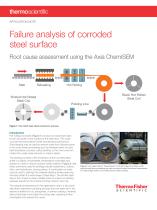
APPLICATION NOTE Failure analysis of corroded steel surface Root cause assessment using the Axia ChemiSEM Pickled Hot Rolled Steel Coil Hot Rolling Black Hot Rolled Steel Coil Pickling Line Figure 1. Hot-rolled steel sheet production process. Introduction Hot rolling processes (Figure 1) produce an oxide layer (also known as scale) on the surface of the steel strip. This scale must be removed before further processing is performed. Shot-blasting may be used to remove scale from discreet parts or for some sheet processing such as stainless steel. An acid bath dissolution process, called pickling, is the most common method for oxide scale removal on carbon steels. The pickling consists of the immersion of the hot-rolled steel sheet in a highly concentrated, temperature-controlled acid solution in order to remove surface oxides (visible in Figure 2, left). Acids commonly used for pickling include hydrochloric, sulfuric, nitric, and hydrofluoric, among others. A combination of acids may be used to optimize the material cleaning while preserving the base metal of a wide range of steel alloys. The etched steel strip is then rinsed in water multiple times to ensure no pickling residues are left on the surface and then dried in warm air. The sample characterized in this application note is a structural steel that underwent a pickling process and has been left in the etched condition (no oil, phosphate, or primer coating). However, stains have been found after the drying step, requiring further investigations to assess the cause. Figure 2. Hot-rolled coils or “black bands” in the left image show black oxide scale formed during reheating and red rust which formed at ambient temperature. The right image shows a hot-rolled steel coil after pickling
Open the catalog to page 1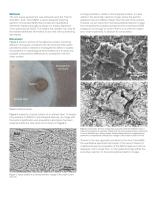
Methods The root cause assessment was achieved using the Thermo Scientific™ Axia™ ChemiSEM, a newly designed scanning electron microscope (SEM) that provides live quantitative elemental mapping through its always-on energy dispersive X-ray spectroscopy (EDS). This means the operator can view all the needed elemental information at any time without switching techniques. Discussion Figure 3 shows a picture of the defective surface. Scanning electron microscopy combined with the chemical information provided by EDS is needed to investigate the defect to assess the presence of morphological abnormalities...
Open the catalog to page 2
The ChemiSEM image in Figure 6 shows the distribution of all the present elements. The presence of iron is expected, while the presence of oxygen highlights where the sample is oxidized. The presence of chlorine, however, is unexpected and needs further investigation. For an instant confirmation of the chlorine distribution, the Axia ChemiSEM allows you to hide certain elements in order to show only the element of interest (Cl in this case). Quick area analyses were then executed on another foreign particle and on a clean area of the etched steel (shown in Figure 8) to quantify the contaminants...
Open the catalog to page 3
Thermo FisherFind out more at thermofisher.com/materialsscience scientific For current certifications, visit thermofisher.com/certifications. © 2021 FEI Company. All rights reserved. All trademarks are the property of Thermo Fisher Scientific and its subsidiaries unless otherwise specified. AN0165-EN-03-2021
Open the catalog to page 4All THERMO FISHER SCIENTIFIC - MATERIALS SCIENCE catalogs and technical brochures
 Axia ChemiSEM
23 Pages
 ChemiSEM Technology
18 Pages
 V400ACE
2 Pages
 Phenom XL G2 Desktop SEM
6 Pages
 Helios 5 Laser Hydra System
4 Pages
 Phenom Pharos G2
4 Pages
 Helios 5 CX DualBeam
4 Pages
 Phenom Pure G6 Desktop SEM
4 Pages
 Phenom ParticleX TC
6 Pages
 Phenom ParticleX Steel
6 Pages
 ChemiSEM Technology
3 Pages


Archived catalogs
 Titan? ETEM G2
4 Pages
 Scios for Materials Science
4 Pages
 Talos
2 Pages
 V400ACE Focused Ion Beam
2 Pages

- Thermo Fisher automation software
- Thermo Fisher analysis software
- Process software
- Real-time software
- Computer-aided design software
- Cloud-based software
- Control software
- Spectrometer
- Design software solution
- Industrial software
- 3D software solution
- Measurement software
- Interface software
- Visualization software solution
- Thermo Fisher laboratory microscope
- Quality software
- Programming software solution
- Thermo Fisher automated software
- Development software