
- Catalogs
- THERMO FISHER SCIENTIFIC - MATERIALS SCIENCE
- Characterization of tire fillers with Axia ChemiSEM


- Company
- Products
- Catalogs
- News & Trends
- Exhibitions
Characterization of tire fillers with Axia ChemiSEM
Characterization of tire fillers with Axia ChemiSEM
- Acceleration Voltage: 20 keV
- Beam Current: 0.48 nA
- Acquisition Time: 60 seconds
- Carbon (C): 38.4% ± 0.2%
- Oxygen (O): 44.5% ± 0.2%
- Sulfur (S): 0.3% ± 0.0%
- Zinc (Zn): 0.3% ± 0.0%
- Magnesium (Mg): 7.5% ± 0.0%
- Silicon (Si): 9.0% ± 0.0%
This document provides the specifications for an analysis conducted with an acceleration voltage of 20 keV and a beam current of 0.48 nA over an acquisition time of 60 seconds. The elemental composition of the sample is primarily composed of Carbon and Oxygen, with minor amounts of Sulfur, Zinc, Magnesium, and Silicon. The atomic percentage errors are minimal, indicating precise measurements.
Catalog excerpts
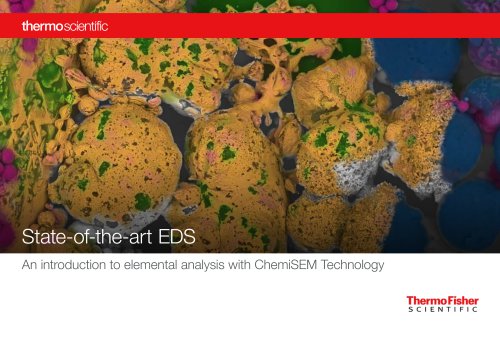
APPLICATION NOTE Characterization of tire fillers with Axia ChemiSEM A new and more efficient approach to failure analysis Abstract Tires are often considered as low-tech commodities. However, contrary to popular perception, tires are actually highly engineered structural composites. Tires contain many rubber compounds (up to 20, with several types of microstructures) that provide different levels of grip and traction. Fillers are added to the main polymer matrix to facilitate rubber reinforcement. Tire failures often occur due to a lower or decreased material quality, and an optimal and homogenous dispersion of all the different fillers is a key factor for a higher material quality. Analytical techniques like SEM-EDS are required to understand the root cause of a failure but the material contrast obtained from a backscattered electron image is not enough to distinguish between the large variety of materials employed. This application note demonstrates that the live quantitative elemental analysis of Axia ChemiSEM provides an efficient and easy way to characterize the different fillers, despite their similar compositional contrast. Introduction Tires are designed to perform for thousands of kilometers, while maintaining the same performance and safety properties under a wide range of conditions. In failure analysis, tread (part of the tire in contact with the road) detachment and tire aging are listed among the most common tire failures. The possible causes for these failures are usually directly or indirectly related to material or manufacturing defects. Reduced elasticity of the rubber parts due to aging takes place even if tires are not in use (rubber mixtures tend to harden over time naturally). Natural and synthetic rubbers are the main raw materials used to manufacture a tire. In order to develop proper characteristics of strength, resilience, and wear-resistance, rubber products are modified by adding fillers, as a reinforcement, to each of the different rubber compounds. The original purpose of fillers was to lower the final cost of the product. Nowadays however, rubber manufacturing technology has seen an increasing amount of research in selective fillers for their abilities to enhance different composite characteristics, depending on their chemical composition (Brewer HK, 2006). Specific fillers can improve durability of the product, the cost, and the processability during the manufacturing process. Reinforcing fillers are often more than 40 percent of the whole tire compound, and play a key role in the elastic efficiency and tire aging leading to subsequent possible failure. Filler dispersion in the rubber matrix is the parameter that controls performance. Improving the filler dispersion leads to an improved polymer-filler interaction, which will subsequently improve the elastic behavior of the material and the rolling resistance of the tire. Methods Scanning electron microscopy (SEM) with backscattered electron imaging (BSE) and energy dispersive X-ray spectroscopy (EDS) are the go-to solutions for characterizing different additives and their dispersion within the polymer matrix. BSE images are commonly considered the easiest way to obtain compositional information. This is because the contrast seen with BSE images is due to the variation in atomic number. This helps to easily differentiate the rubber matrix (low atomic number) from inorganic particles (high atomic number) that are generally used as fillers. However, the large variety of materials employed nowadays in the tire industry makes it necessary to use EDS analysis to discriminate between the different elements. However, conventional EDS characterization is expensive, slow and complicated. The need to set up the parameters (which requires extensive knowledge and experience) and the system for data acquisition, has made it inefficient and impractical. In this application note we present a characterization of the different fillers in a tire cross section obtained using the Axia ChemiSEM, a completely new platform that’s designed to provide the most efficient SEM-EDS user experience possible. Axia’s main feature - the live quantitative elemental mapping resolves the above-mentioned limitations of conventional EDS
Open the catalog to page 1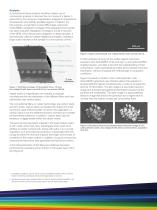
Analysis A conventional failure analysis workflow makes use of microscopic analysis to discover the root cause of a failure. It does this by first using low magnification analysis to characterize the specimen and identify possible regions of interest. For this purpose, a large field-of-view SEM image using Axia ChemiSEM’s navigation montage of the prepared cross section has been acquired. Navigation montage is a built-in function of the SEM, which allows easy navigation on large samples. It automatically collects multiple neighboring images, creating a large-scale overview of the sample in a...
Open the catalog to page 2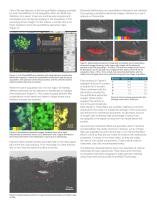
One of the key features of the live quantitative mapping provided by Axia ChemiSEM is its full integration within the SEM user interface. As a result, X-rays are continuously acquired and processed, even during live imaging or the acquisition of the previously shown image. For this reason, a simple click is all that’s needed to show the quantitative elemental maps (Figure 4). Elemental distributions and quantitative information are obtained by acquiring quantitative elemental images, followed by a point analysis on the particle. Figure 4. Axia ChemiSEM user interface with integrated live quantitative...
Open the catalog to page 3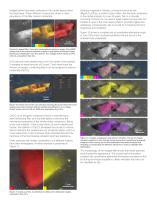
Images below have been collected in the rubber layers below the tread layer. These different compounds shown a clear abundancy of the filler calcium carbonate. Hydrous magnesium silicate, commonly known as talc (Mg3Si4O10 (OH)2), is another type of filler, that has been employed in the rubber industry for over 40 years. Talc is a naturally occurring mineral; it is not used in tread rubber compounds, but instead is used in the inner layers where it provides higher tear resistance. Consequently, talc is crucial for increasing the tire’s toughness and durability. Figure 12 shows a complete set of...
Open the catalog to page 4All THERMO FISHER SCIENTIFIC - MATERIALS SCIENCE catalogs and technical brochures
 Axia ChemiSEM
23 Pages
 ChemiSEM Technology
18 Pages
 V400ACE
2 Pages
 Phenom XL G2 Desktop SEM
6 Pages
 Helios 5 Laser Hydra System
4 Pages
 Phenom Pharos G2
4 Pages
 Helios 5 CX DualBeam
4 Pages
 Phenom Pure G6 Desktop SEM
4 Pages
 Phenom ParticleX TC
6 Pages
 Phenom ParticleX Steel
6 Pages
 ChemiSEM Technology
3 Pages


Archived catalogs
 Titan? ETEM G2
4 Pages
 Scios for Materials Science
4 Pages
 Talos
2 Pages
 V400ACE Focused Ion Beam
2 Pages

- Thermo Fisher automation software
- Thermo Fisher analysis software
- Process software
- Real-time software
- Thermo Fisher microscope
- Computer-aided design software
- Cloud-based software
- Control software
- Spectrometer
- Design software solution
- Industrial software
- 3D software solution
- Measurement software
- Interface software
- Visualization software solution
- Thermo Fisher laboratory microscope
- Quality software
- Programming software solution
- Thermo Fisher automated software
- Development software