
- Catalogs
- THERMO FISHER SCIENTIFIC - MATERIALS SCIENCE
- Characterization of complex refractories for steel production using the Axia ChemiSEM


- Company
- Products
- Catalogs
- News & Trends
- Exhibitions
Characterization of complex refractories for steel production using the Axia ChemiSEM
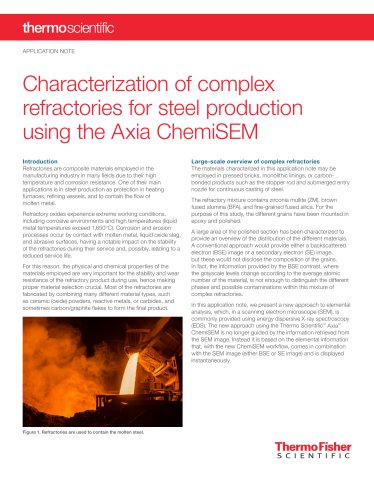
Characterization of complex refractories for steel production using the Axia ChemiSEM
Refractories are composite materials used in industries like steel production due to their high temperature and corrosion resistance. They protect heating furnaces and refining vessels and contain molten metal flow. These materials face extreme conditions, including high temperatures and corrosive environments, which can lead to reduced service life. Proper material selection is crucial for stability and wear resistance.
Overview of Complex Refractories
The document discusses materials like zirconia mullite (ZM), brown fused alumina (BFA), and fused silica used in refractory products. A new approach using the Thermo Scientific™ Axia™ ChemiSEM is introduced for elemental analysis, providing chemical information alongside SEM images to identify different materials and contaminants efficiently.
Zirconia Mullite
ZM is valued for its high refractoriness and corrosion resistance. It is used in thermal shock-prone applications. The ChemiSEM approach allows for quick and comprehensive characterization of ZM, revealing different phases and potential contaminants.
Brown Fused Alumina
BFA is used in various refractory applications. It is derived from bauxite, which contains impurities like Na, Ti, Fe, and Si. The ChemiSEM characterization helps identify these impurities and the distribution of different elements.
Elemental Analysis and Contaminants
The ChemiSEM technique allows for the identification of different phases and contaminants within the refractory materials. Point analyses and linescans confirm the presence of phases like zirconia, silicate, and mullite, as well as impurities such as sodium.
Conclusion
Refractory materials are essential in steelmaking due to their resistance to extreme conditions. Characterization of these materials is crucial to ensure performance and identify contaminants. The Axia ChemiSEM provides a fast and efficient method for chemical identification, aiding in the discovery of unknown elements and materials.
Catalog excerpts

APPLICATION NOTE Characterization of complex refractories for steel production using the Axia ChemiSEM Introduction Refractories are composite materials employed in the manufacturing industry in many fields due to their high temperature and corrosion resistance. One of their main applications is in steel production as protection in heating furnaces, refining vessels, and to contain the flow of molten metal. Refractory oxides experience extreme working conditions, including corrosive environments and high temperatures (liquid metal temperatures exceed 1,650°C). Corrosion and erosion processes occur by contact with molten metal, liquid oxide slag, and abrasive surfaces, having a notable impact on the stability of the refractories during their service and, possibly, leading to a reduced service life. For this reason, the physical and chemical properties of the materials employed are very important for the stability and wear resistance of the refractory product during use, hence making proper material selection crucial. Most of the refractories are fabricated by combining many different material types, such as ceramic (oxide) powders, reactive metals, or carbides, and sometimes carbon/graphite flakes to form the final product. Figure 1. Refractories are used to contain the molten steel. Large-scale overview of complex refractories The materials characterized in this application note may be employed in pressed bricks, monolithic linings, or carbonbonded products such as the stopper rod and submerged entry nozzle for continuous casting of steel. The refractory mixture contains zirconia mullite (ZM), brown fused alumina (BFA), and fine-grained fused silica. For the purpose of this study, the different grains have been mounted in epoxy and polished. A large area of the polished section has been characterized to provide an overview of the distribution of the different materials. A conventional approach would provide either a backscattered electron (BSE) image or a secondary electron (SE) image, but these would not disclose the composition of the grains. In fact, the information provided by the BSE contrast, where the grayscale levels change according to the average atomic number of the material, is not enough to distinguish the different phases and possible contaminations within this mixture of complex refractories. In this application note, we present a new approach to elemental analysis, which, in a scanning electron microscope (SEM), is commonly provided using energy dispersive X-ray spectroscopy (EDS). The new approach using the Thermo Scientific™ Axia™ ChemiSEM is no longer guided by the information retrieved from the SEM image. Instead it is based on the elemental information that, with the new ChemiSEM workflow, comes in combination with the SEM image (either BSE or SE image) and is displayed instantaneousl
Open the catalog to page 1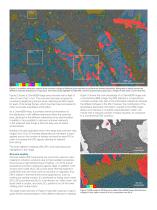
500 μm C O Al Si Zr Ti Fe Na Ca S Figure 2. A modern refractory system often contains a range of different grain materials to achieve the desired properties. Being able to easily unravel the different materials distribution is important. The three boxes highlight the ZM, BFA, and fine-grained silica grains (acc voltage 15 keV, beam current 0.85 nA). Figure 2 shows a ChemiSEM large-area overview with a field of view of more than 2 mm. The overview has been acquired by combining neighboring frames while collecting the EDS signal for each of the single frames, which has then been processed in order...
Open the catalog to page 2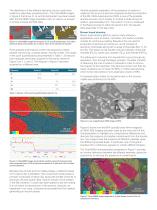
The distribution of the different elements can be made more evident by selectively visualizing them. The ChemiSEM images in Figure 4 that show Zr, Al, and Si distribution have been saved after the first SEM image acquisition with no need to re-acquire or further process the EDS data. Point analyses and linescan confirm the presence of three phases: the zirconia, a silicate phase, and the mullite. The results of the point quantifications are presented in Table 1. 30-second point analyses have been acquired in the points marked in Figure 3 as 1, 2, and 3. The linescan in Figure 5 has been acquired...
Open the catalog to page 3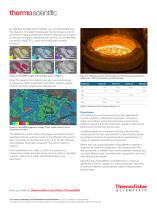
By selecting the elements of interest, you can immediately find the presence of at least three phases: the first phase is a Si-Al and Na-rich material (distribution shown in the first row of Figure 8), the second phase, intertwined with the first, can be identified as titanium oxide (TiO2), while the smaller grain contains Fe and S. Given the speed of the analysis, and as no post-processing is required to obtain quantitative information, another unique impurity has been imaged and characterized. The distribution of the carbon and oxygen are hidden to avoid possible confusion with the overlay...
Open the catalog to page 4All THERMO FISHER SCIENTIFIC - MATERIALS SCIENCE catalogs and technical brochures
 Axia ChemiSEM
23 Pages
 ChemiSEM Technology
18 Pages
 V400ACE
2 Pages
 Phenom XL G2 Desktop SEM
6 Pages
 Helios 5 Laser Hydra System
4 Pages
 Phenom Pharos G2
4 Pages
 Helios 5 CX DualBeam
4 Pages
 Phenom Pure G6 Desktop SEM
4 Pages
 Phenom ParticleX TC
6 Pages
 Phenom ParticleX Steel
6 Pages
 ChemiSEM Technology
3 Pages



Archived catalogs
 Titan? ETEM G2
4 Pages
 Scios for Materials Science
4 Pages
 Talos
2 Pages
 V400ACE Focused Ion Beam
2 Pages

- Thermo Fisher automation software
- Thermo Fisher analysis software
- Process software
- Real-time software
- Computer-aided design software
- Cloud-based software
- Control software
- Spectrometer
- Design software solution
- Industrial software
- 3D software solution
- Measurement software
- Interface software
- Visualization software solution
- Thermo Fisher laboratory microscope
- Quality software
- Programming software solution
- Thermo Fisher automated software
- Development software