
- Catalogs
- Thermo Fisher Scientific - Industrial & Applied S
- Advances in Chemical Suppression

Advances in Chemical Suppression

Advances in Chemical Suppression
- Packed-Bed Suppressors: Utilize ion-exchange resins and require regular offline regeneration.
- Hollow Fiber Suppressors: Launched in 1981, these allow continuous operation without offline regeneration but are prone to rupture.
- MicroMembrane Suppressors (MMS): Introduced in 1985, offering greater dynamic capacity and robustness.
- Self-Regenerating Suppressors (SRS): Introduced in 1992, these use electrolysis for regenerant ion generation, eliminating the need for chemical regenerants.
- Atlas Suppressor: Launched in 2001, this suppressor provides fast start-up times and low noise, suitable for specific applications despite its lower capacity.
Catalog excerpts

Advances in Chemical Suppression Thermo Scientific brand Passion. Power. Productivity.
Open the catalog to page 1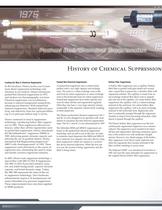
History of Chemical Suppression Leading the Way in Chemical Suppression Packed-Bed Chemical Suppressors Hollow Fiber Suppressors In this brochure, Dionex invites you to learn more about suppression technology and advances in ion analysis. Dionex introduced packed-bed chemical suppression in 1975, and modern ion chromatography was born. Chemical suppression was revolutionary because it reduced background conductivity, enhancing ion detection. With packed-bed chemical suppression, chemists achieved sensitivity and selectivity from low parts-per-billion (µg/L) to parts-per-million (mg/L) levels....
Open the catalog to page 2
Technology MicroMembrane Suppressor A MMS uses a pair of membranes separating a central eluent chamber from regenerant chambers on either side. The chambers are filled with functionalized ionically charged screens. In an anion MMS the membrane itself as well as screens are cation exchangers in the acid form. In a cation MMS the charge is reversed. The Dionex MMS had substantially increased capacity compared to the hollow fiber suppressor, allowing continuous operation with moderate to strong eluents. The MMS was also more robust. AutoRegen® for MMS Introduced in 1987, the AutoRegen module allows...
Open the catalog to page 3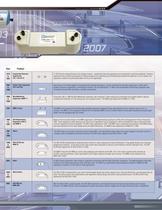
Packed-Bed Chemical Suppressors (SC-1 and SC-2) In 1975 Dionex changed the face of Ion Analysis forever – packed bed chemical suppression was introduced to chemists worldwide. Chemical suppression was revolutionary because it reduced background conductivity and simultaneously enhanced the detection of ions; however, the suppressor needed to be periodically taken off-line to be regenerated. Hollow Fiber Suppressor (FS1 and FS2) Improving on the limited capacity of the packed-bed chemical suppressors, Dionex introduced hollow fiber suppressors in 1981 which allowed continuous regeneration, eliminating...
Open the catalog to page 4
Atlas Suppressor Suppressor Availability An Atlas suppressor uses a small column body packed with a series of monolithic ion exchange disks through which the eluent is passed. The ends of the column body are separated from regenerant chambers by ion exchange membranes. The regenerant chambers contain electrodes that are used to generate the regenerant ions from water. When current is applied to the electrodes, an electric field pushes the regenerant ions lengthwise through the column body counter-current to the eluent flow. As Dionex advances IC technology over the years, some suppressors are...
Open the catalog to page 5
Corporate Headquarters Dionex’s goal is to provide you with solutions to your chromatographic challenges rather than just selling you an instrument. We offer more than a product; we offer a complete solution with an open future, and a partner committed to your success. Quality Products from a Global Leader in Separation Science Dionex provides an extensive array of innovative, high-quality instruments, software, consumables, and associated products that solve problems for laboratories. All Dionex products are designed, developed, tested, and manufactured in accordance with life cycle processes...
Open the catalog to page 6All Thermo Fisher Scientific - Industrial & Applied S catalogs and technical brochures
 Remel Spectra-VRE
2 Pages
 Vanquish Duo UHPLC Systems
12 Pages
 Vanquish UHPLC System
16 Pages
 EASY-nLC 1200 System
8 Pages
 Dionex Product Selection Guide
436 Pages
 Dionex ICS-5000+ HPIC System
20 Pages
 Dionex IC Solutions
8 Pages
 Chemicals for a Global Market
16 Pages
 Dionex Product Selection Guide
340 Pages
 ICS-900 Brochure
4 Pages
 ICS-2100/1600/1100
8 Pages
 Combustion IC System
4 Pages
 AutoTrace SPE Instrument
6 Pages


Archived catalogs
 ICS-3000 System
16 Pages
 Reagent-Free Ion Chromatography
12 Pages
 Virtual Column
8 Pages
 Surge Suppressor
19 Pages
 Ion Chromatography
16 Pages


- Automation software solution
- Liquids analyzer
- Automatic analyser
- Benchtop analyser
- Spectrometer
- Continuous analyzer
- Water analyzer
- Laboratory analyzer
- Compact analyzer
- Laboratory spectrometer
- Thermo Fisher Scientific chromatograph
- Analyzer for the food industry
- Thermo Fisher Scientific laboratory chromatograph
- Compact detector
- Mass spectrometer
- Electrochemical analyzer
- Conductivity analyzer
- Process detector
- Electrochemical detector
- Gas chromatography system