
- Catalogs
- Thermatool Europe
- TECHNICAL ABSRACT - The Radyne Approach to Spring Wire Processing

TECHNICAL ABSRACT - The Radyne Approach to Spring Wire Processing
TECHNICAL ABSRACT - The Radyne Approach to Spring Wire Processing
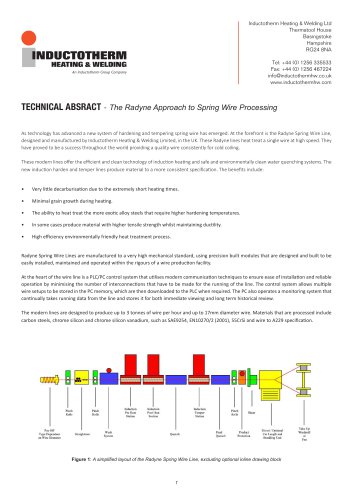
The document discusses the Radyne Spring Wire Line, a system for hardening and tempering spring wire developed by Inductotherm Heating & Welding Limited. This system uses induction heating and water quenching to treat single wires at high speed, offering consistent quality for cold coiling applications.
Specifications and Benefits
- Minimal decarburization and grain growth due to short heating times.
- Capability to treat exotic alloy steels requiring higher hardening temperatures.
- Potential to produce materials with higher tensile strength while maintaining ductility.
- Environmentally friendly and efficient heat treatment process.
System Design and Operation
The Radyne lines are built with precision modules for easy installation and maintenance. A PLC/PC control system facilitates reliable operation and allows multiple wire setups to be stored and managed efficiently. The system can produce up to 3 tonnes of wire per hour and handle wire up to 17mm in diameter.
Process Details
- Continuous operation without stopping for coil changes, using welding to join coils.
- Wire tension is controlled using pinch rolls to maintain diameter specifications.
- Inline drawing block option reduces handling damage and achieves up to 30% reduction of area (ROA).
- Heat treatment involves heating to the Curie point and desired hardening temperature, followed by controlled water quenching.
- Tempering is done by reheating to achieve the final martensitic structure, followed by another water quench.
Advantages of Induction Heating
- Non-contact heating avoids surface damage and eliminates the need for replaceable media.
- Instant heat with no warm-up or cool-down time, reducing energy consumption during non-production periods.
- Water quenching eliminates fire hazards and reduces costs associated with oil use and disposal.
Additional Features
After processing, the wire receives a protective coating, and a hydraulic shear removes welds. A divert system guides the wire to the correct take-up.
Future Installations
In 2012, two additional Radyne Spring Wire Lines will be installed, enhancing production capacity.
For further information, visit the company's website or contact Mr. Gareth Blackman via email.
Catalog excerpts
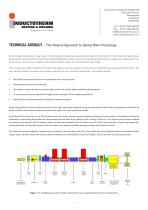
Inductotherm Heating & Welding Ltd Thermatool House Basingstoke Hampshire RG24 8NA HEATING & WELDING An Inductotherm Group Company TECHNICAL ABSRACT - The Radyne Approach to Spring Wire Processing As technology has advanced a new system of hardening and tempering spring wire has emerged. At the forefront is the Radyne Spring Wire Line, designed and manufactured by Inductotherm Heating & Welding Limited, in the UK. These Radyne lines heat treat a single wire at high speed. They have proved to be a success throughout the world providing a quality wire consistently for cold coiling. These modern lines offer the efficient and clean technology of induction heating and safe and environmentally clean water quenching systems. The new induction harden and temper lines produce material to a more consistent specification. The benefits include: • Very little decarburisation due to the extremely short heating times. Minimal grain growth during heating. The ability to heat treat the more exotic alloy steels that require higher hardening temperatures. In some cases produce material with higher tensile strength whilst maintaining ductility. High efficiency environmentally friendly heat treatment process. Radyne Spring Wire Lines are manufactured to a very high mechanical standard, using precision built modules that are designed and built to be easily installed, maintained and operated within the rigours of a wire production facility. At the heart of the wire line is a PLC/PC control system that utilises modern communication techniques to ensure ease of installation and reliable operation by minimising the number of interconnections that have to be made for the running of the line. The control system allows multiple wire setups to be stored in the PC memory, which are then downloaded to the PLC when required. The PC also operates a monitoring system that continually takes running data from the line and stores it for both immediate viewing and long term historical review. The modern lines are designed to produce up to 3 tonnes of wire per hour and up to 17mm diameter wire. Materials that are processed include carbon steels, chrome silicon and chrome silicon vanadium, such as SAE9254, EN10270/2 (2001), 55CrSi and wire to A229 specification. Figure 1: A simplified layout of the Radyne Spring Wire Line, excluding optional inline drawing block
Open the catalog to page 1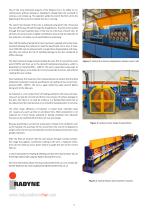
One of the most important aspects of the Radyne line is its ability to run continuously, without slowing or stopping to change feed coil at payoff or remove a coil at take up. The operator welds the end of the first coil to the beginning of the second coil whilst the line is running. The control and tension of the wire is achieved using pinch rolls. These pull the wire off the pay-off and through the straighteners. The wire is then pulled through the heat treatment part of the line by a third set of pinch rolls. At all times, the wire tension is tightly controlled to ensure that the diameter...
Open the catalog to page 2All Thermatool Europe catalogs and technical brochures
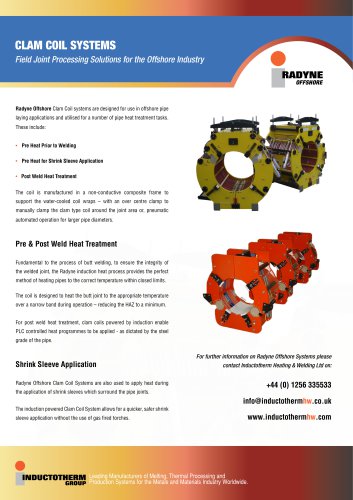
 Radyne Offshore
5 Pages
 Induction Billet Heaters
4 Pages
 TFi Series Power Convertor
3 Pages
 Spring Wire Processing
3 Pages
 Line Pipe Pre-heating
3 Pages
 Induction Heating Systems
3 Pages




Archived catalogs

- Welding system
- Metal sawing line
- Automation software solution
- Automatic welding machine
- Process software
- Circular sawing machine
- Real-time software
- Control software
- Welder
- Arc welder
- Interface software
- Metal welding machine
- Automated software
- Precision saw
- Precision welding machine
- Vertical saw
- Steel saw
- Compact sealer
- DC welder
- Steel welding machine