
- Catalogs
- Thermal Hazard Technology
- RSD Rapid Screening Device

RSD Rapid Screening Device

RSD Rapid Screening Device
The Rapid Screening Device (RSD™) is a versatile hazards safety calorimeter designed for chemists and engineers to quantify exothermic and endothermic reactions. It accommodates larger samples compared to DSC and offers standard pressure measurement. The RSD can handle up to six samples simultaneously, providing high-quality comparative and differential data with multiple safety features.
Options and Features
The RSD offers cryogenic operation from -100°C, stirring, dosing, and gas release/collection capabilities. It features a thermally controlled calorimeter chamber that can hold various sample sizes and types, including liquids, solids, mixtures, and gases.
Test Protocols
1. Choose appropriate sample holders and prepare samples.
2. Set up the test protocol using LabVIEW software, entering sample information and test conditions.
3. Start the test, which includes multiple safety interlocks. Data can be analyzed on the PC or transferred for further analysis.
Analysis
1. Pre-analysis involves data filtering and sizing.
2. Differential analysis compares sample data against a reference.
3. Quantitative analysis uses thermodynamic and kinetic routines to determine heat of reaction and activation energy.
Performance Demonstration
The RSD demonstrates superior performance with Di-tertiary Butyl Peroxide (DTBP), showing reproducibility and sensitivity to low concentrations. It can detect heat releases as low as 1 J/g, illustrating its capability to quantify hazards in waste streams.
Applications
The RSD is suitable for a wide range of applications, including high energy explosives, oxidation reactions, and endothermic processes like ammonium nitrate phase transitions.
Options and Specifications
Additional options include liquid dosing, gas flow control, cryogenic capabilities, and stirring. The RSD operates within a temperature range of -100 to 400°C, with a pressure range up to 160 bar. It supports sample sizes from 20mg to 100g and can handle up to six samples simultaneously.
Contact Information
Worldwide distribution with offices in the UK, USA, India, and China.
Catalog excerpts

THT THERMAL HAZARD TECHNOLOGY RSD®Rapid Screening Device Versatile Hazards Safety Calorimeter 6 Samples Simultaneously Scanning Calorimetry Isothermal Calorimetry Dosing, Stirring Cryogenic Temperature & Pressure mg to 100g sample size ALL IN ONE INSTRUMENT
Open the catalog to page 1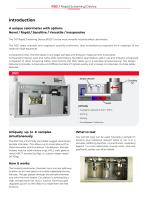
RSD / Rapid Screening Device Introduction A unique calorimeter with options Novel / Rapid / Sensitive / Versatile / Inexpensive The THT Rapid Screening Device (RSD™) is the most versatile hazards safety calorimeter. The RSD helps chemists and engineers quantify exothermic (and endothermic) reactions from materials of low hazard to high explosives. Compared to DSC, the RSD takes much larger samples and pressure measurement is standard. Compared to Dewar, oven and home built calorimeters, the RSD is quantitative, safe in use and industry recognised. Compared to other screening safety calorimeters,...
Open the catalog to page 2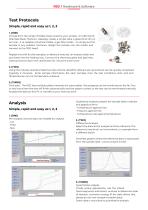
Test ProtocolsSimple, rapid and easy as 1, 2, 3 1. (ONE) Choose from the range of holders best suited to your sample. An ARC bomb (Stainless Steel, Titanium, Hastelloy, Glass), a simple tube, a glass HPLC 2ml or 4ml vial - a re-useable cylindrical holder, a gas flow holder - or simply put the sample in any suitable container. Weigh the sample into the holder and connect to the ‘RSD head’. Repeat this with further samples, a reference material, an empty holder and put these into the holding tray. Connect the thermocouples and gas lines, close and screw down the calorimeter lid. Shut the outer...
Open the catalog to page 3
RSD / Performance Demonstrated with DTBP Unrivalled performance compared to any other safety screening calorimeter 20% DTBP 20% DTBP Toluene Air Time (min) This is uniquely possible with the RSD and RSD RAP software and is illustrated as DT (DTBP-Toluene) Vs Temperature of toluene with 5%, 10% and 15% DTBP. Ramp heating tests typically cause onset of reaction to be recorded at higher temperature than step heated (ARC-type) tests. Closer inspection of RSD data shows this with the thermal data, but pressure data shows the most accurate onset, see below. Toluene Reference Temperature (°C) DTBP data...
Open the catalog to page 4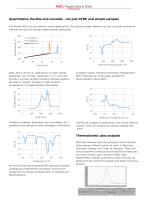
The flexible RSD can be used for varied applications. The previous page detailed not just a simple exothermic material but also low energy (waste stream) application. Data above shows an application to high energy explosives. Two ‘similar’ explosives run in one test; Sample 1 is a fresh sample, Sample 2 has been aged to simulate 6 months storage at high ambient temperature. The aged sample is less stable. Complex organic chemical; illustrates melting below 100°C followed by multi-stage exothermic decomposition above 180°C. Oxidation example; illustrates heat of oxidation of a powdered coal sample...
Open the catalog to page 5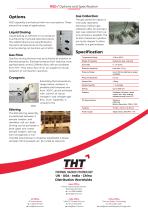
RSD / Options and Specification Gas Collection Options RSD capability is enhanced with low cost options. These extend the range of applications. Liquid Dosing Liquid dosing at ambient or low pressure is achieved by manually operated valves. The added liquid is pre-equilibrated to the same temperatures as the sample. Volume dosing can be done up to 50ml. The gas collection option is manually operated. Allowing residual gas collection after (or during) a test. Gas collection from up to 6 samples is possible. The 10-25ml collection cylinders are ‘quick release’ to allow transfer to a gas analyser....
Open the catalog to page 6All Thermal Hazard Technology catalogs and technical brochures
 BPC ARC System
2 Pages


