


Electronic leakage detector for refrigerants - testo 316-3

Electronic leakage detector for refrigerants - testo 316-3
- Sensitivity: 4 g/a (0.15 oz/a), allowing detection of the smallest leaks.
- Detectable Refrigerants: R-22, R134a, R-404A, R-410A, R-507, R438A, and all CFCs, HFCs, and HCFCs.
- Conformities: Complies with SAE J1627, EN 14624, and EG 2004/108/EG standards.
- Operating Temperature: -20 to +50 °C.
- Operating Humidity: 20 to 80 %RH.
- Storage Temperature: 0 to +50 °C.
- Battery Type: 2 x D batteries with a life of 16 hours of continuous operation.
- Sensor Lifetime: Approximately 80 to 100 hours, equivalent to about one year.
- Weight: Approximately 500 g including batteries.
- Warranty: 2 years.
- Immediate readiness with no pre-settings required.
- Automatic zeroing allows detection in contaminated environments.
- Single-button operation for ease of use.
- LED indicator and audible alarm for leak detection.
Catalog excerpts
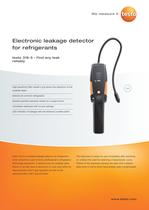
Electronic leakage detector testo 316-3 - Find any leak High sensitivity #No value* 4 g/a allows the detection of the smallest leaks Detects all common refrigerants Easiest possible operation thanks to a single button Immediate readiness with no pre-settings LED indicator of leakage with simultaneous audible alarm testo 316-3 is a reliable leakage detector for refrigerants which should be a part of every professional's refrigeration technology equipment. It detects even the smallest leaks thanks to its high level of sensitivity of 4 g/a, and fulfils the requirements of the F-gas regulation as well as the The instrument is ready for use immediately after switching on, without the need for selecting a characteristic curve. Thanks to the automatic zeroing, the testo 316-3 detects leaks even in rooms which have already been contaminated.
Open the catalog to page 1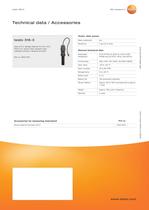
Technical data / Accessories Techn. data sensor testo 316-3, leakage detector for CFC, HFC, HCFC incl. sensor head, transport case, calibration protocol, batteries and filter General technical data Accessories for measuring instrument Sensor head for the testo 316-3
Open the catalog to page 2All TESTO catalogs and technical brochures
 622
6222 Pages
 First choice for every job
8 Pages
 Thermal imager testo 883
4 Pages
 testo 317-3
4 Pages
 testo 316-1
8 Pages
 testo-315-3
4 Pages
 testo-570-Datasheet EN
4 Pages
 Digital manifold
4 Pages
 Gas leak detectors
8 Pages
 Flue gas analyzer
4 Pages
 testo 440
12 Pages
 testo 400
12 Pages
 Digital multimeter
2 Pages
 Testo Smart Probes
8 Pages
 Product brochure testo Saveris
24 Pages
 Brochure_Refrigeration_EN
16 Pages
 Datasheet-testo-557-NEW-EN
4 Pages
 Datasheet-testo-550-NEW-EN
4 Pages
 Datasheet-testo-549-NEW-EN
4 Pages
 Brochure-testo-Saveris-2_EN
12 Pages
 testo-Saveris-2-Datasheet_EN
8 Pages
 Huminator
2 Pages
 Digital manifold - testo 570
4 Pages
 Digital manifold - testo 557
4 Pages
 Digital manifold - testo 550
4 Pages
 Hand stroboscope - testo 476
2 Pages
 Vane anemometer - testo 417
2 Pages
 Vane anemometer - testo 416
2 Pages
 Vane anemometer - testo 410
2 Pages
 SO2 analyzer - testo 325-I
2 Pages
 Fiberscope - testo 319
2 Pages
 Smoke tester- testo 308
4 Pages
 Humidity generator
2 Pages
 Software for data loggers
4 Pages
 Mini alarm thermometer
2 Pages
 stationary temperature probe
10 Pages


Archived catalogs


- Digital imager
- Industrial camera module
- Testo data-logger
- Pressure transmitter
- Infrared imager
- Pressure gauge
- Monitoring camera system
- Analog pressure transmitter
- Testo temperature data-logger
- USB camera module
- Digital pyrometer
- Digital weighing scale
- Detection camera system
- Portable tester
- Gas detector
- Waterproof pressure transmitter
- Industrial thermometer
- Waterproof camera module
- USB datalogger