


Datasheet 0563 2750 testo 270

Datasheet 0563 2750 testo 270
- Ergonomic Design: Prevents direct hand exposure to hot oil.
- Alarm System: Uses a colored backlit display to indicate oil quality: Green (OK), Orange (Borderline), Red (Exceeded).
- Customizable Settings: TPM limit values can be individually defined and protected by a PIN.
- Calibration: User can perform on-site calibration with reference oil.
- Storage Temperature: -20 to +70 °C
- Operating Temperature: 0 to +50 °C
- Cooking Oil Temperature Range: +40 to +200 °C
- Dimensions: 50 x 170 x 300 mm
- Weight: 255 g
- Display: LCD, 2-line, backlit
- Battery: 2 AAA micro batteries, approx. 25 hours of continuous operation
- Protection Class: IP65
- Reaction Time: Approx. 30 seconds
- Warranty: 2 years
- Measuring Range: 0.0 to 40.0 %TPM, +40 to +200 °C
- Accuracy: ±2 %TPM (+40 to +190 °C), ±1.5 °C
- Resolution: 0.5 %TPM, 0.1 °C
- Storage case for testo 270
- Reference oil for calibration
- ISO calibration certificate
Catalog excerpts

testo 270 – Ensure cooking oil quality and save costs Ergonomic and robust design Rinsable under running water (IP65) Clear alarms via backlit display using the traffic light principle Hold and auto-hold function %TPM Calibration and adjustment can be carried out by the user °C The cooking oil tester testo 270 easily, quickly and reliably The new testo 270 stands out thanks to its ergonomic determines the quality of cooking oil. To do so, it measures design, which prevents the direct exposure of the hand to the so-called "Total Polar Material" (TPM) content in the oil the hot oil. The clear alarm via the coloured backlit display and gives it as a percentage. If the oil is aged, it shows an makes it even easier to evaluate the quality of the cooking increased TPM value. As a result, qualitatively inferior deep- oil: Green means the TPM content is OK. Orange: TPM fried goods are produced. In addition to this, it can contain value is borderline. Red: TPM value exceeded. The TPM potentially health-damaging substances. Regular limit values can also be individually defined, and can, like measurement with the testo 270 can prevent this. The use other instrument configurations, be protected from of the measuring instrument also prevents too early replacement of the cooking oil. That reduces the cooking oil consumption by up to 20 %.
Open the catalog to page 1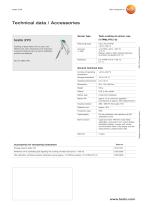
Technical data / Accessories Sensor type Testo cooking oil sensor, cap. testo 270 Measuring range ±2 %TPM (+40 to +190 °C) ±1.5 °C (typical, refers to Testo-internal reference, at ambient temperature 25 °C) General technical data Cooking oil operating temperature Storage temperature Operating temperature Battery type Battery life approx. 25 h continuous operation (corresponds to approx. 500 measurements ) Housing material ABS / ABS-PC fibre glass 10% Reaction time Protection class On-site calibration with reference oil ISO calibration by TIS Alarm function Upper and lower TPM limit value freely...
Open the catalog to page 2All TESTO catalogs and technical brochures
 622
6222 Pages
 First choice for every job
8 Pages
 Thermal imager testo 883
4 Pages
 testo 317-3
4 Pages
 testo 316-1
8 Pages
 testo-315-3
4 Pages
 testo-570-Datasheet EN
4 Pages
 Digital manifold
4 Pages
 Gas leak detectors
8 Pages
 Flue gas analyzer
4 Pages
 testo 440
12 Pages
 testo 400
12 Pages
 Digital multimeter
2 Pages
 Testo Smart Probes
8 Pages
 Product brochure testo Saveris
24 Pages
 Brochure_Refrigeration_EN
16 Pages
 Datasheet-testo-557-NEW-EN
4 Pages
 Datasheet-testo-550-NEW-EN
4 Pages
 Datasheet-testo-549-NEW-EN
4 Pages
 Brochure-testo-Saveris-2_EN
12 Pages
 testo-Saveris-2-Datasheet_EN
8 Pages
 Huminator
2 Pages
 Digital manifold - testo 570
4 Pages
 Digital manifold - testo 557
4 Pages
 Digital manifold - testo 550
4 Pages
 Hand stroboscope - testo 476
2 Pages
 Vane anemometer - testo 417
2 Pages
 Vane anemometer - testo 416
2 Pages
 Vane anemometer - testo 410
2 Pages
 SO2 analyzer - testo 325-I
2 Pages
 Fiberscope - testo 319
2 Pages
 Smoke tester- testo 308
4 Pages
 Humidity generator
2 Pages
 Software for data loggers
4 Pages
 Mini alarm thermometer
2 Pages
 stationary temperature probe
10 Pages


Archived catalogs


- Digital imager
- Industrial camera module
- Testo data-logger
- Pressure transmitter
- Infrared imager
- Pressure gauge
- Monitoring camera system
- Analog pressure transmitter
- Testo temperature data-logger
- USB camera module
- Digital pyrometer
- Digital weighing scale
- Detection camera system
- Portable tester
- Gas detector
- Waterproof pressure transmitter
- Industrial thermometer
- Waterproof camera module
- USB datalogger