
- Catalogs
- Testing Machines Inc
- 13-60 Burst Testers

13-60 Burst Testers

13-60 Burst Testers
Burst Testers are utilized for multi-directional tensile testing to determine failure in the direction of least resistance, assessing physical strength and fiber bond. They are adaptable for various materials and can include a device to measure sample deflection before bursting. These testers comply with international standards for testing paper, foils, boards, textiles, etc.
The Burst Tester measures the bursting strength of fabric materials under increasing hydrostatic pressure applied via an elastic diaphragm. The specimen is clamped pneumatically, and the bursting strength is the maximum pressure before failure. This method is independent of the sample's cutting direction, focusing on the least resistance direction. Rubber diaphragms must meet specific standards for bulge versus pressure patterns.
- Textiles, fibers, non-wovens, polyester, fabrics, and felts
- Assessment of strength, stiffness, dyeability, resilience, fatigue elasticity, orientation, and crystallinity
The Burst Tester meets various standards, including ISO 2758, ISO 2759, ASTM D 3786, ASTM D-774, BS 4768, TAPPI T403, T807, and T810.
- Three models for different materials: paper and film, board and corrugated, textiles
- Pneumatic sample clamping with transducer-measured pressure
- Compatible with GraphMaster™ software for data collection and analysis
- Memory storage for calibration dates and test counts
- Programmable menus for predefined test methods and standards
- Pressure system: Hydrostatic pressure via hydraulic jack and precision DC motor
- Sample tightening: Pneumatic jack with precision manometer
- Bursting pressure measurement: Metallic gages pressure transducer with high accuracy and resolution
- Model specifications: Different ranges for paper, boards, and textiles
- Dimensions: 517 mm x 565 mm x 495 mm; Weight: 65 kg
- Electrical: 110V/60Hz or 220V/50Hz; Air: 600 kPa
- Safety: One or two start buttons depending on hood position
- Options: Height gauge and printer
Catalog excerpts

Burst Tester 13-60 Series FEATURES • Three (3) models to choose from to measure Paper and film, Board and Corrugated, and Textiles • Pneumatic sample clamping pressure is measured with a transducer and displayed in bar/PSI • Compatible with GraphMaster™ PC based data collection and curve analysis software • Date of last calibration stored in memory (clamp pressure, bursting pressure, and height gauge) • Menus allow programming to meet predefined test methods and international standards • Number of test performed with diaphragm stored in memory BURST TESTING Burst Testers are used as a multi-directional tensile test to identify failure in the direction of least resistance for evaluating physical strength and fiber bond. Models are available to test a variety of materials. These models can also be fitted with a device to measure the deflection of the sample prior to burst. The rubber diaphragms with specific thickness and shore hardness must have a bulge versus pressure pattern within the tolerance of the standards related to the type of material tested. The Burst tester is designed to meet international standards for tests on paper, foils, paper boards, corrugated board, textiles etc. OPERATION The Burst Tester is designed for measuring the bursting strength of fabric materials subjected to an increasing hydrostatic pressure. This pressure is applied to a circular region of the specimen via an elastic diaphragm. The specimen is firmly held round the edge of this circular region by a pneumatic clamping device. When the pressure is applied, the specimen deforms together with the diaphragm. The bursting strength corresponds to the maximum pressure supported by the specimen before failure. Identical, in the principle to the multi-directional tensile test, Ball Burst Method for Fabrics, this measurement is independent from the cutting direction of the sample (machine or cross) since the failure naturally occurs in the least resistance direction. APPLICATIONS • Textiles, Fibers, Non-woven’s, Polyester, Fabrics and Felts etc. • Strength, stiffness, dye ability, resilience, fatigue elasticity, orientation and crystallinity. MEETS STANDARDS • ISO 2758, ISO 2759, , ISO 1328-2:1999, ISO 2960, ASTM D 3786 , ASTM D-774, BS 4768, TAPPI T403, TAPPI T807, TAPPI T810
Open the catalog to page 1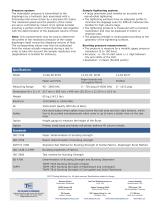
Pressure system: The hydrostatic pressure is transmitted to the diaphragm by a hydraulic jack associated with a frictionless ball-screw driven by a precision DC motor. The rotational speed and the position of the motor are servo-controlled by means of an optical encoder ensuring a perfect control of the fluid flow rate together with the determination of the displaced volume of fluid. Note: This measurement may be used to determine the profile of the resistance pressure of the rubber diaphragm itself versus the displaced volume of fluid. The corresponding values may then be subtracted from the...
Open the catalog to page 2All Testing Machines Inc catalogs and technical brochures
 43-02 Monitor Impact Tester
2 Pages
 Top Load Compression Tester
2 Pages
 17-76 Compression Tester
2 Pages
 10-48 Rotary Abraser
2 Pages
 Digital Ink Rub Tester
1 Page
 49-56 Digital Micrometer
2 Pages
 49-86 Digital Micrometer
2 Pages
 49-87 Digital Micrometer
2 Pages
 58-03 Densometers
1 Page
 GraphMaster
2 Pages
 SD-200L
2 Pages
 tear-tester
2 Pages
 13-50 Puncture Tester
1 Page
 Dial Micrometers
2 Pages
 13-50 Puncture Tester
1 Page
 68-21 Digital Hazemeter
2 Pages
 92-15 Laray Viscometer
1 Page
 Cobb Sizing Testers
1 Page
 Tensile Tester
3 Pages
 Impact Tester
2 Pages
 compression testing machine
3 Pages
 Bekk Smoothness Tester
2 Pages
 Contanst Tension Transport
4 Pages
 Dynamic Modulus Tester
2 Pages
 ADF Yarn Strength Tester
4 Pages
 LabMaster Slip Friction
2 Pages
 Ink Rub tester
1 Page
 49-50 Digital Micrometer
2 Pages
 Heat Sealer
4 Pages
 Slip Friction tester
2 Pages
 Hygrometer
1 Page
 Brightnesss Color Meter
4 Pages
 TS-4 Heat Sealer
3 Pages
 Moisture Meter
2 Pages
 Photovolt
2 Pages
 TS-12 Heat Sealer
2 Pages
 Bending Resistance
1 Page
 Internal Bond tester
4 Pages
 Loop Tack tester
2 Pages
 Probe Tack
2 Pages
 Short Span Compression
1 Page
 Peel/Adhesion Tester
2 Pages
 Dart Impact Tester
1 Page
 Canadian Freeness
1 Page
 Pulp Beater
1 Page
 Standard Sheet Former
1 Page
 Tear Tester
1 Page
 49-60 Digital Micrometer
1 Page
 portable hardness tester
1 Page




- Industrial press
- Test machine
- Forming press
- Hydraulic press
- Management software solution
- Test stand
- Windows software
- Automated testing machine
- Material test machine
- Indentation hardness tester
- Compression testing machine
- Automated test bench
- Tensile testing machine
- Digital display hardness tester
- Automatic test kit
- Micrometer
- Manual test equipment
- Column type press
- Portable hardness tester
- Tension test machine