

TESTBOY 110

TESTBOY 110
- Capacitive measurement procedure for accurate detection.
- Measurement range from 12 V to 1000 V AC.
- Integrated LED torch for visibility in low-light conditions.
- Optical display for easy reading of results.
- Overload Category: CAT III 1000V.
- Dimensions: 160 x 25 mm.
- Weight: 45 g.
- Color: Red.
- Power Supply: 2x 1.5V AAA Micro, LR03 batteries (included).
- Housing: Made from ABS synthetic material, resistant to impact.
- Standard Compliance: IEC/EN 61010-1 (DIN VDE 0411).
Catalog excerpts
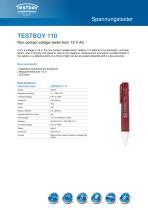
TESTBOY 110 Non-contact voltage tester from 12 V AC From a voltage of 12 V, the non-contact voltage tester Testboy 110 detects a live conductor, amongst others, also in the low volt systems. Due to the capacitive measurement procedure, invisible brakes in the cables or a defective lamp in a chain of light can be accurately detected within a few seconds. How you benefit: | Capacitive measurement procedure | Measurements from 12 V | LED torch Specifications Technical Data Measurement Range Overload Category Incl. batteries Integrated LED-torch Lamp Power Supply Overload Category ABS synthetic material, resistant to breaking by impact
Open the catalog to page 1All Testboy catalogs and technical brochures
 THE CATALOG 2018 | 2019
84 Pages
 TESTBOY 10
1 Page
 TESTBOY 11
1 Page
 TESTBOY 20 Plus
1 Page
 Testboy TV 455
1 Page
 Testboy 28
1 Page
 Testboy 74
1 Page
 Testboy 51
1 Page
 Testboy 3000
2 Pages
 Testboy 2200
1 Page
 Testboy 313
1 Page
 Testboy 15, Testboy 130
1 Page
 Testboy 113
1 Page
 Testboy 114
1 Page
 Testboy TV 325
2 Pages
 Testboy TV 322
2 Pages
 Testboy TV 460
2 Pages
 Testboy TV 450
2 Pages
 Testboy TV 440N
2 Pages
 Testboy TV 430N
2 Pages
 Testboy 410N
1 Page
 Testboy TV 416/432
1 Page
 Testboy 26
2 Pages
 Testboy Car Tester
1 Page
 Testboy 75
1 Page
 Testboy 70
2 Pages
 Testboy 50
2 Pages
 Testboy TV 218
2 Pages
 TESTBOY TV 215/216
2 Pages
 Testboy Pocket
1 Page
 Testboy 20
2 Pages
 Testboy Profi LCD Plus
2 Pages
 Testboy Profi LED Plus
2 Pages
 Testboy Profi LCD
2 Pages
 Testboy Profi LED
2 Pages
 Testboy 40 Plus
1 Page
 Testboy 11, Testboy 111
2 Pages


Archived catalogs
 Testboy TV 321
2 Pages
- Digital imager
- Industrial camera module
- Liquids analyzer
- Infrared imager
- USB camera module
- Detection camera system
- Portable tester
- Portable analyzer
- Industrial thermometer
- Digital tester
- Thermographic camera
- °C thermometer
- Industrial tester
- IR pyrometer
- Compact analyzer
- Thickness gauge
- Rugged camera
- Multimeter
- Digital multimeter