


Temperature Hand Book
Temperature Hand Book
Catalog excerpts
Temperature Hand Book
Open the catalog to page 1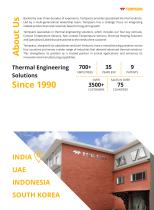
Backed by over three decades of experience, Tempsens provides specialised thermal solutions. Led by a multi-generational leadership team, Tempsens has a strategic focus on integrating related product lines and customer bases for long-term growth. Tempsens specialises in thermal engineering solutions, which includes our four key verticals, Contact Temperature Sensors, Non-contact Temperature Sensors, Electrical Heating Solutions and Specialised Cables that are tailored to the needs of the customer. Tempsens, along with its subsidiaries and Joint Ventures, have a manufacturing presence across four...
Open the catalog to page 2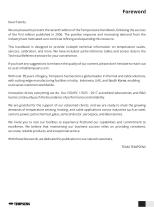
Foreword Dear friends, We are pleased to present the seventh edition of the Temperature Handbook, following the success of the first edition published in 2006. The positive response and increasing demand from the industry have motivated us to continue refining and expanding this resource. This handbook is designed to provide in-depth technical information on temperature scales, sensors, calibration, and more. We have included useful reference tables and sensor data in the Technical Reference section for your convenience. If you have any suggestions to enhance the quality of our content, please...
Open the catalog to page 3
1. Temperature and Temperature Scales 03 5. Protection Tubes, Thermowell, Fittings and Terminations 41 6. Extension Leads and Compensating Cables 60 7. Pyrometer Fundamental and Infrared Thermography 66 8. Furnace Monitoring System 79 9. Inspection, Testing and Calibration 82 10. Electronic and Instrumentation for Temperature 95
Open the catalog to page 5
1 Temperature and Temperature Scales 1.1 The temperature of a substance is the degree of hotness or coldness of the substance. A hot substance is said to have a high temperature whereas a cold substance is said to have a low temperature. Therefore, the temperature of a substance is an indication of the average kinetic energy of the molecules of the substance. Heat always flow from a body at higher temperature to the body at lower temperature. So, we can also say that temperature of a body is the property which governs the flow of heat. It can easily be demonstrated as follows: When two objects...
Open the catalog to page 7
An engraved scale on the tube allowed for a quantitative measure of the fluctuations. The air in the bulb is referred to as the thermometric medium, i.e. the medium whose property changes with temperature. In 1641, the first sealed thermometer that used liquid rather than air as the thermometric medium was developed for Ferdinand II, Grand Duke of Tuscany. His thermometer used a sealed alcohol-in-glass device, with 50 "degree" marks on its stem but no "fixed point" was used to zero the scale. These were referred to as "spirit" thermometers. Robert Hook, Curator of the Royal Society, in 1664 used...
Open the catalog to page 8
To convert from Celsius to Fahrenheit: multiply by 1.8 and add 32. ° F = 1.8° C + 32 K = °C + 273. In 1780, J. A. C. Charles, a French physician, showed that for the same increase in temperature, all gases exhibited the same increase in volume. Because the expansion coefficient of gases is nearly the same, it is possible to establish a temperature scale based on a single fixed point rather than the two fixed- point scales, such as the Fahrenheit and Celsius scales. This brings us back to a thermometer that uses a gas as the thermometric medium. Constant Volume Gas Thermometer In a constant volume...
Open the catalog to page 9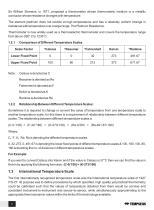
Sir William Siemens, in 1871, proposed a thermometer whose thermometric medium is a metallic conductor whose resistance changes with temperature. The element platinum does not oxidize at high temperatures and has a relatively uniform change in resistance with temperature over a large range. The Platinum Resistance. Thermometer is now widely used as a thermoelectric thermometer and covers the temperature range from about -260° C to 1235°C. Note: Celsius is denoted as C Reaumer is denoted as Re Fahrenheit is denoted as F Kelvin is denoted as K Rankine is denoted as Ra Sometimes it is required to...
Open the catalog to page 10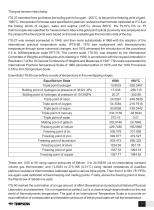
This goal remains intact today. ITS-27 extended from just below the boiling point of oxygen, -200°C, to beyond the freezing point of gold, 1065°C. Interpolation formulae were specified for platinum resistance thermometer calibrated at 0°C & at the boiling points of oxygen, water and sulphur (445°C). Above 660°C, the Pt-10% Rh vs. Pt thermocouple was specified for measurement. Above the gold point optical pyrometry was employed and the values of the fixed points were based on the best available gas thermometry data of the day. ITS-27 was revised somewhat in 1948, and then more substantially in1968-with...
Open the catalog to page 11
2 Temperature Measurement The measurement of temperature is very important in industrial application, so therefore continuous measurement of temperature is very much essential. Temperature can be measured through various types of sensors; all of them run on the same basic principle that they give temperature in the output according to the changes produced in their physical characteristics in the input. According to the type of application, measurement of temperature can be divided into following parts: Contact Method This method is used when the body (whose temperature is to be measured) and...
Open the catalog to page 12
Electrical Temperature Instruments As the name implies these types of instruments sense the temperature in the terms of electrical quantities like voltage, resistance etc. Therefore, we can say that these types of instruments are not directing indicating thermometers like mercury in glass devices. In the majority of industrial and laboratory processes the measurement point is usually far from the indicating or controlling instrument. This may be due to necessity (e.g. an adverse environment) or convenience (e.g. centralized data acquisition).Therefore; Devices are required which convert temperature...
Open the catalog to page 13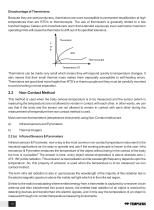
Disadvantage of Thermistors Because they are semiconductors, thermistors are more susceptible to permanent decalibration at high temperatures than are RTD's or thermocouple. The use of thermistors is generally limited to a few hundred degree Celsius and manufacturers warn that extended exposures even well below maximum operating limits will cause the thermistor to drift out of its specified tolerance. Thermistors can be made very small which means they will respond quickly to temperature changes. It also means that their small thermal mass makes them especially susceptible to self-heating errors....
Open the catalog to page 14All TEMPSENS catalogs and technical brochures
 Temperature Measurement
12 Pages
 Mineral Insulated Cables
16 Pages
 Thermal and Cable Solutions
20 Pages
 Fiber Temperature Sensor
36 Pages
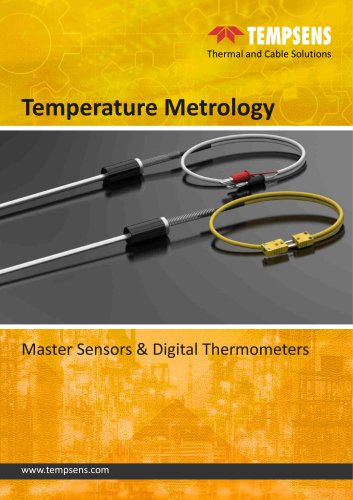 Temperature Metrology
11 Pages
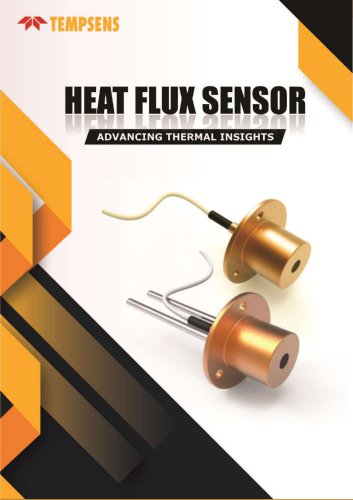 HEAT FLUX SENSOR
9 Pages
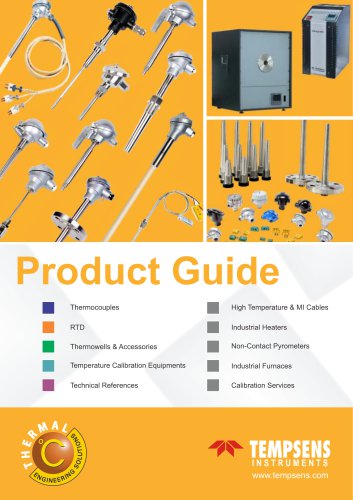 Product Guide
296 Pages
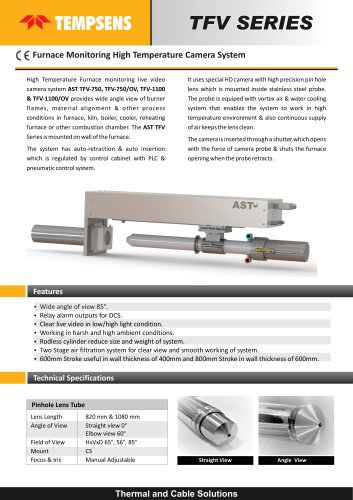 TFV SERIES
4 Pages
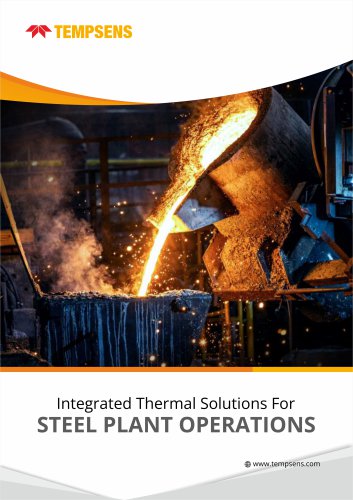 Steel Industry Catalogue
19 Pages
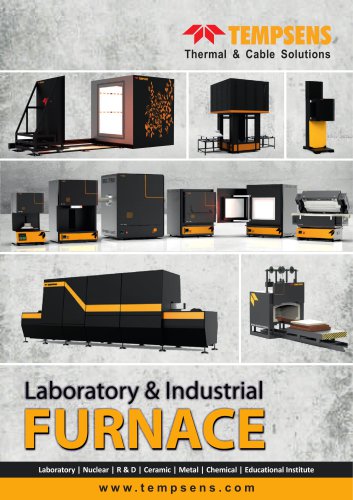 Industrial & Laboratory Furnaces
44 Pages
 Tempsens Product Catalogue
59 Pages
 Nickel & Thermocouple Alloy
26 Pages
 Thermowells and accessories
12 Pages
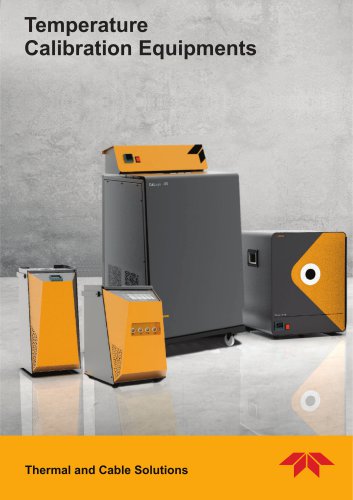 Temperature Calibrators
16 Pages
 Cables & Wires
16 Pages


Archived catalogs
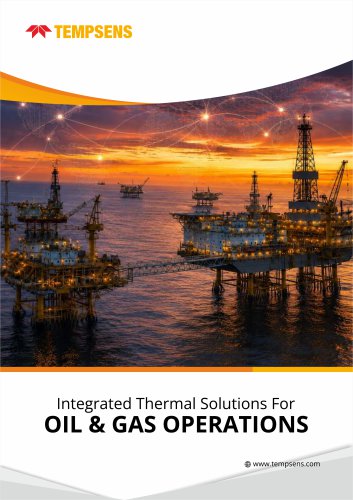
 Petrochemical Industry
22 Pages
 Petro-Chemicals Industry
12 Pages
 Miniature Thermocouple
1 Page
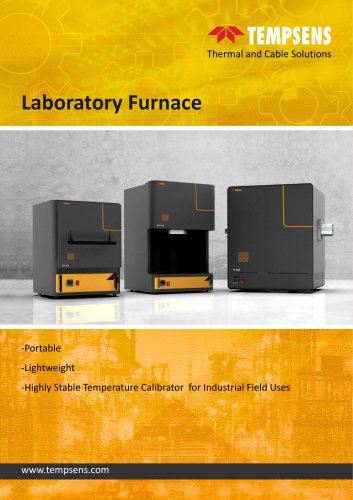 Laboratory Furnace
13 Pages
 Thermal Profiling System
10 Pages
 Product overview
2 Pages
 Tempsens Products
6 Pages
- TEMPSENS oven
- Digital imager
- Electrical cable
- Visible imager
- TEMPSENS chamber oven
- Electric furnace
- Heat treatment kiln
- Industrial camera module
- Data logger
- Copper cable
- Resistance temperature sensor
- Copper electrical cable
- Power cable
- Infrared imager
- Full-color camera system
- Monitoring camera system
- TEMPSENS calibrator
- Temperature datalogger
- Multi-strand cable