


- Products
- Catalogs
- News & Trends
- Exhibitions
Steel Industry Catalogue
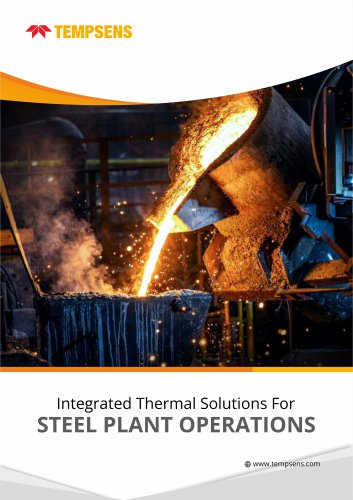
Steel Industry Catalogue
Tempsens is a global leader in temperature sensors and industrial heating solutions, with operations in over 75 countries and manufacturing facilities in India, Indonesia, UAE, and South Korea.
Tempsens offers a diverse range of products including thermocouples, RTDs, temperature gauges, fiber optic sensors, industrial heaters, and calibration services, all designed for precise temperature control in harsh environments.
In the steel industry, accurate temperature measurement is essential for product quality, energy efficiency, and safety. Tempsens provides solutions to enhance process stability and efficiency under extreme conditions.
- Coke Oven: High-temperature monitoring optimizes the coking process and improves fuel utilization.
- Pelletization & Sinter Plant: Ensures uniform temperature for pellet strength and stability.
- Iron Making Operations: Robust temperature measurement for efficient blast furnace operations.
- Steelmaking Operations: Continuous monitoring for detecting refractory hot spots and ensuring safe handling.
- Continuous Casting, Preheating & Reheating, Annealing Furnace, TMT Quenching, Galvanizing Line: Solutions for precise temperature control to maintain product quality and efficiency.
Specialized cables for high-temperature applications ensure reliable signal transmission and reduce measurement errors.
Tempsens offers calibration and traceability services to ensure accuracy and reliability, supported by various certifications.
Tempsens emphasizes engineering excellence and offers tailored solutions to meet specific customer needs globally.
ThermCAM160 and ThermCAM-HT thermal imagers provide real-time temperature visualization in high-radiation environments, supporting hot-spot detection.
Precise temperature monitoring is crucial for controlling cooling rates and preventing defects.
Accurate temperature measurement optimizes rolling parameters and maintains metallurgical properties.
Maintaining uniform temperature distribution is key to modifying steel properties.
Controlled temperature reduction is essential for achieving desired mechanical properties in rebars.
Accurate monitoring ensures uniform coating thickness and stable process conditions.
Tempsens provides calibration services to ensure measurement accuracy across a wide temperature range.
Tempsens offers tailored thermal solutions for steel manufacturing, ensuring reliable temperature monitoring and supporting stable production processes.
Catalog excerpts
Integrated Thermal Solutions For STEEL PLANT OPERATIONS www.tempsens.com
Open the catalog to page 1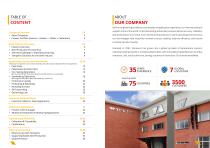
• Product Portfolio (Sensors + Heaters + Cables + Calibration) 4 Steel Industry Overview 6-9 • Steel Production Process Flow 7 • Thermal Challenges in Steel Manufacturing 8 • Tempsens Solutions for the Steel Industry 9 Built on engineering excellence and decades of application experience, our thermal solutions support some of the world's most demanding industrial processes where accuracy, reliability, and performance are critical. From extreme temperatures to harsh operating environments, our technologies help industries maintain process stability, improve efficiency, and ensure consistent product...
Open the catalog to page 2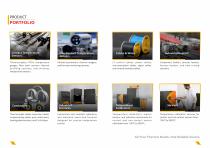
Contact Temperature Sensors Thermocouples, RTDs, temperature gauges, fiber optic sensors, thermal profiling systems, and wireless temperature sensors. Conductors Thermocouple cables, extension cables, compensating cables, pure nickel wires, heating element wires, and Cu-Ni alloys. Non-Contact Temperature Sensors Infrared pyrometers, thermal imagers, and furnace monitoring cameras. Industrial Furnaces Customized and standard laboratory and industrial ovens and furnaces designed for precise temperature control. Cables & Wires LT control cables, power cables, instrumentation cables, signal cables,...
Open the catalog to page 3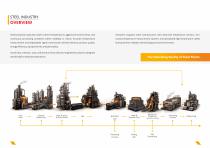
STEEL INDUSTRY OVERVIEW Steel production operates under extreme temperatures, aggressive environments, and Tempsens supports steel manufacturers with advanced temperature sensors, non- continuous processing conditions where reliability is critical. Accurate temperature contact temperature measurement systems, and specialized high-temperature cables measurement and dependable signal transmission directly influence product quality, built to perform reliably in demanding process environments. energy efficiency, equipment life, and plant safety. Harsh heat, vibration, dust, and thermal shock demand...
Open the catalog to page 4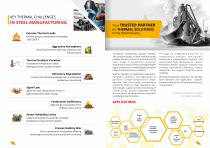
KEY THERMAL CHALLENGES IN STEEL MANUFACTURING KEY THERMAL CHALLENGES Extreme process temperatures exceeding 1500–2500°C IN STEEL MANUFACTURING Harsh environments with dust, vibration, and thermal shock Extreme Thermal Loads Inconsistent temperature control leading to product quality variation Extreme process temperatures exceeding 1500–2500°C Furnace and refractory damage due to inadequate temperature monitoring Your TRUSTED PARTNER for THERMAL SOLUTIONS in the Steel Industry High energy consumption from inefficient heat control Aggressive Atmosphere Harsh environments with dust, vibration, and...
Open the catalog to page 5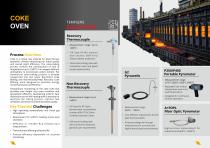
Process Overview Coke is a critical raw material for blast furnace operation, directly influencing hot metal quality and overall plant efficiency. The coke-making process involves the carbonization of coal at temperatures up to 1300°C in an oxygen-deficient atmosphere to concentrate carbon content. The commercial coke-making process is broadly categorized into two types: Byproduct Coke Making and Non-Recovery/Heat Recovery Coke Making, each designed to optimize energy recovery and process efficiency. Temperature monitoring of the coke oven flue provides vital insight into oven condition and operational...
Open the catalog to page 6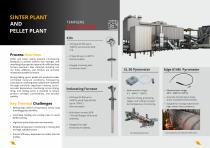
Kiln Process Overview Pellet and sinter plants prepare iron-bearing feedstock to achieve uniform size, strength, and metallurgical properties required for efficient blast furnace operation. Raw materials including iron ore fines, additives, and binders are precisely mixed before pellet formation. During balling, green pellets are produced under controlled moisture conditions, followed by induration or sintering where pellets are hardened through carefully regulated heating cycles. Accurate temperature monitoring across drying, firing, and cooling zones is essential to ensure product strength,...
Open the catalog to page 7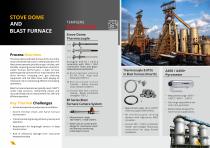
STOVE DOME AND BLAST FURNACE SOLUTIONS Stove Dome Thermocouple (a) (b) Process Overview The stove dome and blast furnace form one of the most critical thermal zones in steel production. Hot blast stoves operate cyclically on gas, on blast, and standby, requiring precise temperature control for stable furnace performance. A blast furnace system typically consists of four major sections: the blast furnace, charging unit, gas cleaning equipment, and hot blast stove, each playing an important role in maintaining efficient ironmaking operations. (c) Flanged SS310 / SS316 assembly with IP65 / IP67 connection...
Open the catalog to page 8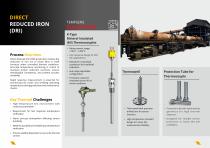
Process Overview Direct Reduced Iron (DRI) production involves the reduction of iron ore in rotary kilns or shaft furnaces under controlled thermal conditions. Accurate temperature monitoring is critical to maintain proper reduction reactions, ensure metallurgical consistency, and prevent process instability. Rapid response measurement is essential for monitoring kiln zones and verifying operating temperatures during production and maintenance checks. Mineral Insulated (Ml) Thermocouples • Measurement range: • Fast response design for DRI kiln applications. • Miniature or standard connectors...
Open the catalog to page 9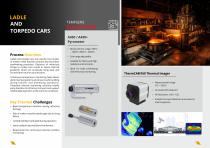
TORPEDO CARS Process Overview Ladles and torpedo cars are used for the transfer of molten metal between primary and secondary steelmaking processes. Exposure of refractory linings to molten iron results in severe thermal gradients, which can accelerate lining wear and increase the risk of structural failure. Continuous temperature monitoring helps detect abnormal heat patterns and ensures safe handling during transfer and preheating operations. Tempsens thermal monitoring solutions enable early detection of refractory hot spots and support reliable ladle operation under extreme conditions. •...
Open the catalog to page 10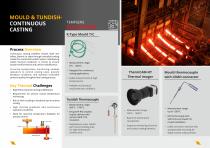
MOULD & TUNDISH- Process Overview Continuous casting solidifies molten steel into billets, blooms, or slabs through controlled cooling inside the mould and tundish system. Maintaining stable thermal conditions is critical to ensure proper shell formation and uniform solidification. Accurate temperature monitoring enables operators to control cooling rates, prevent breakout conditions, and maintain consistent product quality throughout the casting process. • Rapid heat extraction during solidification • Requirement for precise mould temperature monitoring • Risk of shell cracking or breakout due...
Open the catalog to page 11All TEMPSENS catalogs and technical brochures
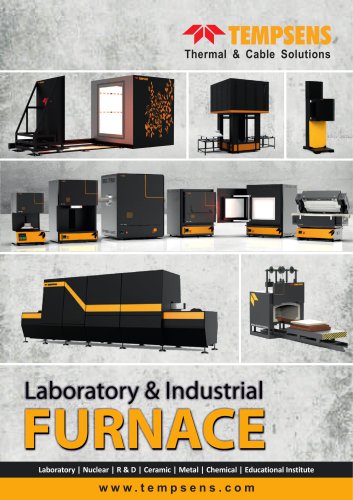 Industrial & Laboratory Furnaces
44 Pages
 Tempsens Product Catalogue
59 Pages
 Nickel & Thermocouple Alloy
26 Pages
 Thermal Profiling System
10 Pages
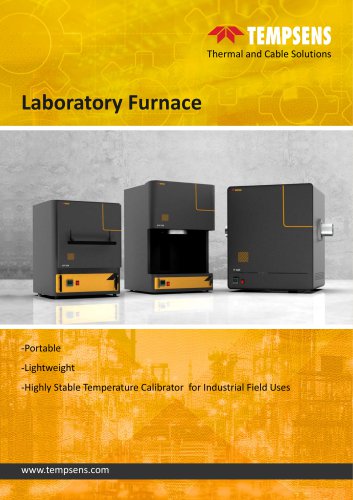 Laboratory Furnace
13 Pages
 Thermowells and accessories
12 Pages
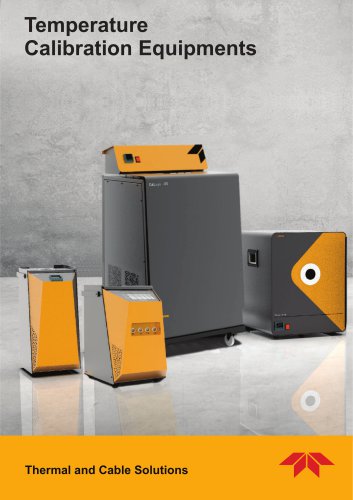 Temperature Calibrators
16 Pages
 Petrochemical Industry
22 Pages
 Cables & Wires
16 Pages
 Petro-Chemicals Industry
12 Pages
 Miniature Thermocouple
1 Page


Archived catalogs
 Product overview
2 Pages
 Tempsens Products
6 Pages