
- Catalogs
- Telemecanique Sensors
- Ultrasonic sensors OsiSense XX


Ultrasonic sensors OsiSense XX

Ultrasonic sensors OsiSense XX
- Diffuse Mode: Suitable for flat objects, where the object reflects the ultrasonic wave back to the sensor.
- Reflex Mode: Ideal for objects that absorb or do not reflect ultrasonic waves, such as sponges or pointed objects.
- Thru-beam Mode: Best for detecting small objects with high accuracy and switching frequencies.
Catalog excerpts

Ultrasonic sensors OsiSense XX Catalogue
Open the catalog to page 1
Optimise detection with OsiSense XX Detect all types of objects in all types of applications with OsiSense™ XX ultrasonic sensors. These ultrasonic sensors offer an efficient solution for reliable and high performance detection at distances of up to 8m, this being mainly due to the mode window*. * The mode window enables suppression of the foreground and the background using the same sensor. A technology suited to your needs Detection of all materials 3 modes for assuring efficient detection Detection of all objects irrespective of shape Long distance proximity detection Up to 50 mm for all types...
Open the catalog to page 3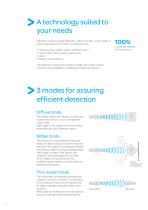
A technology suited to your needs Ultrasonic sensors enable detection, without contact, of any object in severe industrial environments, irrespective of its: • material (metal, plastic, wood, cardboard, etc.), • nature (solid, liquid, powder, paste, etc.), • colour, • degree of transparency. of materials detected in all applications The ultrasonic sensors are simple to install due to their integral connector and availability of cabling and fixing accessories. 3 modes for assuring efficient detection Diffuse mode The object reflects the ultrasonic wave back to the sensor which, in turn, changes...
Open the catalog to page 4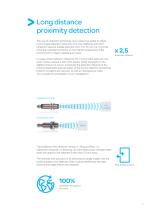
Long distance proximity detection The use of ultrasonic technology now makes it possible to obtain much longer detection distances. The new OsiSense XXV Ø18 ultrasonic sensors enable detection from 0 to 50 mm (i.e. 2.5 times more than standard products on the market) irrespective of the environment or object material and colour. detection distance In cases where detection distances for moving metal parts are very short, there is always a risk of the sensor being damaged on the slightest impact or knock. Increasing the detection distance of the moving metal parts assures safety of the sensor....
Open the catalog to page 5
Selection guide based on application Detection “Digital” Machine part Vibrating bowl Conveying Presence Absence Transparent bottles
Open the catalog to page 6
Diffuse mode Reflex mode Thru-beam mode Regulation "Analogue output" Packaging Handling Level monitoring elevating table boarding bridge
Open the catalog to page 7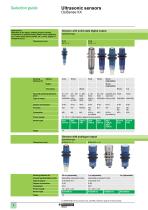
Ultrasonic sensors Selection guide Applications Detection of any object, without physical contact, irrespective of: material (metal, plastic, wood, cardboard, etc.), nature (solid, liquid, powder, etc.), colour, degree of transparency, etc. Sensors with solid-state digital output Cylindrical type Assured operating distance (mm) Adjustable using Fixed teach mode PNP/NPN NPN or PNP PNP/NPN PNP/NPN Power supply 12...24 V c with protection against reverse polarity Sensor type Sensors with analogue output Cylindrical type Dimensions (mm) Adjustable using teach mode Adjustable using teach mode Power...
Open the catalog to page 8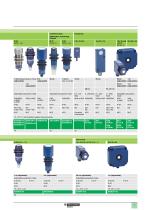
Cylindrical type Flat format Application, monitoring 2 levels Ø 30 (M30 x 1.5) 2 3 1 m/2 m depending on model 8 m (adjustable) (adjustable) – Adjustable using teach mode Adjustable using teach mode Adjustable using teach mode Connector M12 on flying lead 12...24 V c with protection against reverse polarity Adjustable using teach mode 4-20 mA Adjustable using teach mode 4-20 mA
Open the catalog to page 9
Quality, standards and certifications Ultrasonic sensors Quality control The OsiSense XX ultrasonic sensors are subjected to special precautions in order to guarantee their reliability in the most arduous industrial environments. b Qualification A qualification procedure on the characteristics of OsiSense XX ultrasonic sensors is carried out in our laboratories. b Production The electrical characteristics, sensing distances at the ambient temperature and operating temperatures are 100% verified. Sensors are statistically selected during the course of production and subjected to monitoring tests...
Open the catalog to page 10
General (continued) Ultrasonic sensors Recommendations The ultrasonic sensors are designed for use in standard industrial applications involving presence detection. Since these sensors do not incorporate a redundant electrical circuit, they are not suitable for use in safety applications. For safety applications, please refer to our “Safety functions and solutions using Preventa” catalogue. Principle of ultrasonic detection Presentation Ultrasonic sensors enable detection, without contact, of any object irrespective of its: b material (metal, plastic, wood, cardboard, etc.), b nature (solid,...
Open the catalog to page 11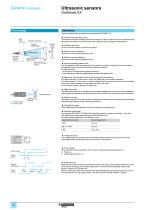
Ultrasonic sensors General (continued) Definitions The terms listed below are defined by the standard IEC 60947-5-2: Blind zone b Nominal sensing distance (Sn) Conventional value for indicating the sensing distance. It does not take into account manufacturing tolerances nor variations caused by external conditions such as voltage and temperature. Detection zone (Sd) Standard metal target Overall beam angle b Minimum sensing distance Lower limit of the specified detection zone. Reference axis Minimum sensing distance Assured operating distance (Sa) b Detection zone (Sd) Zone in which the sensor...
Open the catalog to page 12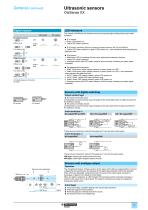
Ultrasonic sensors General (continued) Digital outputs No object present Diffuse mode b Ø 12 sensor v Green LED (power on) v Yellow LED (object present) b Ø 18 sensor, sensitivity 500 mm (except thru-beam versions XXT18 and XXR18) v Yellow LED (object present) or green LED (power on) + user assistance when adjusting the detection zone b Ø 30 sensor v Multicolour LED for assisting the user when adjusting the detection distance v Yellow LED (object present) v Analogue version with LED (object present, with luminosity increasing as output signal increases) Reflex mode Object present (2) Diffuse...
Open the catalog to page 13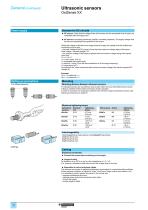
General (continued) Power supply Ultrasonic sensors Sensors for DC circuits b DC source: Check that the voltage limits of the sensor and the acceptable level of ripple, are compatible with the supply used. b AC source (comprising transformer, rectifier, smoothing capacitor): The supply voltage must be within the operating limits specified for the sensor. Where the voltage is derived from a single phase AC supply, the voltage must be rectified and smoothed to ensure that: - the peak voltage of the DC supply is lower than the maximum voltage rating of the sensor. Peak voltage = nominal voltage...
Open the catalog to page 14All Telemecanique Sensors catalogs and technical brochures
 Photo-electric sensors OsiSense XU
186 Pages
 Safety light curtains XUSL range
38 Pages
 Ultrasonic sensors XX range
79 Pages
 Limit switches XC Standard range
161 Pages
 Limit switches XC Special range
67 Pages
 limit switch XCMN
6 Pages
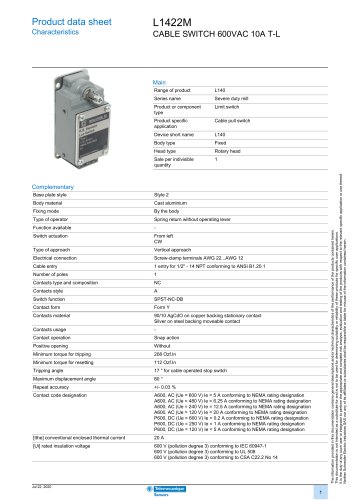 L1422M
2 Pages
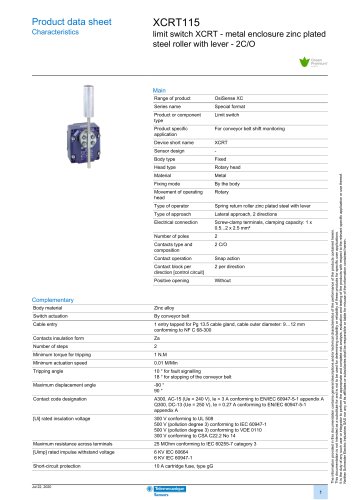 limit switch XCRT
5 Pages
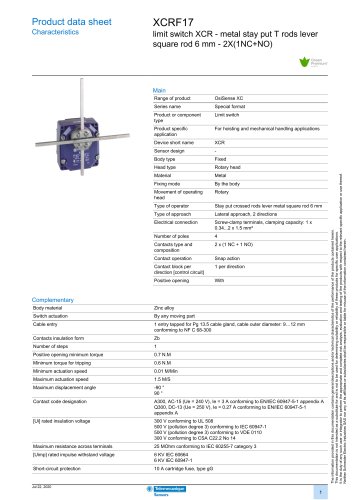 limit switch XCR
5 Pages
 limit switch XCKL
6 Pages
 Limit switches OsiSense XC Standard
146 Pages
 New 2011 sensors catalog
24 Pages
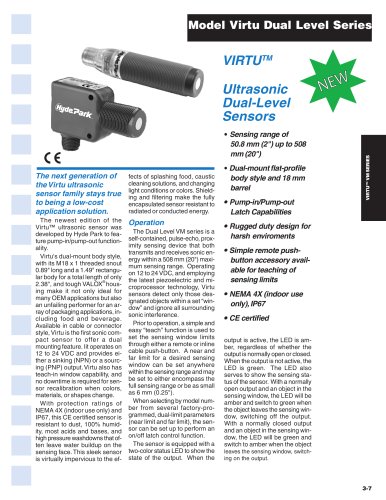 Model VM18 Proximity
6 Pages
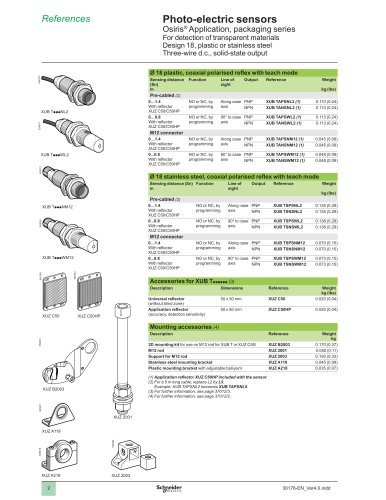 Osiconcept Photoelectric Sensor
2 Pages
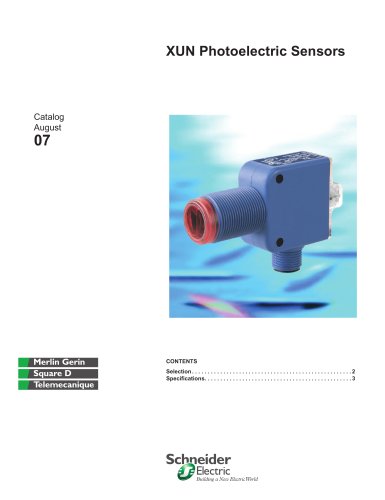 PhotoVirtu™ Photoelectric Sensor
4 Pages
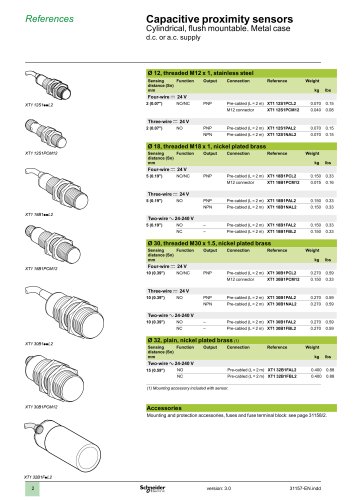 Osicap Capacitive Sensors
8 Pages






Archived catalogs
 Osiris XUA Photoelectric Sensor
2 Pages
 Virtu™ 30A Catalog
4 Pages
 Virtu™ Product Brochure
8 Pages
- Pressure transmitter
- Proximity switch
- Cylindrical proximity sensor
- Pressure switch
- Inductive proximity sensor
- Stainless steel pressure transmitter
- Relative pressure transmitter
- Photoelectric sensor
- Mechanical pressure switch
- IP67 proximity sensor
- DC proximity sensor
- Limit switch
- Sensitive element pressure transmitter
- Rectangular photoelectric sensor
- DC pressure transmitter
- Diaphragm pressure switch
- Adjustable pressure switch
- Light barrier
- Multibeam light curtain
- M12 proximity sensor