
- Catalogs
- Telemecanique Sensors
- New 2011 sensors catalog


New 2011 sensors catalog
New 2011 sensors catalog
The document details the IP (Ingress Protection) and IK (Impact Protection) codes, which classify the protection levels of electrical enclosures. The IP code, as per EN 60529 and IEC 529, indicates protection against solid objects, water ingress, and access to live parts. The IK code, according to EN 50102, indicates protection against mechanical impacts. Standards NF C 15-100 and UTE C 15-103 are referenced for selecting equipment based on environmental conditions.
The document explains the NEMA and UL classifications for enclosures, which offer protection against environmental conditions and incidental contact. Various types are specified for indoor and outdoor use, providing protection against elements like dirt, water, and ice, with some types also resisting corrosion.
A comparison of American Wire Gauge (AWG) and metric wire sizes is provided, including conduit resistance at 20°C, aiding in selecting appropriate wire sizes for different applications.
The glossary defines technical terms related to electrical equipment and sensors, such as actuators, ambient light rejection, and background suppression, providing clarity on terms used in the context of electrical enclosures and sensor technology.
- Snap Switch: Changes state to control devices like pilot lights and relays when actuated.
- Line-Powered Sensor: Requires three or four connections, drawing current directly from the line.
- Load-Powered Sensor: Operates in series with the load, requiring only two connections.
- Magnetic Operated (Reed Relay): Detects magnetic targets, ideal for environments with minimal magnetic interference.
- Resistive Loads: Include lamps and heaters.
- Inductive Loads: Include relays and solenoid valves.
- Maintained Contact: Remains in a condition until actuated to another state.
- Momentary Contact Limit Switch: Returns to normal state when actuating force is removed.
- Make-Before-Break: Normally open contact closes before normally closed contact opens.
- Manifold Mounting: Allows wiring through the underside, preventing leakage.
- Plug-In vs. Non-Plug-In: Plug-in allows easy replacement without disturbing wiring.
- Photoelectric Sensors: Use light to detect objects, can be affected by ambient light.
- Proximity Diffuse: Emitter and receiver in the same housing, detects light bounced back by the target.
- Pulse Modulated: Reduces interference by pulsing light at a specific frequency.
- Maximum Load: Maximum current a device can handle without damage.
- Minimum Load: Minimum current required for proper sensor operation.
- Non-Inductive Ratings: Based on resistive load only.
- Operating Distance: Distance from sensor to target path at operating point.
- Operating Force: Force needed to actuate contacts.
- Operating Range: The x, y, z range causing switch operation.
- NAMUR: European standard for intrinsically safe equipment.
- Non-Incentive: Equipment that does not release enough energy to ignite hazardous materials.
- Operating Distance: Maximum percentage of the operating distance, typically 5%.
- Repeatability: Variance in operating distance under specified conditions.
- Reset Position: Position where actuator contacts return to normal, also known as 'Releasing Position'.
- Resistive Ratings: Indicates resistive load contacts can handle, based on a 75% power factor for AC.
- Response Time: Time required for an interface to trigger an output after receiving an input signal.
- Retroreflective: Sensor and reflector setup where the target blocks the beam, changing the receiver's state.
- Reverse Polarity: Circuitry protecting devices from incorrect voltage polarity.
- Rollers: Recommended materials and sizes for rollers to avoid resetting and snap back issues.
- Safety Interlock: Device ensuring operator protection during machine intervention.
- Short Circuit Protection (SCP): Protects sensors from short circuits and overloads.
- Sensing Distance and Range: Maximum distance and range for reliable sensor operation.
- Simultaneous Make and Break: Contacts open and close simultaneously.
- Single Pole Single Throw (SPST): Switches that make or break one circuit.
- Snap Action Contacts: Contacts with preset travel points, independent of operator speed.
- Solid State: Devices with no moving parts, relying on optical, electrical, or magnetic phenomena.
- Specular Reflection: Combination of thru-beam and proximity diffuse photoelectric devices.
- Stability: Stability of photoelectric output states, affecting system performance.
- Taut Cable Principle: Ensures cable tension for proper switch actuation.
- Telegraph: Condition in lever switches causing potential contact re-tripping.
- Visible Light: Wavelengths range between 400 and 700 nanometers.
- Weld Field Immune (WFI): Devices designed to operate near strong electrical fields from welding processes.
Catalog excerpts
1/1 1 Contents 1—Technical Information Degrees of protection provided by enclosures . . . . . . . . . . . . . . . . . . . . . . . . 1/2 Wire size chart . . . . . . . . . . . . . . . . . . . . . . . . . . . . . . . . . . . . . . . . . . . . . . . . . . . 1/5 Glossary . . . . . . . . . . . . . . . . . . . . . . . . . . . . . . . . . . . . . . . . . . . . . . . . . . . . . . . 1/6
Open the catalog to page 1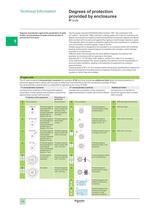
1/2 Degrees of protection provided by enclosures IP code Degrees of protection against the penetration of solid bodies, the penetration of water, and the access of personnel to live parts The European standard EN 60529 dated October 1991, IEC publication 529 (2nd edition - November 1989), defi nes a coding system (IP code) for indicating the degree of protection provided by electrical equipment enclosures against accidental direct contact with live parts and against the ingress of solid foreign objects or water. This standard does not apply to protection against the risk of explosion or conditions...
Open the catalog to page 2
1/3 Degrees of protection provided by enclosures IK code Degrees of protection against mechanical impact The European standard EN 50102 dated March 1995 defi nes a coding system (IK code) for indicating the degree of protection provided by electrical equipment enclosures against external mechanical impact. Standard NF C 15-100 (May 1991 edition), section 512, table 51 A, provides a cross-reference between the various degrees of protection and the environmental conditions classifi cation, relating to the selection of equipment according to external factors. Practical guide UTE C 15-103 contains...
Open the catalog to page 3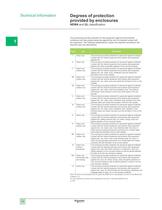
1/4 1| Degrees of protection provided by enclosures NEMA and UL classifi cation The enclosures provide protection for the equipment against environmental conditions and help protect personnel against the risk of incidental contact with the equipment. The following classifications (Types) are required according to the required uses and descriptions: Type Use Description 1 Indoor use. The enclosure provides protection for personnel against incidental contact with the internal equipment and protects said equipment against dirt. 2 Indoor use. The enclosure provides protection for personnel against...
Open the catalog to page 4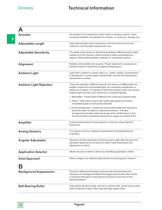
1| 2 3 4 5 6 8 9 10 7 1/6 Glossary Technical Information A Actuator An actuator is the mechanism of the switch or enclosure which, when moved as intended, will operate the contacts, i.e. lever arm, plunger, etc. Adjustable Length Used where length of arm required is not known when devices are ordered or where length requirements vary. Adjustable Sensitivity The ability of the sensor to discriminate between different levels of light incidence on the receiver. Used primarily to black out background objects, discriminate between materials, or transparent objects. Alignment Relation of the emitter...
Open the catalog to page 6
1 2 3 4 5 6 8 9 10 7 1/7 Glossary (continued) Technical Information Barrier Device An intrinsically safe barrier inherently limits the current and voltage that can be transmitted into the hazardous location and has redundant circuitry in case of component failure. Beam Pattern In the operation of thru-beam and retrorefl ective sensors, a degree of deviation from absolute alignment of the emitter and receiver (within which the beam intensity is suffi cient to activate the receiver) determines the beam pattern. Break-Before-Make The normally closed contact opens before the normally open contact...
Open the catalog to page 7
1| 2 3 4 5 6 8 9 10 7 1/8 Color Registration Sensor The color registration sensor is a highly specialized diffuse proximity sensor that has the ability to detect fi ne changes in contrast on a surface. But unlike the standard diffuse proximity sensor, this type of unit uses a powerful lens system and must be positioned at a specifi c focal distance from the target. Complementary Outputs Sensors with both N.O. and N.C. outputs that change state simultaneously. Conducting Path Includes all terminals, inserts, stationary contact material resistance, movable contact material resistance, movable blade...
Open the catalog to page 8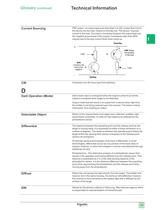
1 2 3 4 5 6 8 9 10 7 1/9 Current Sourcing PNP output - an output type such that when it is ON, current fl ow is from the device into the load. Output is normally low. The sensor “sources” current to the load. The load is connected between the output lead and the negative ground lead of the supply. Considered safer than NPN outputs due to the way current fl ows when wired up. CW Clockwise only (for lever type limit switches). D Dark Operation (Mode) Dark mode output is energized when the target is present (proximity output is energized when target is not detected). Output mode that will result...
Open the catalog to page 9
1| 2 3 4 5 6 8 9 10 7 1/10 Direct (positive) Opening Contact (Also known as positive opening contacts in Europe) - A normally closed (N.C.) contact element coupled with the switch actuator via a nonresilient (non-elastic) member so that full contact opening is obtained when the actuator is moved through the direct (positive) opening travel by applying a direct (positive) opening force against the N.C. moveable contact assembly. The contact element will shear open in the event of sticking contacts or broken springs. Available on both snap action contacts and slow make and break contacts. Proper...
Open the catalog to page 10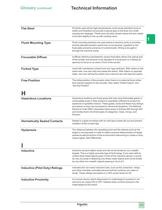
1 2 3 4 5 6 8 9 10 7 1/11 Flat Steel Primarily used where high temperatures could cause standard arms to soften and therefore not provide a secure grip on the lever arm shaft, causing arm slippage. These arms are also chosen where the arm needs to be bent slightly to line up with existing cams. Flush Mounting Type Flush mounting switches are used where a machine cavity is provided and the standard position switch box is not required. A gasket on the fl ush plate prevents entrance of contaminants. Wiring is brought in through the machine cavity. Focusable Diffuse A diffuse refl ective photoelectric...
Open the catalog to page 11
1| 2 3 4 5 6 8 9 10 7 1/12 Initial Position Position of switch actuator when no external force (other than gravity) is applied to the actuator (see Free Position). Interface Translates the presence of a target into an electrical signal. Internal Refl ection Internal refl ection occurs whenever a light ray strikes the surface of a medium whose refractive index is less than that of the medium in which the light is traveling. An example of this is a light source in water, where light is internally refl ected from the surface of air. The amount of light that is refl ected depends upon the angle at...
Open the catalog to page 12All Telemecanique Sensors catalogs and technical brochures
 Photo-electric sensors OsiSense XU
186 Pages
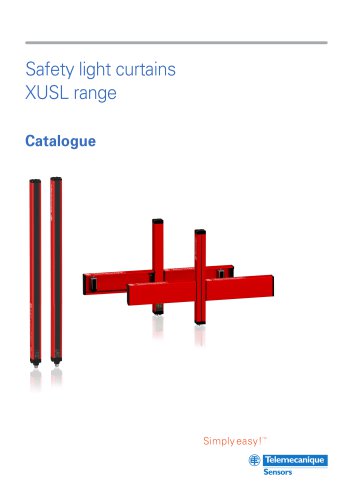 Safety light curtains XUSL range
38 Pages
 Ultrasonic sensors XX range
79 Pages
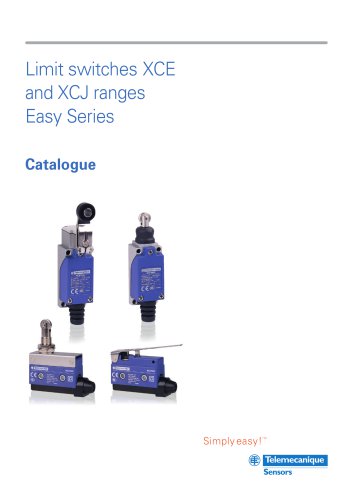
 Limit switches XC Standard range
161 Pages
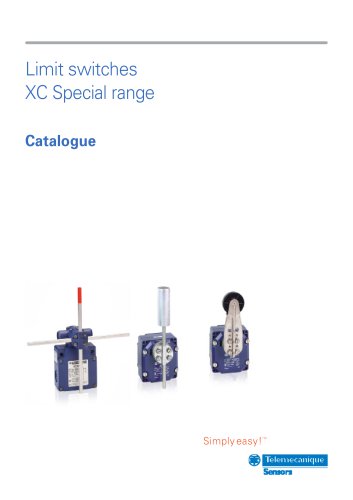 Limit switches XC Special range
67 Pages
 limit switch XCMN
6 Pages
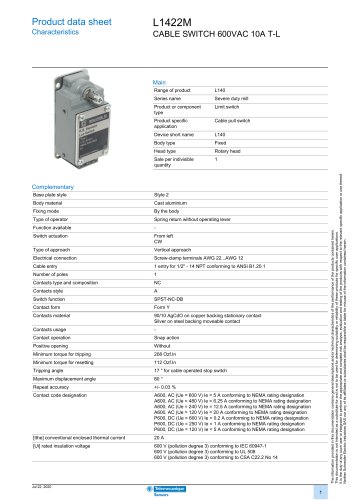 L1422M
2 Pages
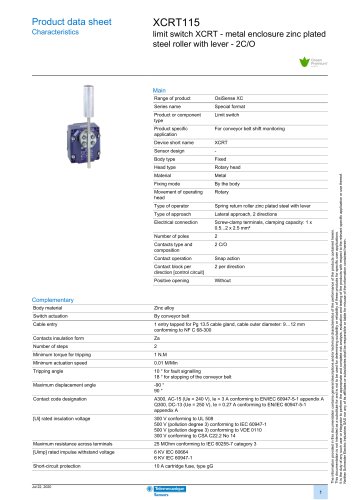 limit switch XCRT
5 Pages
 limit switch XCR
5 Pages
 limit switch XCKL
6 Pages
 Ultrasonic sensors OsiSense XX
36 Pages
 Limit switches OsiSense XC Standard
146 Pages
 Model VM18 Proximity
6 Pages
 Osiconcept Photoelectric Sensor
2 Pages
 PhotoVirtu™ Photoelectric Sensor
4 Pages
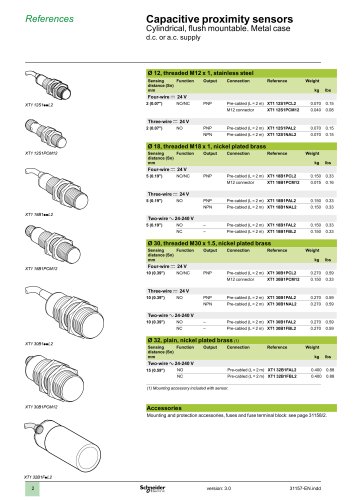 Osicap Capacitive Sensors
8 Pages






Archived catalogs
 Osiris XUA Photoelectric Sensor
2 Pages
 Virtu™ 30A Catalog
4 Pages
 Virtu™ Product Brochure
8 Pages
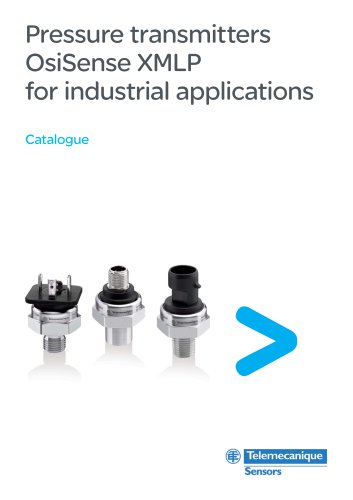
- Pressure transmitter
- Cylindrical proximity sensor
- Pressure switch
- Inductive proximity sensor
- Stainless steel pressure transmitter
- Relative pressure transmitter
- Mechanical pressure switch
- IP67 proximity sensor
- DC proximity sensor
- Sensitive element pressure transmitter
- Rectangular photoelectric sensor
- DC pressure transmitter
- Diaphragm pressure switch
- Adjustable pressure switch
- Light barrier
- Multibeam light curtain
- M12 proximity sensor