- Catalogs
- Tektelic Communications Inc.
- IoT for Oil & Gas

IoT for Oil & Gas
IoT for Oil & Gas
The oil and gas industry, an early adopter of digital transformation, is leveraging IoT and LoRaWAN® technologies to enhance operational efficiency, safety, and environmental accountability. This document explores the benefits of IoT in the industry, focusing on LoRaWAN® connectivity.
LoRaWAN® is emerging as a preferred technology for IoT applications in oil and gas due to its cost-effectiveness, long-range, and low-power connectivity. It offers a lower total cost of ownership compared to LTE and 4G, enabling large-scale sensor deployments and efficient data transmission.
IoT technologies facilitate predictive maintenance by monitoring equipment in real-time, reducing unplanned downtime by 36% and operating costs by 3-5%. LoRaWAN® sensors allow for extensive monitoring of equipment, improving reliability and performance.
IoT-enabled sensors and LoRaWAN® connectivity provide efficient asset monitoring in remote locations, offering real-time data on infrastructure health. This technology supports remote control over assets, enhancing response times to operational issues.
LoRaWAN® supports asset tracking with GPS and TDoA geolocation capabilities, improving inventory control and asset utilization. It is crucial for tracking unpowered and high-value assets across multiple locations.
IoT solutions enhance safety for lone workers by providing real-time location and status data. Devices like panic buttons and biometric sensors improve response times to safety incidents, ensuring worker safety in hazardous environments.
IoT sensors enable remote monitoring of environmental conditions, ensuring compliance with regulatory standards. This technology helps reduce CO2 emissions, conserve water, and prevent oil spills.
IoT and LoRaWAN® technologies are transforming the oil and gas industry by enabling extensive data collection and communication at reduced costs. TEKTELIC offers end-to-end IoT solutions to support industry needs, focusing on quality and cost-optimization.
Catalog excerpts
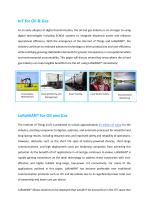
IoT for Oil & Gas As an early adopter of digital transformation, the oil and gas industry is no stranger to using digital technologies including SCADA systems to integrate dispersed assets and enhance operational efficiency. With the emergence of the Internet of Things and LoRaWAN®, the industry continues to embrace advanced technology to drive productivity and cost-efficiency while satisfying growing stakeholder demands for greater transparency in occupational safety and environmental accountability. This paper will discuss several key areas where the oil and gas industry can reap tangible benefits...
Open the catalog to page 2
to the substantial airtime costs associated with establishing cellular connectivity for each enddevice in a network. Lower price points are driving mass wireless sensor deployments, enabling large-scale IoT deployments connecting remote sensors and machine data to analytics platforms at scale. LoRaWAN®'s multi-usage capabilities accommodate a high capacity of IoT devices in a single network. A carrier-grade LoRaWAN® collection hub, known as a gateway has the capacity to simultaneously send and receive hundreds of messages every second from the devices deployed in its vicinity. This is ample capacity...
Open the catalog to page 3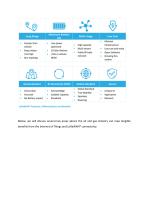
Global Standard True Mobility Seamless Roaming • In/out door Acknowledge Scalable Capacity Broadcast LoRaWAN* Features, Differentiators and Benefits Below, we will discuss several key areas where the oil and gas industry can reap tangible benefits from the Internet of Things and LoRaWAN® connectivity. Low power optimized 10-20yr lifetime >10x vs cellular M2M • Greater than cellular • Deep indoor coverage • Star topology • High capacity • Public/Private network Minimal infrastructure Low cost end-node Open Software Growing Ecosystem
Open the catalog to page 4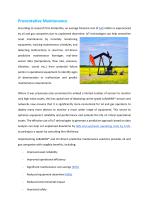
According to research firm Kimberlite, an average financial cost of $49 million is experienced by oil and gas companies due to unplanned downtime. IoT technologies can help streamline asset maintenance by remotely monitoring equipment, tracking maintenance schedules, and detecting malfunctions in real-time. IoT-driven predictive maintenance leverages real-time sensor data (temperature, flow rate, pressure, vibration, sound etc.) from potential failure points in operational equipment to identify signs of deterioration or malfunction and predict maintenance requirements. Where it was previously...
Open the catalog to page 5
Asset Monitoring and Management Infrastructure such as wellheads, oil rigs and pipelines are often located in harsh, remote, or inaccessible environments with limited cellular coverage. Historically, limited connectivity in these environments leaves few monitoring options such as labor-intensive manual checks or expensive satellite connectivity. IoT-enabled sensors and LoRaWAN® connectivity are enabling significantly more efficient and cost-effective asset monitoring, unlocking a vast amount of data and insights into the structural health and operating conditions of critical infrastructure including...
Open the catalog to page 6
Asset Tracking Asset tracking is another major use case for IoT in the oil and gas industry. GPS is the most widely utilized technology for outdoor asset tracking. Combined with the long-range communication capabilities of LoRaWAN®, this technology is opening new opportunities for automating asset inventories, optimizing supply-chain flows and increasing traceability throughout the value chain. LoRaWAN® delivers the ubiquitous connectivity necessary for tracking unpowered assets across multiple locations and regions. LoRaWAN® also provides additional features such as TDoA geolocation capabilities,...
Open the catalog to page 7
Lone Worker Safety Within the oil and gas sector, the potential for health and safety incidents is always present. Lone workers are typically the most vulnerable in this sector and face a multitude of occupational hazards, including slips and falls, confined equipment and machinery, and exposure to hazardous or flammable gas. In these cases, fast response time is crucial, but identifying, locating, and securing workers across multiple locations is no easy task. To minimize the risk of serious injury or death, it is essential that lone workers have a reliable line of communication to instantly...
Open the catalog to page 8
Environmental Monitoring Today, consumers and regulators expect greater levels of transparency when it comes to environmental issues. A report by the World Economic Forum has estimated that over the next decade, IoT technologies will help the oil and gas sector reduce CO2 -equivalent (CO2 e) emissions by approximately 1,300 million tonnes, save roughly 800 million gallons of water, and prevent oil spills equivalent to about 230,000 barrels of oil. IoT sensors can be deployed to remotely monitor environmental conditions and ensure operations are compliant with regulatory standards regarding emissions...
Open the catalog to page 9All Tektelic Communications Inc. catalogs and technical brochures
 KONA Element OA&M Server
8 Pages
 IoT for Smart Cities
8 Pages