- Catalogs
- TEIJIN ARAMID
- Twaron Tape


Twaron Tape

Twaron Tape
- No need to apply low linear density yarns
- High strength and crush efficiency
- Cost-effective
- Easy handling
- Suitable for 1.2mm cables
- Enables faster cable production
Twaron Tape is designed for optical fiber cables (OFC), which are crucial in modern communications. Traditionally, indoor cables use multiple strands of high-modulus, high-strength aramid yarn to protect the core. However, the market is evolving with demands for higher data transmission over longer distances. Twaron Tape, a patented solution by Teijin Aramid, allows for the production of cables as small as 1.2mm in diameter, offering significant space savings and increased capacity for optical distribution frames by 30-50% compared to 1.6mm cables. Additionally, thinner cables require less cooling power, reducing costs and emissions.
Twaron Tape enhances cable production speed, saving time. Cables reinforced with Twaron Tape are easier to handle, install, strip, and connect. This innovation exemplifies how Teijin Aramid adds functionality through advanced finishes.
The FTTx market (Fiber To The Home, Fiber To The Business, etc.) demands optical fiber cables that fit into smaller spaces, are strong, crush-resistant, and easy to install. Twaron Tape D2800, a slim, strong ribbon of aramid fiber, addresses these needs. It consists of a single, spread aramid yarn impregnated and fixed with a matrix material, with a typical width of 2.9mm and thickness of 100 µm, supplied on 25km flange bobbins. Its mechanical properties match those of high-modulus aramid yarn.
As optical fiber cables become smaller, protecting their core becomes challenging. Twaron Tape offers better coverage and optimal force and crush resistance, providing three to five times better crush resistance than ordinary aramid fiber protection.
Catalog excerpts

Protecting the core Twaron Tape for OFC Optical fiber cables play an essential role in today’s communications, and their fragile cores naturally need protection from various hazards and strains. Up to now, the standard method for indoor cables has been to surround the core with multiple parallel strands of high-modulus, high-strength aramid yarn. However, the optical fiber cable market is quickly changing and expanding. With more data being transmitted over longer distances, and with a demand for ever-greater transmission speeds, optical fiber cables are an essential and growing component of our communication systems. To meet these new demands, Teijin Aramid has created a robust and flexible new patented solution: Twaron Tape. This tape enables the production of cables with a diameter as small as 1.2mm. Key benefits of Twaron Tape • No need to apply low linear density yarns • High strength and crush efficiency • Cost-effective • Easy handling • Suitable for 1.2mm cables • Enables faster cable production
Open the catalog to page 1
Meeting the needs of a changing market Nowhere are these new trends in the cable market more apparent than in the last mile of connectivity – where more and more optical fiber cables are being laid in homes and businesses throughout the world. This FTTx market segment (Fiber To The Home, Fiber To The Business, etc.) presents a new set of demands for optical fiber cables. More cables need to fit into smaller spaces. They need to be strong, crush-resistant, and easier to install. A patented solution To address these requirements, Teijin Aramid has created Twaron Tape D2800 – a slim, strong ribbon...
Open the catalog to page 2All TEIJIN ARAMID catalogs and technical brochures
 Teijinconex®
36 Pages
 Twaron®
40 Pages
Archived catalogs
 Sulfron in tires
2 Pages
 Enhance your PPE with Twaron
2 Pages
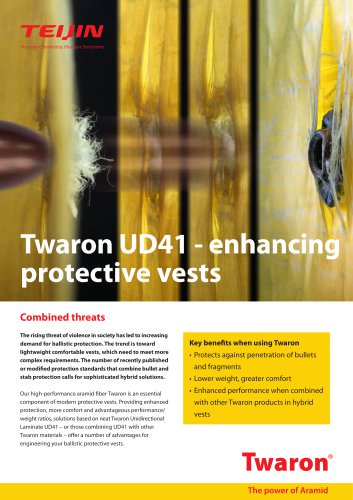 UD41
UD412 Pages
 LFT SB1 plus
2 Pages
 Let?s go deeper
2 Pages
 Creating a safer world
2 Pages
 OTR
OTR2 Pages
 Special Paper
2 Pages
 Gaskets
2 Pages
 Ropes Cables
2 Pages
 Heat Protection
2 Pages
 Cut Protection
2 Pages
 Conveyor Belts
2 Pages
 Leaflet Marine
2 Pages
 Twaron Black
2 Pages
 Ballistics Material Handbook1
11 Pages
 Twaron Product Brochure
7 Pages
 Teijin Aramid leaflet Tires
2 Pages
 Teijin Aramid Corporate Brochure
23 Pages