- Catalogs
- TEIJIN ARAMID
- Teijin Aramid leaflet Tires


Teijin Aramid leaflet Tires
Teijin Aramid leaflet Tires
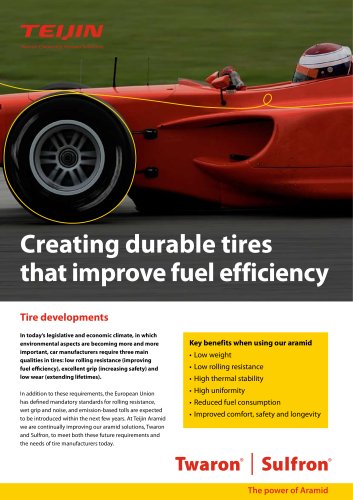
In the current legislative and economic environment, car manufacturers demand tires with low rolling resistance for improved fuel efficiency, excellent grip for safety, and low wear for extended lifetimes. The European Union has set mandatory standards for rolling resistance, wet grip, and noise, with emission-based tolls anticipated soon. Teijin Aramid is enhancing its aramid solutions, Twaron and Sulfron, to meet these requirements.
Key Benefits of Aramid
- Low weight
- Low rolling resistance
- High thermal stability
- High uniformity
- Reduced fuel consumption
- Improved comfort, safety, and longevity
Sulfron: Reducing Heat Generation
Sulfron addresses the issue of heat generation due to tire deformation by reducing frictional energy in rubber compounds. Adding 1 kg of Sulfron to 180 kg of rubber can reduce rolling resistance by 25% while maintaining traction and improving wear characteristics.
Twaron: Reinforcing Tire Structures
Twaron is used to reduce tire weight while enhancing safety and longevity. Initially a niche technology for racing tires, it is now widely used in mainstream passenger car tires. Twaron is superior to polyamide in the cap ply, belt, and carcass, and it stiffens sidewalls. It can replace steel cord in truck tires, reducing weight by 3 kg, which contributes to lower fuel consumption.
Physical Benefits
In motorsports, aramid offers durability and excellent 'cut belt' properties. In trucks, it results in lighter, longer-lasting tires. Aircraft tires benefit from reduced damage risk and greater resistance to compressive loads.
Disclaimer
The technical data reflects the best knowledge at the time of publication and is subject to change based on new developments.
Catalog excerpts
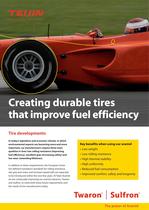
Creating durable tires that improve fuel efficiency Tire developments In today’s legislative and economic climate, in which environmental aspects are becoming more and more important, car manufacturers require three main qualities in tires: low rolling resistance (improving fuel efficiency), excellent grip (increasing safety) and low wear (extending lifetimes). In addition to these requirements, the European Union has defined mandatory standards for rolling resistance, wet grip and noise, and emission-based tolls are expected to be introduced within the next few years. At Teijin Aramid we are continually improving our aramid solutions, Twaron and Sulfron, to meet both these future requirements and the needs of tire manufacturers today. Key benefits when using our aramid • Low weight • Low rolling resistance • High thermal stability • High uniformity • Reduced fuel consumption • Improved comfort, safety and longevity
Open the catalog to page 1
In diggers and agricultural tractors there is better punch resistance. In bicycle tires a foldable bead becomes possible, there’s enhanced protection against punctures and better cut, chip and chunk resistance. Sulfron: reducing heat generation When a vehicle is being driven, the shape of its tires gets deformed and, due to visco-elastic properties, heat is generated. Tire researchers have been trying to solve this problem for many years. Sulfron is now seen as the solution by rubber compounders and tire manufacturers. We discovered a way to reduce the frictional energy in rubber compounds and,...
Open the catalog to page 2All TEIJIN ARAMID catalogs and technical brochures
 Teijinconex®
36 Pages
 Twaron®
40 Pages
Archived catalogs
 Sulfron in tires
2 Pages
 Enhance your PPE with Twaron
2 Pages
 UD41
UD412 Pages
 LFT SB1 plus
2 Pages
 Let?s go deeper
2 Pages
 Creating a safer world
2 Pages
 OTR
OTR2 Pages
 Special Paper
2 Pages
 Gaskets
2 Pages
 Ropes Cables
2 Pages
 Twaron Tape
2 Pages
 Heat Protection
2 Pages
 Cut Protection
2 Pages
 Conveyor Belts
2 Pages
 Leaflet Marine
2 Pages
 Twaron Black
2 Pages
 Ballistics Material Handbook1
11 Pages
 Twaron Product Brochure
7 Pages
 Teijin Aramid Corporate Brochure
23 Pages