- Catalogs
- TEIJIN ARAMID
- Sulfron in tires


Sulfron in tires

Sulfron in tires
Sulfron is a modified aramid-based rubber ingredient designed to enhance the performance of tires by reducing hysteresis, improving anti-puncture and abrasion resistance, and lowering rolling resistance. This results in more durable tires that consume less fuel without compromising performance, aligning with upcoming European Union standards for rolling resistance, wet grip, and noise.
- Reduced frictional energy and hysteresis
- Lower heat build-up and rolling resistance
- Improved cut, chip, and chunk resistance
- Enhanced durability
- Up to 25% reduction in rolling resistance
- Significant improvement in heat build-up and blowout times
- Improved mileage
For optimal interaction between Sulfron and carbon black fillers, Sulfron should be added with or just after the fillers during the first stage of mixing at 150-165 ºC for at least 1½ minutes.
Sulfron 3001 enhances tread lifespan and reduces fuel consumption, offering significant environmental and economic benefits. The life cycle savings are 100 times the cost of Sulfron, with a positive environmental impact 70 times greater than the impact of its application.
Sulfron, based on modified granules of Twaron, improves rubber compound hysteresis, leading to lower rolling resistance and fuel savings while maintaining performance.
- Truck and bus tires
- Off-road vehicles and agricultural tractors
- Tread (base and cap) for reduced rolling resistance
- Aircraft tires
- Belt skim on top of steel cord
- Motorcycle and bicycle tires
The technical data reflects the best knowledge at the time of publication and is subject to change.
Catalog excerpts
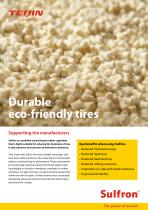
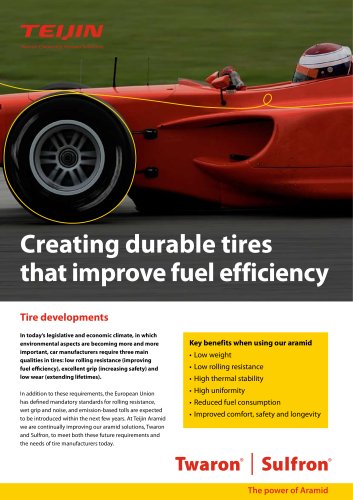
Durable eco-friendly tires Supporting tire manufacturers Sulfron is a modified aramid-based rubber ingredient that is highly suitable for reducing the hysteresis of tires. It also improves anti-puncture and abrasion resistance. Tires made with Sulfron are more durable, last longer, and have lower rolling resistance, thus reducing fuel consumption without compromising on performance. These requirements are increasingly important given that the European Union has pledged to introduce mandatory standards for rolling resistance, wet grip and noise, as well as emission-based tolls within the next few years. At Teijin Aramid we’re continually developing advanced solutions that will meet both today’s and tomorrow’s needs. Key benefits when using Sulfron • Reduced frictional energy • Reduced hysteresis • Reduced heat build-up • Reduced rolling resistance • Improved cut, chip and chunk resistance • Improved durability
Open the catalog to page 1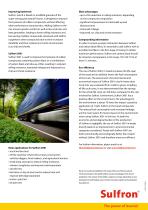
Sulfron 3001 Sulfron 3001 is used to improve the hysteresis of rubber compounds containing carbon black or a combination of carbon black and silica as a filler, resulting in reduced rolling resistance, improved mileage and improved cut, chip and chunk resistance. Main applications for Sulfron 3001 • ruck and bus tires t • ff the road four-wheel-drive, heavy construction o vehicles (diggers, front loaders), and agricultural tractors • read (base and cap) to reduce rolling resistance, t enhance toughness and improve tread separation • ircraft tires a • elt skim on top of steel cord to reduce heat...
Open the catalog to page 2All TEIJIN ARAMID catalogs and technical brochures
 Teijinconex®
36 Pages
 Twaron®
40 Pages
Archived catalogs
 Enhance your PPE with Twaron
2 Pages
 UD41
UD412 Pages
 LFT SB1 plus
2 Pages
 Let?s go deeper
2 Pages
 Creating a safer world
2 Pages
 OTR
OTR2 Pages
 Special Paper
2 Pages
 Gaskets
2 Pages
 Ropes Cables
2 Pages
 Twaron Tape
2 Pages
 Heat Protection
2 Pages
 Cut Protection
2 Pages
 Conveyor Belts
2 Pages
 Leaflet Marine
2 Pages
 Twaron Black
2 Pages
 Ballistics Material Handbook1
11 Pages
 Twaron Product Brochure
7 Pages
 Teijin Aramid leaflet Tires
2 Pages
 Teijin Aramid Corporate Brochure
23 Pages