- Catalogs
- TEIJIN ARAMID
- Leaflet Marine


Leaflet Marine

Leaflet Marine
The document discusses the increasing demand for strength and safety in the marine industry, driven by the trend towards larger and faster motorboats and sailing yachts. It highlights the role of Teijin Aramid's high-performance fiber, Twaron, in meeting these demands by providing structural integrity and reducing vibration and noise.
- Excellent impact resistance
- Superior performance-to-weight ratio
- Effective vibration and sound-dampening properties
- High modulus and tensile strength
- High dimensional stability
The document describes a revolution in high-tech sail-making, emphasizing the need for durable, light, strong, and stretch-resistant sails. Twaron-reinforced laminated sails offer strength, stiffness, and dimensional stability, enabling racing yachts to compete at high levels. Teijin Aramid has developed Twaron Black, a high-modulus black aramid yarn, and Technora Black, known for its UV-resistant properties, used in sail reinforcement.
Twaron is widely used in composites alongside carbon and glass fiber. It is particularly valuable in high-performance applications where weight reduction is crucial. Twaron-based reinforcement in hulls maintains structural integrity during collisions and reduces vibrations and noise.
Twaron is twice as strong as glass fiber and half as heavy, with a substantially higher modulus. It is compatible with various resins and used in different reinforcement types, including unidirectional, multiaxial, and woven fabrics.
Beyond racing and motorboats, Twaron is used in building canoes, kayaks, catamarans, fast rowing boats, fishing boats, and ferries.
The document concludes with a disclaimer about the liability and the potential for changes in technical data based on new developments.
Catalog excerpts
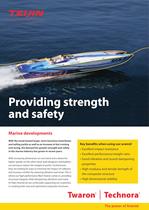
Providing strength and safety Marine developments With the trend toward larger, more luxurious motorboats and sailing yachts as well as an increase in fast cruising and racing, the demand for greater strength and safety in the marine industry has grown in recent years. With increasing dimensions on one hand and a desire for higher speeds on the other hand, boat designers and builders are aiming to reduce the weight of yachts. Furthermore, they are looking for ways to minimize the impact of collisions and increase comfort by reducing vibration and noise. This is where our high-performance fiber Twaron comes in, providing structural integrity while dampening vibrations and noise. At Teijin Aramid we are continually supporting our customers in creating both new and optimized composite structures. Key benefits when using our aramid • Excellent impact resistance • Excellent performance/weight ratio • ood vibration and sound-dampening G properties • igh modulus and tensile strength of H the composite structure • High dimensional stability
Open the catalog to page 1
Twaron: a sea-worthy fiber Our high-performance aramid fiber Twaron is widely used in composites, alongside carbon and glass fiber. Boat builders and designers use reinforcements based on one or more of these fibers. Whereas fiberglass is a cost-effective solution, carbon and aramid are particularly valuable in high-performance applications, especially where weight reduction is an important factor. In addition, applying Twaron-based reinforcement in hulls is a prerequisite for maintaining the structural integrity of hulls in case of collision. It also reduces vibrations and dampens the sound...
Open the catalog to page 2All TEIJIN ARAMID catalogs and technical brochures
 Teijinconex®
36 Pages
 Twaron®
40 Pages
Archived catalogs
 Sulfron in tires
2 Pages
 Enhance your PPE with Twaron
2 Pages
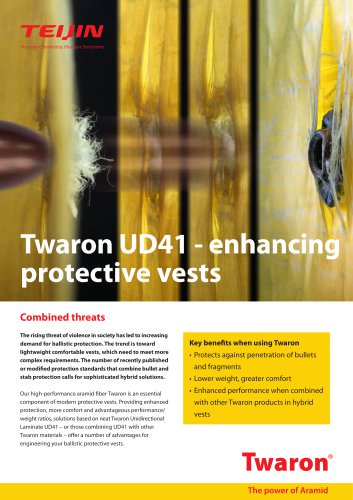 UD41
UD412 Pages
 LFT SB1 plus
2 Pages
 Let?s go deeper
2 Pages
 Creating a safer world
2 Pages
 OTR
OTR2 Pages
 Special Paper
2 Pages
 Gaskets
2 Pages
 Ropes Cables
2 Pages
 Twaron Tape
2 Pages
 Heat Protection
2 Pages
 Cut Protection
2 Pages
 Conveyor Belts
2 Pages
 Twaron Black
2 Pages
 Ballistics Material Handbook1
11 Pages
 Twaron Product Brochure
7 Pages
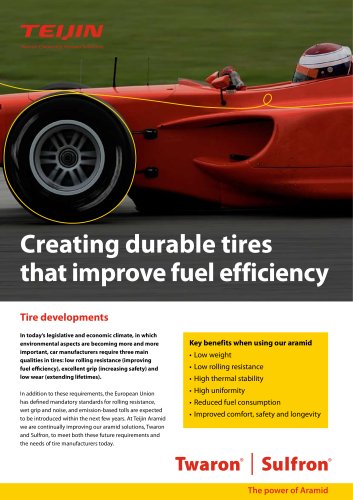 Teijin Aramid leaflet Tires
2 Pages
 Teijin Aramid Corporate Brochure
23 Pages