

- Products
- Catalogs
- News & Trends
- Exhibitions
Balancing valves catalogue

Balancing valves catalogue
This document provides comprehensive technical specifications and guidelines for the use of balancing valves, specifically pressure independent control valves, in heating and cooling systems. It covers models such as RC2106, RC4240, and RC7240N, detailing their applications, functionalities, and installation procedures.
The Tecofi balancing valves are designed for precise regulation in heating, sanitary, and cooling circuits. The RC2106 model features an oblique seat for enhanced adjustment precision and reduced resistance, resulting in minimal head losses and higher flow rates. The valves have a maximum working pressure of 20 bar and a temperature range from -10°C to +90°C, with test pressures of 30 bar for the body and 22 bar for the seat.
Balancing valves ensure correct flow distribution in hydraulic networks, enhancing comfort, energy savings, and control. Properly balanced systems can lead to energy savings of 10-20% or more by preventing overheating or underheating in different building areas.
Instructions are provided for installing balancing valves on supply and return lines, with a recommended flow direction indicated on the valve body. The RC2106 model includes a digital wheel for precise adjustment and test points for measuring head losses and flow rates. The valve requires four complete turns to move from closed to fully open, with a factory preset at position 4.0.
The balancing process complies with the RT2000 Thermal Regulation, which mandates energy-saving measures in thermal installations. The valves meet standards such as EN 12266-1, DIN 3230, BS 5154, and ISO 5208.
The valve is composed of materials like brass, ABS, PTFE, and EPDM, with detailed descriptions of each component's material and function.
Instructions for selecting the nominal diameter (DN) based on required flow are provided, using diagrams and calculation formulas for Kv and Z coefficients. The guide explains how to calculate head losses and the importance of the Zeta ratio.
Detailed charts for pressure loss and Kv values for different DN sizes are included, providing essential data for system design and valve selection.
This section includes detailed balancing charts for various DN sizes, illustrating the Kv values at different positions to determine the pressure drop across the valve for specific flow rates.
The RCC balancing measurer is introduced as a tool for controlling flow rates and balancing heating and cooling systems, recording pressure and flow data viewable on its display.
Pressure-independent control valves (PICV) are described, designed for HVAC systems to maintain a constant flow rate despite differential pressure variations. They can be manually or automatically controlled, with options for on/off or proportional control using a thermo-electric actuator.
The PICV is designed for HVAC installations, maintaining a constant flow rate regardless of differential pressure variations. It features a proportional actuator controlled by a regulator, with control signals of 0(2) - 10V or 0(4) - 20mA and an operating voltage of 24 VAC 50/60Hz. The valves have a caliber range of DN50-DN250, a flow rate range of 13-240m3/h, and are made from ductile iron QT450-10 with stainless steel stems and PTFE sealing rings.
Catalog excerpts

Robinets d’équilibrage - Vannes de régulation automatiques BALANCING VALVES PRESSURE INDEPENDENT CONTROL VALV
Open the catalog to page 1
Index Robinet d'équilibrage RC2106 Balancing Valve RC2106 Robinet d'équilibrage RC4240 Balancing Valve RC4240 Appareil de mesure RCC Balancing measurer Robinet RC7240N Balancing valve RC7240N (p. 19-24) Vanne de régulation DN15-25 Pressure control valve DN15-25 Vanne de régulation DN25-50 Pressure control valve DN25-50 Vanne de régulation DN50-250 Pressure control valve DN50-250 (p.
Open the catalog to page 2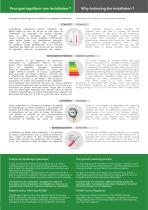
Pourquoi équilibrer une installation ? Avantages de l’équilibrage d’une installation de chauffage et climatisation. Advantages of the heating and cooling system balancing. L’équilibrage hydraulique permet d’apporter les débits requis et donc de fournir en tout point de l’installation les quantités de chaleur désirées. Dans un même immeuble, par exemple, un certain nombre de locaux atteignent difficilement, voire parfois jamais, les températures prescrites, alors que d’autres locaux sont «surchauffés». Ce problème résulte généralement d’une mauvaise répartition des débits qui ne permet pas aux...
Open the catalog to page 3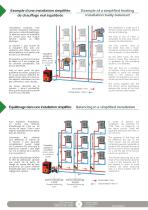
Exemple d’une installation simplifiée de chauffage mal équilibrée Example of a simplified heating installation badly balanced L’installation comporte trois colonnes montantes identiques, sans aucun robinet d’équilibrage. Le débit en sortie de chaudière, est calculé pour que chaque colonne reçoive un débit identique. The installation is made up of 3 identical rising columns, without any tap of balancing. La colonne 1, plus proche de la chaudière donc avec une résistance plus faible, reçoit un débit supérieur à son besoin, elle est donc sur-alimenteé. The first column, close to the boiler thus...
Open the catalog to page 4
Robinet d’équilibrage taraudé RC2106 Threaded balancing valve RC2106 CARACTÉRISTIQUES GÉNÉRALES GENERAL CHARACTERISTICS 1. Indicateur de sens Tous les robinets d’équilibrage Tecofi se montent indifféremment sur les canalisations départ ou retour, et dans toutes les positions. Cela autorise une circulation du fluide dans les deux sens, mais il est conseillé de respecter le sens de la flèche indiquée sur le corps du robinet. 1. Direction indicator Every Tecofi balancing valves can be installed either on back or start canalizations, and in every positions. It authorizes a fluid circulation in both...
Open the catalog to page 5
Robinet d’équilibrage taraudé RC2106 APPLICATION Les robinets d’équilibrage permettent de réaliser des réglages précis sur les circuits de chauffage, de sanitaire et de climatisation. La gamme des robinets d’équilibrage taraudés RC 2106 donne la possibilité à l’installateur de mesurer les pertes de charge et de contôler les débits de l’installation par deux prises de pression instantanées. Threaded balancing valve RC2106 APPLICATION The balancing valves are designed to realize exact regulations on heating and cooling systems. The entire threaded balancing valves RC 2106 range allows the fitter...
Open the catalog to page 6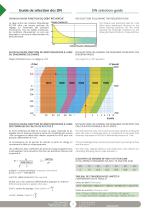
CHOIX DU DN EN FONCTION DU DÉBIT RECHERCHÉ DN SELECTION FOLLOWING THE REQUIRED FLOW Le siège incliné des robinets d’équilibrage RC2106 offre une bonne précision de réglage sur l’ensemble des positions d’ouvertures. Pour les faibles ouvertures, les conditions d’écoulement ne sont pas favorables à une bonne détermination du débit demandé. The oblique seat balancing valve RC 2106 offers good adjustment accuracy on the whole opening positions. For the small opening, the discharge conditions do not allow good determination of required flow. CHOIX DU DN EN FONCTION DU DÉBIT RECHERCHÉ À L’AIDE DU DIAGRAMME...
Open the catalog to page 7
Réglage des robinets d’équilibrage RC2106 Threaded Balancing valves RC2106 adjustment EXEMPLE D’UNE INSTALLATION DE CHAUFFAGE SIMPLIFIÉE EXAMPLE OF A SIMPLIFIED HEATING SYSTEM 1 Données techniques de l’installation / Installation technical datas DN (pré-déterminé) des robinets RC1, RC2 et RC3 RC1, RC2 and RC3 valves DN (predefined) Débit théorique nécessaire dans chaque colonne Necessary theoretic flow in each column Pression disponible à la pompe Available pressure in the pump Débit constant en sortie de pompe Constant flow in pump outlet Résistances calculées de chaque colonne Calculated resistance...
Open the catalog to page 8
Abaques de pertes de charge du robinet RC 2106 Balancing charts of threaded balancing valve RC 2106 1 TECOFI - Bureaux 8 et 9 83 rue Marcel Mérieux - CS 92013 69969 Corbas Cedex - FRANCE
Open the catalog to page 9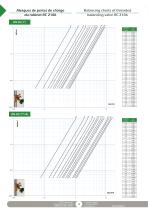
Abaques de pertes de charge du robinet RC 2106 Balancing charts of threaded balancing valve RC 2106 1 TECOFI - Bureaux 8 et 9 83 rue Marcel Mérieux - CS 92013 69969 Corbas Cedex - FRANCE
Open the catalog to page 10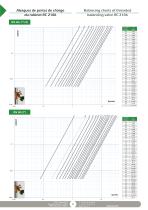
Abaques de pertes de charge du robinet RC 2106 Balancing charts of threaded balancing valve RC 2106 1 TECOFI - Bureaux 8 et 9 83 rue Marcel Mérieux - CS 92013 69969 Corbas Cedex - FRANCE
Open the catalog to page 11
Notice d’instructions Instructions notice INDICATEUR VISUEL D’OUVERTURE DE VANNE ET RÉGLAGE VISUAL INDICATOR OF VALVE OPENING AND ADJUSTING BLOCAGE & DÉBLOCAGE DE LA POSITION MAXIMUM D’OUVERTURE LOCKING & UNLOCKING OF THE MAXIMUM OPENING POSITION Attention! Ce robinet n’est pas prévu pour la vapeur, les liquides contenant des solides en suspension ou des liquides dangereux. Les vannes sont équipées de 2 prises de pression. Les vannes doivent rester propres et sèches avant l’installation. La flèche sur le robinet doit être dans la même direction que l’écoulement du fluide dans la tuyauterie. La...
Open the catalog to page 12All TECOFI catalogs and technical brochures
 Volume 2
157 Pages
 Compensateurs
12 Pages
 Robinetterie pour Eau
18 Pages
 Vannes à Opercule Caoutchouc
5 Pages
 Robinets à Membrane
13 Pages
 Clapets-Filtres
33 Pages
 Vannes à Guillotine
56 Pages
 Vannes papillon
47 Pages
 General Presentation
24 Pages
 Products catalogue
168 Pages