
- Catalogs
- Tecnopenta SRL
- G1-TDR

G1-TDR
1 /2Pages
G1-TDR
1 /2Pages
Catalog excerpts
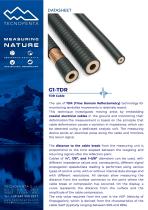
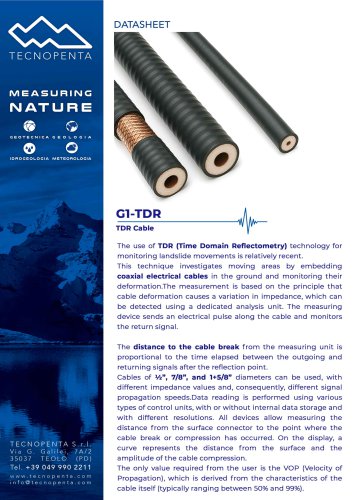
The use of TDR (Time Domain Reflectometry) technology for monitoring landslide movements is relatively recent. This technique investigates moving areas by embedding coaxial electrical cables in the ground and monitoring their deformation.The measurement is based on the principle that cable deformation causes a variation in impedance, which can be detected using a dedicated analysis unit. The measuring device sends an electrical pulse along the cable and monitors the return signal. The distance to the cable break from the measuring unit is proportional to the time elapsed between the outgoing and returning signals after the reflection point. TECNOPENTA S.r.l. Via G. Galilei, 7A/2 35037 TEOLO (PD) Cables of V*”, 7/8”, and 1+5/8” diameters can be used, with different impedance values and, consequently, different signal propagation speeds.Data reading is performed using various types of control units, with or without internal data storage and with different resolutions. All devices allow measuring the distance from the surface connector to the point where the cable break or compression has occurred. On the display, a curve represents the distance from the surface and the amplitude of the cable compression. The only value required from the user is the VOP (Velocity of Propagation), which is derived from the characteristics of the cable itself (typically ranging between 50% and 99%).
Open the catalog to page 1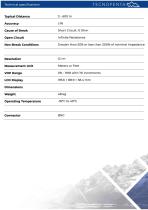
Technical specifications TECNOPENTA Typical Distance Open Circuit Infinite Resistance Non-Break Conditions Greater than 50% or less than 200% of nominal impedance Measurement Unit Operating Temperature
Open the catalog to page 2All Tecnopenta SRL catalogs and technical brochures
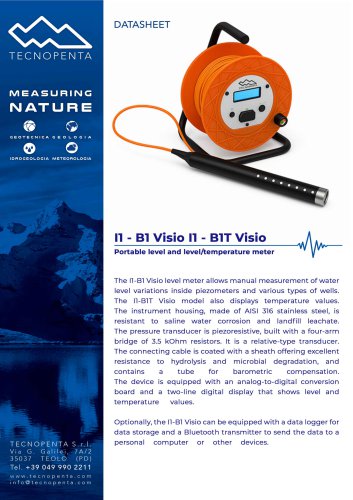 I1-B1 VISIO I1 - B1T VISIO
3 Pages
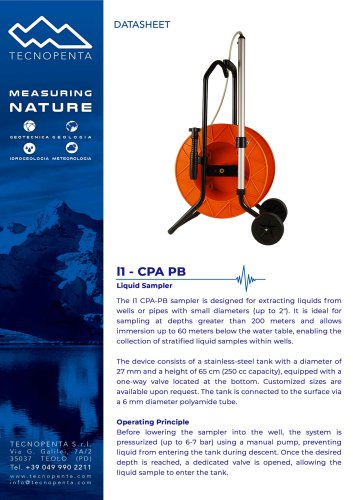 I1-CPA PB
2 Pages
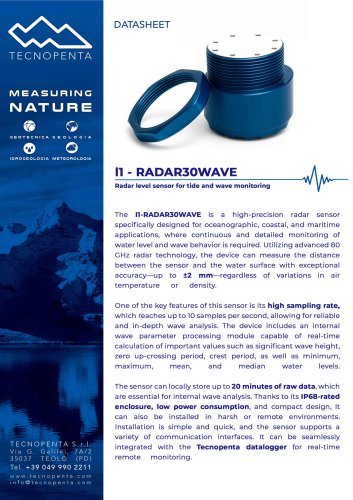 I1-Radar30Wave
2 Pages
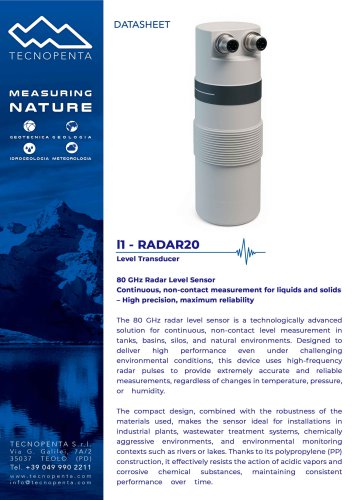 I1-Radar20
2 Pages
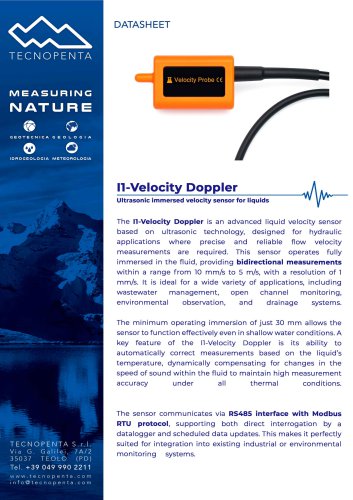 I1-Velocity_Doppler
2 Pages
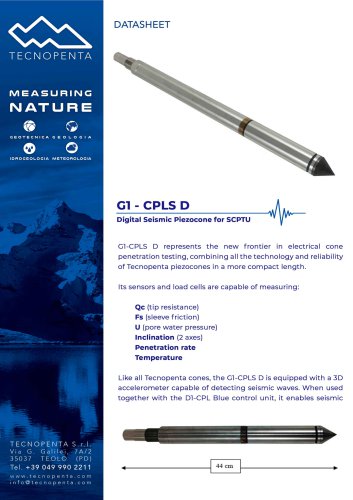 G1-CPLS D
6 Pages
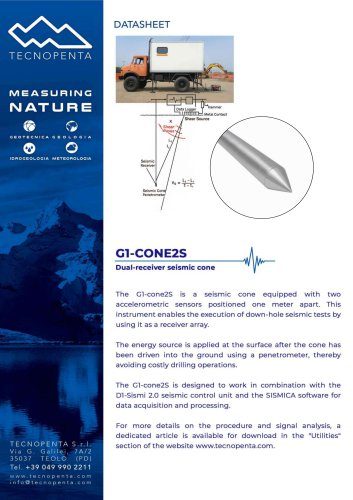 G1-CONE2S
2 Pages
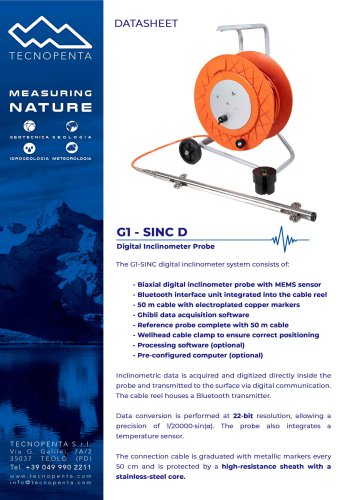 G1-SINC-D
4 Pages
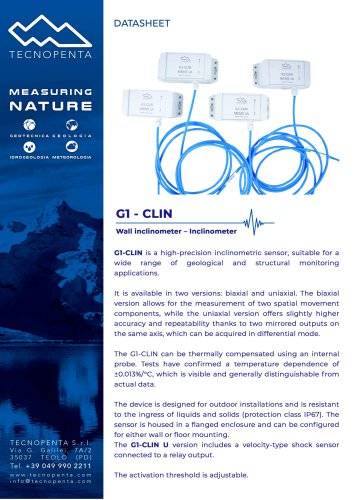 G1-CLIN
2 Pages
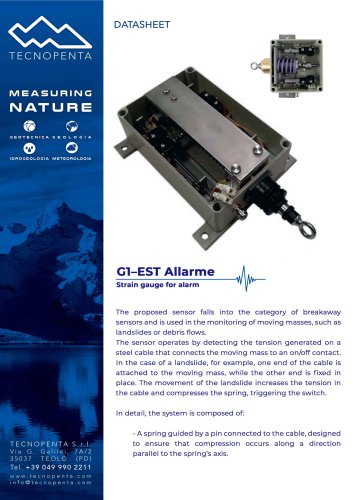 G1-EST ALLARME
2 Pages
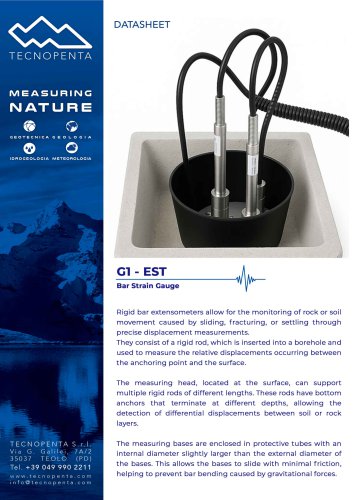 G1-EST
2 Pages
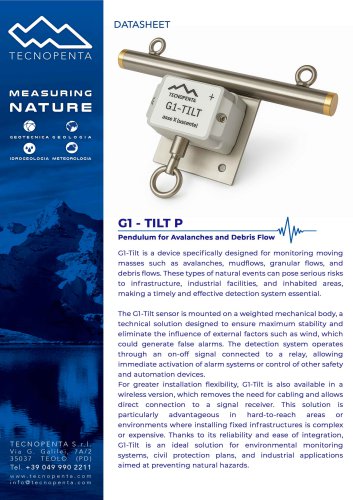 G1-TILT_P
2 Pages
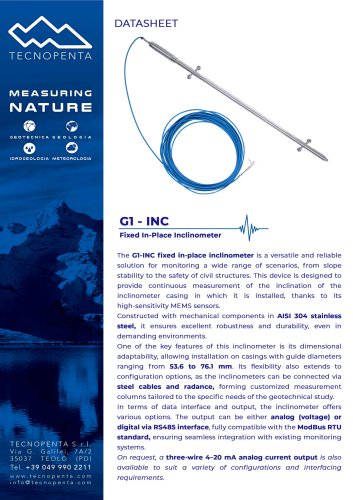 G1-INC
2 Pages
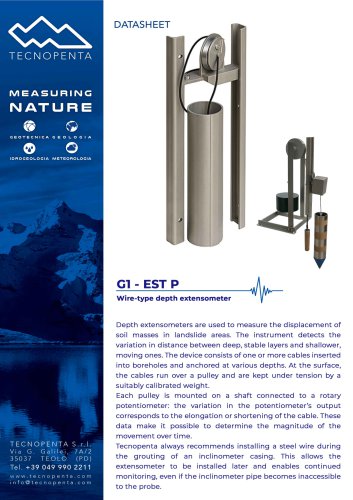 G1-EST P
2 Pages
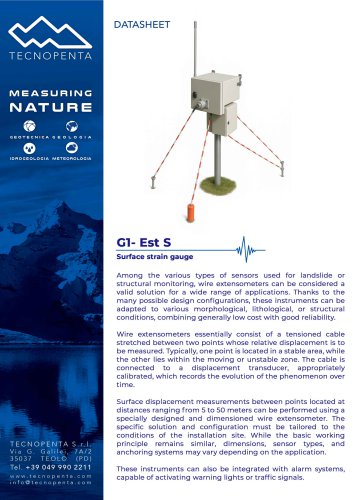 G1-EST S
4 Pages
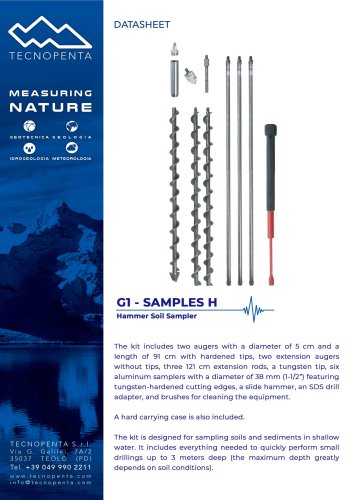 G1 - SAMPLES H
1 Page
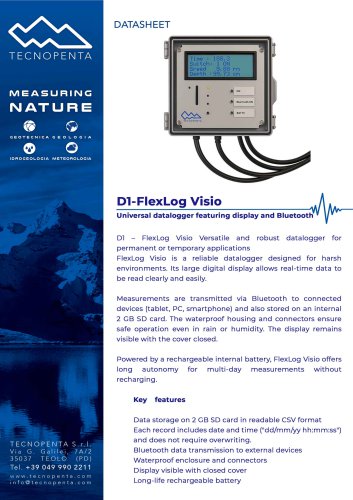 D1-FlexLog Visio
2 Pages
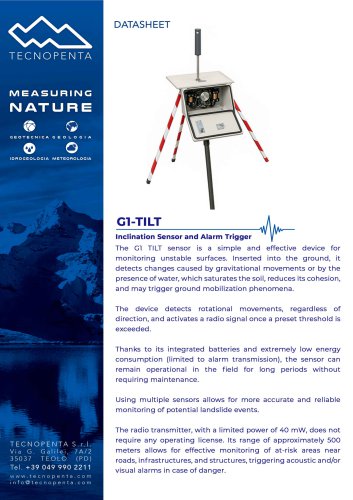 G1-TILT
2 Pages
- Pump
- Industrial pump
- Pump with electric motor
- Seawater pump
- Centrifugal pump
- Piping
- Self-priming pump
- Flowmeter
- Stainless steel pump
- Volume flow monitor
- Liquid flow monitor
- Force sensor
- Submersible pump
- Data logger
- Tension/compression force transducer
- Steel load cell
- Acceleration sensor
- Strain gauge force sensor
- Filter with cartridge
- Waterproof flow meter