
- Catalogs
- Tecnopenta SRL
- G1-EST P

G1-EST P
1 /2Pages
G1-EST P
1 /2Pages
Catalog excerpts
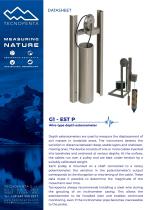
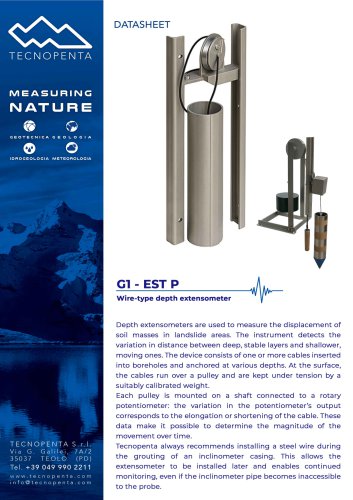
Cl - EST P_ Wire-type depth extensometer Depth extensometers are used to measure the displacement of soil masses in landslide areas. The instrument detects the variation in distance between deep, stable layers and shallower, moving ones. The device consists of one or more cables inserted into boreholes and anchored at various depths. At the surface, the cables run over a pulley and are kept under tension by a suitably calibrated weight. Each pulley is mounted on a shaft connected to a rotary potentiometer: the variation in the potentiometer's output corresponds to the elongation or shortening of the cable. These data make it possible to determine the magnitude of the movement over time. TECNOPENTA S.r.l. Via G. Galilei, 7A/2 35037 TEOLO (PD) Tecnopenta always recommends installing a steel wire during the grouting of an inclinometer casing. This allows the extensometer to be installed later and enables continued monitoring, even if the inclinometer pipe becomes inaccessible to the probe.
Open the catalog to page 1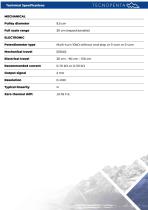
Technical Specifications TECNOPENTA MECHANICAL Pulley diameter Full scale range Potentiometer type Multi-turn lOkD. without end stop or 3-turn or 5-turn Mechanical travel Electrical travel Recommended current Output signal Typical linearity Zero thermal drift
Open the catalog to page 2All Tecnopenta SRL catalogs and technical brochures
 I1-B1 VISIO I1 - B1T VISIO
3 Pages
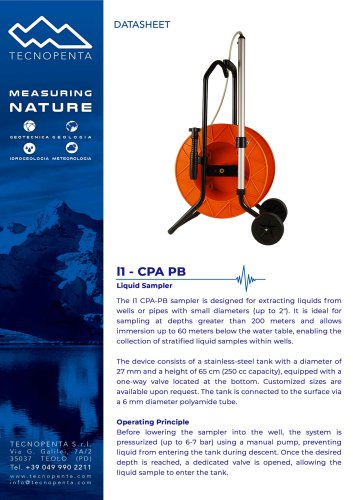 I1-CPA PB
2 Pages
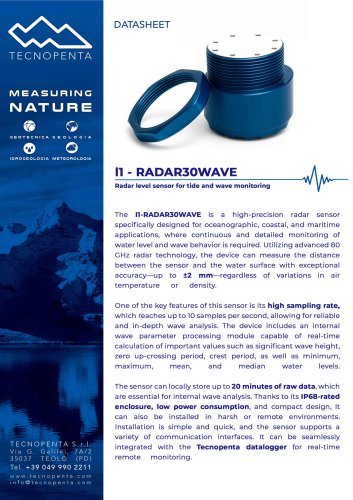 I1-Radar30Wave
2 Pages
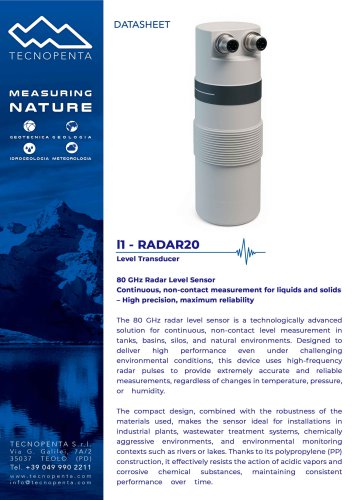 I1-Radar20
2 Pages
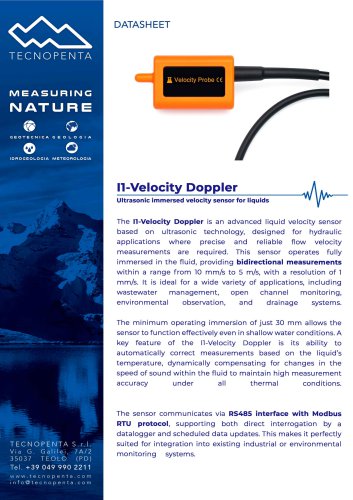 I1-Velocity_Doppler
2 Pages
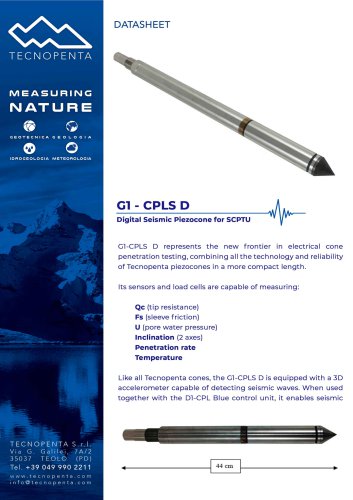 G1-CPLS D
6 Pages
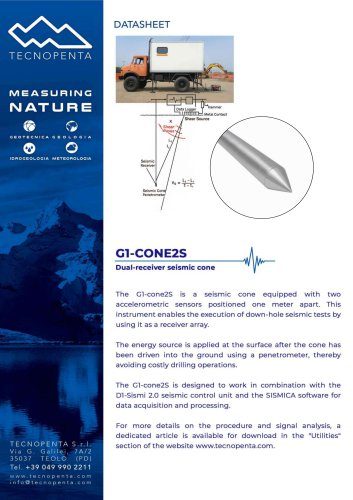 G1-CONE2S
2 Pages
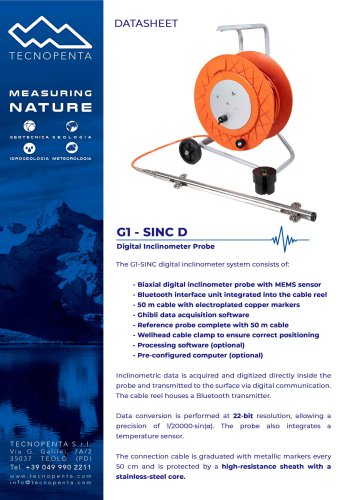 G1-SINC-D
4 Pages
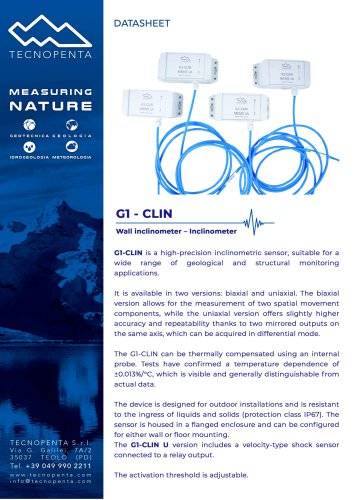 G1-CLIN
2 Pages
 G1-EST ALLARME
2 Pages
 G1-EST
2 Pages
 G1-TILT_P
2 Pages
 G1-INC
2 Pages
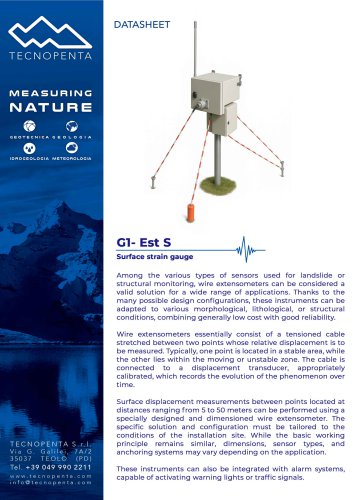 G1-EST S
4 Pages
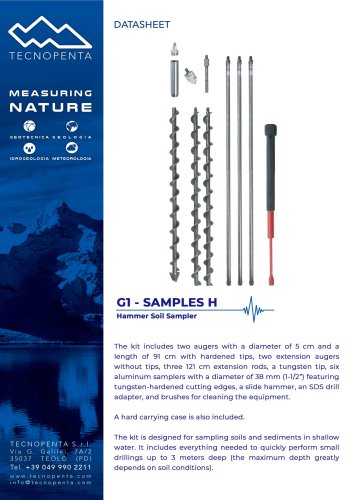 G1 - SAMPLES H
1 Page
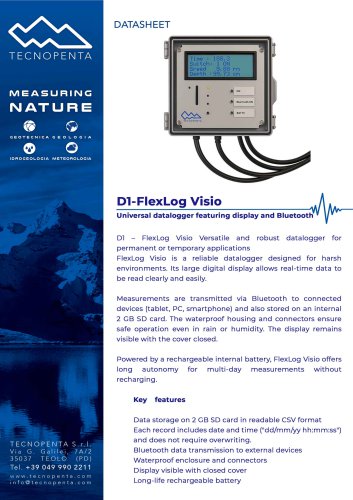 D1-FlexLog Visio
2 Pages
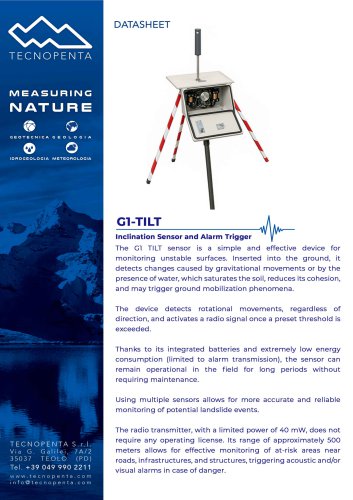 G1-TILT
2 Pages
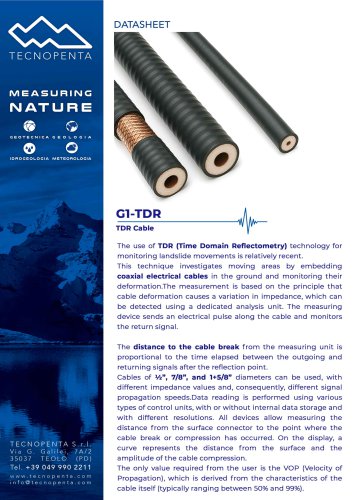 G1-TDR
2 Pages
- Pump
- Industrial pump
- Pump with electric motor
- Seawater pump
- Centrifugal pump
- Piping
- Self-priming pump
- Flowmeter
- Stainless steel pump
- Volume flow monitor
- Liquid flow monitor
- Force sensor
- Submersible pump
- Data logger
- Tension/compression force transducer
- Steel load cell
- Acceleration sensor
- Strain gauge force sensor
- Filter with cartridge
- Waterproof flow meter