

AR/VR

AR/VR
- Evaluation of Luminance, Chromaticity, and Uniformity for RGBW: This section focuses on assessing the brightness, color accuracy, and consistency of RGBW panels used in AR/VR/MR devices.
- Nine Point Average Value: Measures luminance and chromaticity at nine different points to ensure uniformity.
- Luminance and Chromaticity Non-uniformity: Evaluates the variation in brightness and color across the display.
- Contrast Ratio (CR): Assesses the difference between the brightest and darkest parts of the display.
- Contrast Modulation Transfer Function (CM/MTF): Analyzes the display's ability to reproduce contrast at different spatial frequencies.
- Evaluation of Ghosting: Checks for unwanted image artifacts that can affect visual clarity.
- Focuses on the specific optical and image quality requirements for augmented reality glasses.
- Discusses the challenges and methods for measuring devices that use laser light sources, highlighting the need for spectroradiometers due to the narrowband spectral characteristics of lasers and OLED panels.
- References IEC standards for measurement methods related to optical properties and image quality in AR/VR devices.
- Defines key terms such as PPI, PPD, FOV, IPD, MTF, EP, and EPD, which are crucial for understanding AR/VR device specifications.
- Highlights the limitations of current measurement instruments like XYZ detectors and the necessity for spectroradiometers to accurately measure luminance and chromaticity in devices using laser light.
- Illustrates potential errors in chromaticity measurements due to spectral peak shifts, emphasizing the importance of precise measurement tools.
- Provides contact details for Techno Optis, the company responsible for the document.
Catalog excerpts

AR/VR Evaluation Example 1. Panel Evaluation for Integration into AR/VR/MR Devices 1- 1.Evaluation of luminance, Chromaticity, and Uniformity for RGBW 2- 1.Nine point average value of Luminance(L),chromaticity(u', v’) 2-2.Luminance non-uniformity (NU), Chromaticity non-uniformity ((Au'v')max),Contrast ratio (CR) 2-3.Contrast Modulation Transfer Function (CM/MTF) 4. Evaluation of AR/VR using Laser Light
Open the catalog to page 1
The market for wearable devices, including AR (Augmented Reality), VR (Virtual Reality), and MR (Mixed Reality), is rapidly growing. AR technology overlays digital information onto the real world and VR technology allows users to experience virtual worlds. MR combines virtual and real-world elements by overlaying virtual objects onto the real world up to the device. As the wearable device market continues to expand, it becomes increasingly important to assess the optical properties of HMD(Head Mounted Displays) and AR glasses. Usually, evaluations of flat panel display measures such as luminance,...
Open the catalog to page 2
In addition to evaluating displays, it can also assess the luminance, chromaticity, and uniformity of backlight modules. It can also evaluate the spectral transmittance of goggle lenses and other optical components. To calculate the spectral transmittance of goggle lenses, divide the spectral radiance transmitted through the lens by the spectral radiance of the light source (Fig. 3). During measurement, it is important to maintain a consistent distance between the light source and the spectroradiometer. Additionally, using the 2D spectroradiometer SR-5100 enables the display of spectral transmittance...
Open the catalog to page 3
Fig.7 The four AR/VR display devices. 2D spectroradiometer SR-5100HM micro lens type can be attached additional wide-angle lens that match the field of view each AR/VR device. We measured 2 type of AR/VR devices (Fig7). And (Fig8) indicate gray scale of luminance image of measurement results of SR-5100HM with additional lens. IN addition, Spectroscopic measurement allow to display spectral distribution for the nine measurement points of each AR/VR devices (Fig9). NU, Au' v' and CR are calculated as follows: (Ymax - Yave) Fig.9 Spectral distribution for the nine points ■ 2-3.Contrast Modulation...
Open the catalog to page 4
AR glasses (Fig.12) display images in the user's field of view. To measure parameters such as luminance, instruments with national traceability are necessary. The 2D spectroradiometer SR-5100HM, equipped with national traceability, can measure AR glasses when fitted with a C-mount lens. Using the 2D spectroradiometer SR-5100for spectral measurements enables precise Fig.l 2 Example image of AR grasses measurement of each spot. An example is provided in which white is displayed on AR glasses, and measurements are taken at five points (Fig.l 3). The average values of parameters such as luminance...
Open the catalog to page 5
4. Evaluation of AR/VR using Laser Light Backlight for current LCD using white LED cannot express wide color range. To expand the color range, laser light and OLED are increasingly being used. As a Spectral Peak shift result, the development of devices that utilize lasers as light sources for AR/VR is underway. This has led to changing requirements for measurement Sample-B Sample-C instruments. Due to the narrowband spectral characteristics of lasers and OLED panels, it is difficult to accurately measure them with existing color luminance meters that use XYZ detectors. XYZ detectors have spectral...
Open the catalog to page 6
Example of SR-5100HM + C-mount adapter + Wide lens WxHxDiagonalO Occasionally, there may be deviations. ■ Uniformity (Movement is necessary) Luminance & Chromaticity Uniformity Analyzer Example image of illumination inspection for module manufacturing equipment
Open the catalog to page 7
formerly Topcon Technohouse Corporation 4F, Imas Itabashi Base, 2-4-1, Sakashita, Itabashi-ku, Tokyo 174-0043 JAPAN Phone: +81-3-3558-2666 Fax: +81-3-3558-4661 E-mail: [email protected] techno optis Printed in Japan 2026 05 E6
Open the catalog to page 8All Techno Optis Co., Ltd. catalogs and technical brochures
 Optical measurement
6 Pages
 Next generation
6 Pages
 Automotive
8 Pages
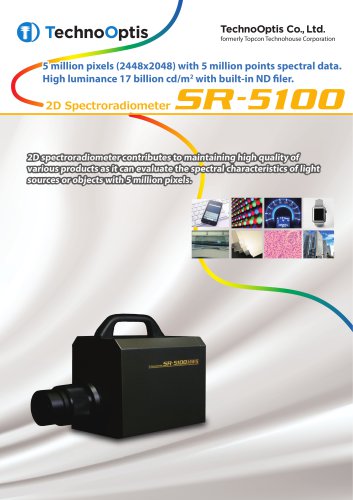 SR-5100
8 Pages
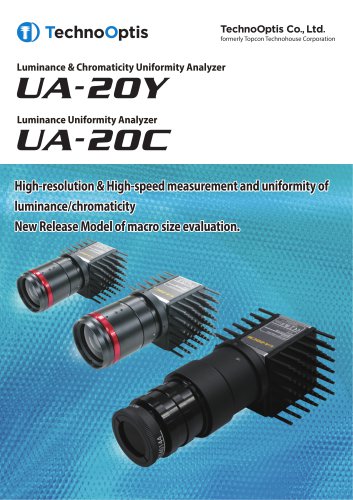 UA-20
UA-206 Pages
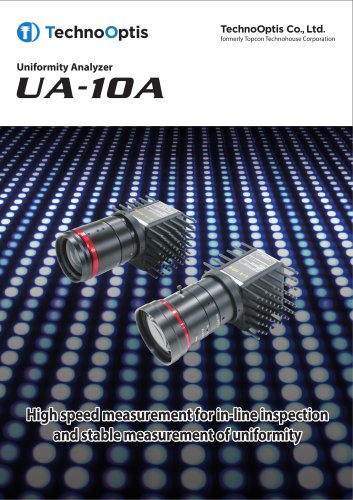 UA-10A
4 Pages
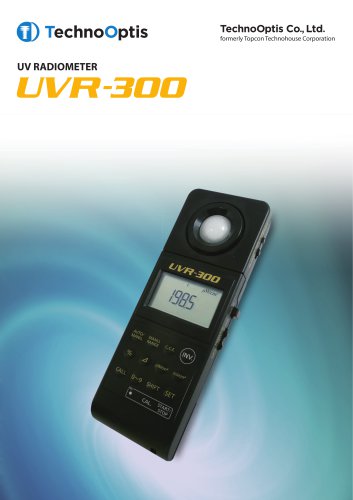 UV Radiometer UVR-300
4 Pages
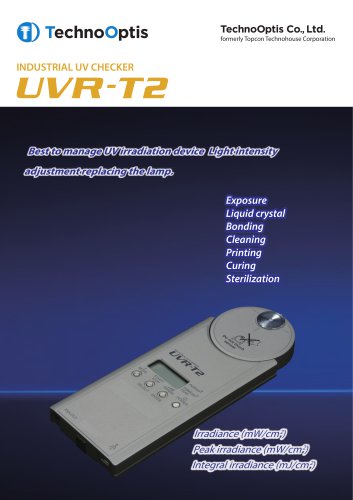 Industrial UV Checker UVR-T2
4 Pages
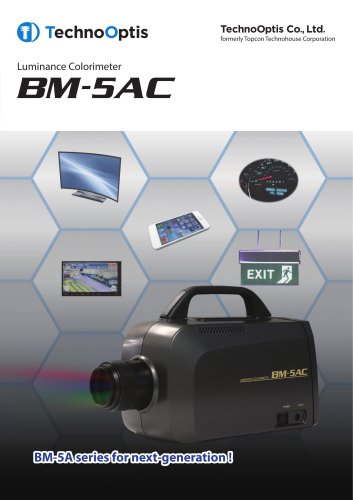 Luminance Colorimeter BM-5AC
4 Pages
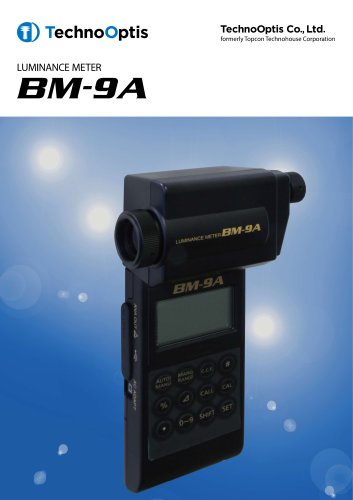 BM-9A
BM-9A4 Pages
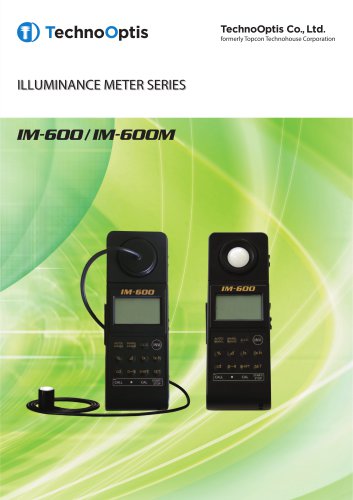 IM-600
4 Pages
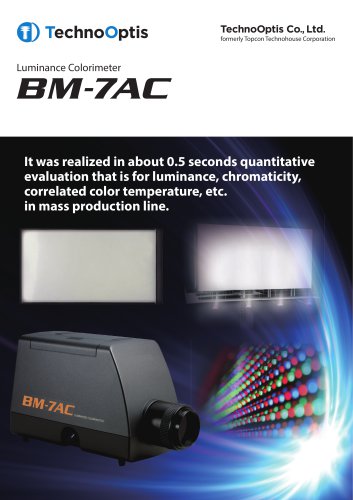 Luminance Colorimeter BM-7AC
4 Pages

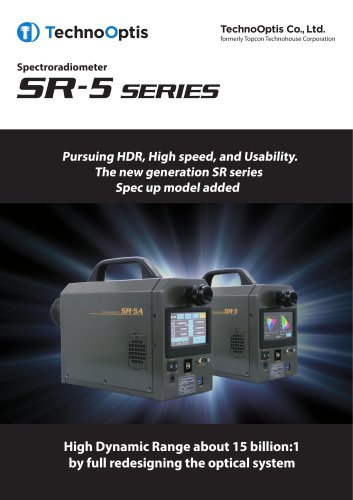
Archived catalogs
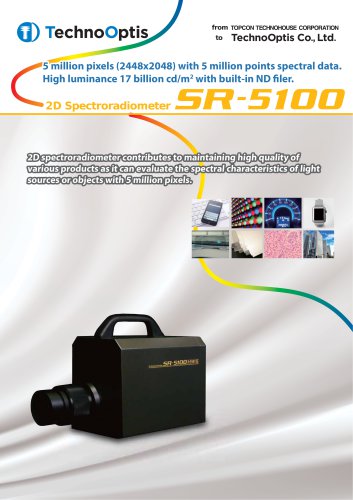 Spectroradiometer SR-5100
8 Pages
- Automation software solution
- Management software solution
- Process software
- Windows software
- Control software
- Measurement software
- Compact analyzer
- Quality control analyzer
- Inspection software
- Calibration software
- Printing software
- Colorimeter
- Photometer
- Imaging software
- Electric software
- Color software
- Inspection analyzer
- Color analysis colorimeter
- Measurement spectroradiometer