
- Catalogs
- Technische Antriebselemente GmbH
- rubber element A - E standard

- Company
- Products
- Catalogs
- News & Trends
- Exhibitions
rubber element A - E standard
1 / 1 PageView full catalog
rubber element A - E standard
Product catalog summary
Specifications:
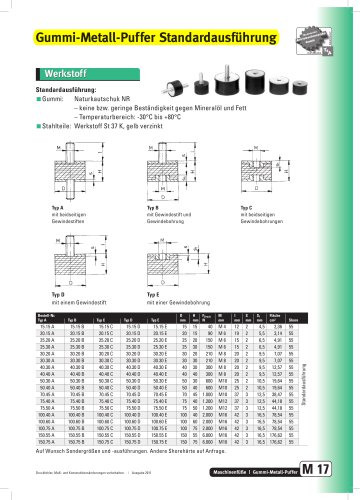
The document provides specifications for rubber-metal buffers, detailing various types (A, B, C, D, E) with dimensions and load capacities. The buffers are available in different sizes, ranging from 15mm to 150mm in diameter, with corresponding load capacities from 40N to 6000N. The standard hardness is 55 Shore.
Material:
The standard material for the rubber component is natural rubber (NR), which has low resistance to mineral oil and grease. The temperature range for use is -30°C to +80°C. The metal parts are made from St 37 K steel, yellow zinc-plated.
Types and Configurations:
- Type A: Both sides with threaded studs.
- Type B: With threaded stud and threaded hole.
- Type C: Both sides with threaded holes.
- Type D: With one threaded stud.
- Type E: With one threaded hole.
Customization:
Special sizes and configurations are available upon request. Different Shore hardness can also be requested.
Key Data from Table:
The table lists various types of buffers with their dimensions (D, H), load capacity (FDruck), thread size (M), and other specifications like area (Fläche) and Shore hardness. For example, a 15mm diameter buffer has a load capacity of 40N and a 2.36 cm² area.
The document provides specifications for rubber-metal buffers, detailing various types (A, B, C, D, E) with dimensions and load capacities. The buffers are available in different sizes, ranging from 15mm to 150mm in diameter, with corresponding load capacities from 40N to 6000N. The standard hardness is 55 Shore.
Material:
The standard material for the rubber component is natural rubber (NR), which has low resistance to mineral oil and grease. The temperature range for use is -30°C to +80°C. The metal parts are made from St 37 K steel, yellow zinc-plated.
Types and Configurations:
- Type A: Both sides with threaded studs.
- Type B: With threaded stud and threaded hole.
- Type C: Both sides with threaded holes.
- Type D: With one threaded stud.
- Type E: With one threaded hole.
Customization:
Special sizes and configurations are available upon request. Different Shore hardness can also be requested.
Key Data from Table:
The table lists various types of buffers with their dimensions (D, H), load capacity (FDruck), thread size (M), and other specifications like area (Fläche) and Shore hardness. For example, a 15mm diameter buffer has a load capacity of 40N and a 2.36 cm² area.
See more
Catalog excerpts
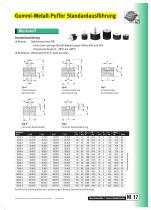
Gummi-Metall-Puffer Standardausführung Werkstoff Standardausführung: Gummi: Naturkautschuk NR – keine bzw. geringe Beständigkeit gegen Mineralöl und Fett – Temperaturbereich: -30°C bis +80°C Stahlteile: Werkstoff St 37 K, gelb verzinkt Auf Wunsch Sondergrößen und -ausführungen. Andere Shorehärte auf Anfrage. Druckfehler, Maß- und Konstruktionsänderungen vorbehalten. | Ausgabe 2011
Open the catalog to page 1All Technische Antriebselemente GmbH catalogs and technical brochures
 Heavy-duty roller guides
19 Pages
 IEC Standard Motors
14 Pages
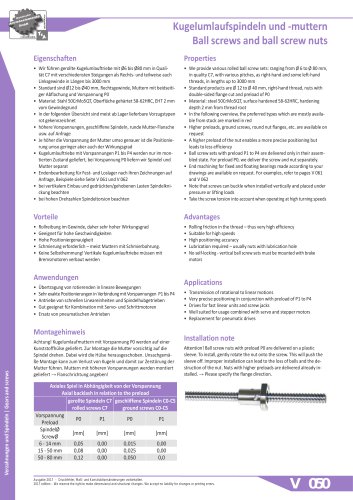 Ball screws and ball screw nuts
11 Pages
 Closed - loop stepper motors
15 Pages
 V 050
V 05011 Pages
 Freewheel, roller type GF
2 Pages
 Efficiency classes for motors
13 Pages
 Mini actuator HG1
4 Pages
 Ball guide systems
9 Pages
 DI-System
3 Pages
 Free Wheels US
2 Pages
 Free Wheels USNU
2 Pages
 Free Wheels UF
2 Pages
 Free Wheel GL...F2
2 Pages
 Free Wheel GL...F4
2 Pages
 Free Wheel GL...F5
2 Pages
 Free Wheels GLPF
2 Pages
 Free Wheels GLG
2 Pages
 Free Wheels GO
2 Pages
 Free Wheels UK
2 Pages
 Free Wheel Cages GM
2 Pages
 Free Wheel Cages GP
2 Pages
 Free Wheel Races GP
2 Pages
 Free Wheels GF
2 Pages
 Free Wheels GV
2 Pages
 Free Wheels GL
2 Pages
 Hubgetriebe HG/AL4
17 Pages



Related Searches
- Electromotor
- Actuator
- Alternating current motor
- Multipole motor
- Electric gearmotor
- Linear actuator
- Asynchronous motor
- Electric actuator
- Coaxial gearhead
- Clamping device
- Three-phase motor
- Precision gearhead
- Servo-motor
- Right angle gearhead
- Nut
- Compact gearhead
- Direct current gear-motor
- 4-pole motor
- 2-pole motor
- Flexible coupling
*Prices are pre-tax. They exclude delivery charges and customs duties and do not include additional charges for installation or activation options. Prices are indicative only and may vary by country, with changes to the cost of raw materials and exchange rates.