
- Catalogs
- TDK Electronics Europe
- Pi Type Ferrite Magnetostrictive Vibrators


- Products
- Catalogs
- News & Trends
- Exhibitions
Pi Type Ferrite Magnetostrictive Vibrators

Pi Type Ferrite Magnetostrictive Vibrators
Magnetostriction involves dimensional changes in ferromagnetic materials when magnetized. TDK's V2X Series uses this to produce ultrasonic waves, offering unique characteristics compared to metal vibrators.
- High electro-mechanical energy conversion efficiency (85-90%).
- Minimal eddy current loss due to high specific resistance.
- No need for DC bias due to ferrite magnet usage.
- Excellent anticorrosive properties, suitable for various solvents.
- Ultrasonic cleaning
- Sonar
- Ultrasonic machining
- Material name
- Ferrite magnetostriction vibrator
- Type and resonant frequency
- Shape classification code
- Temperature dependence of resonant frequency: 17×10-5 1/°C
- Motional impedance: 180 Ω
- Quality factor: 350
- Electro-acoustic efficiency: 90%
- Electro-mechanical coupling factor: 18%
- Maximum input power (water load): 10 W/cm2
- Continuous input power (water load): 3 to 5 W/cm2
Frequency deviations are color-coded for matching sets, with ranks potentially changing based on production.
Complies with EU Directive 2002/95/EC, avoiding harmful substances except for exempted applications.
- Excitation and Driving: Utilizes the Joule effect for vibration, achieving maximum amplitude at resonant frequency.
- Vibrator Life: Virtually permanent under appropriate conditions, with guidelines for temperature and bonding.
- Corrosion Resistance: Ferrite vibrators resist corrosion in various liquids, though caution is needed with coil and magnet elements.
- Vibrator Selection: Ferrite vibrators are preferred for stability and cost.
- Frequency Selection: Typically 28kHz for large-scale cleaners, 40-50kHz for smaller ones.
- Cleaner Power: Relation between tank volume and oscillator output is crucial.
- Input Power: Calculated based on load conditions, with guidelines for maximum allowable amplitude and stress.
- Proper arrangement ensures uniform load impedance and effective vibration.
- Impedance matching is essential for optimal vibrator performance.
To determine the correct impedance for a vibrator, consider the medium generating ultrasonic waves, the radiating surface, support, temperature, amplitude, and cavitation. Three excitation methods affect matching impedance: parallel resonance (fa), series resonance (fr), and fm excitation, each with different circuit configurations and load impedance calculations.
- Parallel Resonance (fa): Involves adding a capacitor to resonate with damping inductance, leaving only the resistance component.
- Series Resonance (fr): Adds series capacitance to cause resonance with the vibrator’s damping inductance.
- fm Excitation: Practical for maintaining constant impedance despite load fluctuations, often matched with the frequency generating intense cavitation.
Magnets can be secured using rubber-based or epoxy adhesives. Care must be taken to prevent contact with the vibrator, as this affects precision and resonant frequency. Mechanical strength may require additional support, ensuring no direct contact with the vibrator.
Ultrasonic cleaners come in various types, with 28kHz π-shaped vibrators suited for industrial use. Lower frequency vibrators are effective for large objects. Water is the preferred cleaning liquid, with detergents enhancing performance. Proper setup ensures efficient cleaning, avoiding attenuation of ultrasonic waves by using large mesh sizes.
Vibrators are also used in fish detectors and ultrasonic machining tools. Handling precautions include avoiding impacts, not operating in open air, and ensuring correct magnet polarity. Closed cell sponges are recommended to prevent water absorption and maintain a loadless condition.
Catalog excerpts

Fig.5 Cleaner tank volume and oscillator output > 123 Cleaner tank volume( ) 1 100100050010550 Oscillator output(W)205010010005005000 Fig.6 Examples of loads(a) Heavy load(b) Light load (deep liquid)(c) Light load (shallow liquid) > VibratorRadiating surface area (cm > 2 )Maximum allowable input power with water loadMaximum allowable amplitudeMaximum allowable stress(kg/cm m)p-p20kHz > 2 )Light loads (W)Heavy loads (W)( Տ type134080715028kHz type82550540kHz type82550450kHz type82550375kHz type3.510202100kHz type2.15121.5 Fig.7 Node position of > 2 -shaped vibrator > C Node
Open the catalog to page 4
(6/9) 002-02 / 20080108 / e171.fm (9) Impedance MatchingThe vibrators will not vibrate if their impedance is not matched.If they are not matched, the vibrators Q - which constitute loads in an output matching circuitҒs design - would be high, preventing the impedance to vary significantly near the resonant frequency and cause the Q to be different from the resistance load because the vibrator has the impedance.Such problems can be resolved by adjusting the vibrators impedance using coils and matching it with the oscillatorҒs output impedance.The following table shows actual examples. Actual impedance...
Open the catalog to page 6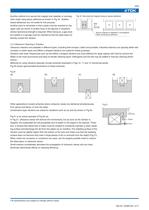
(8/9) 002-02 / 20080108 / e171.fm Another method is to secure the magnet onto bakelite or nonmag-netic metal using epoxy adhesive as shown in Fig.19. Rubber-based adhesives are not suited for this purpose. Another point to remember is that a plate must be inserted on the upper side (as shown in broken lines in the figures) in situations where mechanical strength is required. When doing so, a gap must be created or a sponge must be inserted so that the plate does not directly contact the vibrator. > Fig.19 Securing the magnet using an epoxy adhesive NNSNNGap or spongeSecure magnet on bakelite...
Open the catalog to page 8
4/2 Type VibratorRubberpacking Vibrating plate8.8mmt > Cable Rubber > Ҹ74 Sponge > 4 74 90 Dimensions in mm >
Open the catalog to page 9All TDK Electronics Europe catalogs and technical brochures
 YFF-HC series
5 Pages
 Aluminum electrolytic capacitors
18 Pages
 CK45 series
6 Pages

Archived catalogs
 SATA SSD
3 Pages
 CF CARD
3 Pages
 TDK MLCC CATALOG b11
72 Pages
 Wound Type SMD Inductors (Coils)
12 Pages
 Ferrite Magnets FB
27 Pages
 Pin Terminal Type PFC
14 Pages
 E Series
45 Pages
 Feed-back Type EFS
4 Pages
 Piezoelectric Type LTS, TSP
9 Pages
 Chip Beads STD
29 Pages
 Humidity Sensor CHS Series
11 Pages
 Color Video Camera
2 Pages
 Multilayer Chip Beads
27 Pages
 NTC Thermistors SMD
14 Pages
 Multilayer/Q-up MLG0402Q
5 Pages
 SMD NTCG
14 Pages
 Piezoelectric Receiver RU
2 Pages
 EFE300M / EFE400M 300/400
4 Pages
 PTC Thermistors
28 Pages
 Flip Chip Bonder
1 Page
 EMC and RF testing
4 Pages
 RF Integrated Test Systems
12 Pages
 Microwave Absorbers
16 Pages
 Power supplies catalog
24 Pages
 Planar Cores
8 Pages
 Toroidal Cores
2 Pages
 Ferrite Electrodes
4 Pages


![[BHF/BHP] Series for Barcode Printers, and Label Printers](https://img.directindustry.com/pdf/repository_di/34778/bhf-bhp-series-barcode-printers-label-printers-374455_1mg.jpg)


- Transformer
- Dry transformer
- Encapsulated transformer
- Electronic filter
- Isolation transformer
- Passive electronic filter
- Contactor
- Diode
- Solid-state drive
- TDK ceramic capacitor
- Low-pass electronic filter
- TDK SMD capacitor
- Internal solid-state drive
- Power capacitor
- TDK film capacitor
- TDK RoHS capacitor
- Industrial solid-state drive
- Current capacitor
- High-voltage diode