
- Catalogs
- TDK Electronics Europe
- Permeability Sensing Type TS-L, TS-A, TS-K


- Products
- Catalogs
- News & Trends
- Exhibitions
Permeability Sensing Type TS-L, TS-A, TS-K

Permeability Sensing Type TS-L, TS-A, TS-K
Catalog excerpts
Toner Density/Quantity Sensors Permeability sensing type TS series Type: TS-L(Double-sided substrate type) TS-A(One-sided substrate type) TS-K(One-sided substrate type) Issue date: • All specifications are subject to change without notice. • Conformity to RoHS Directive: This means that, in conformity with EU Directive 2002/95/EC, lead, cadmium, mercury, hexavalent chromium, and specific bromine-based flame retardants, PBB and PBDE, have not been used, except for exempted applications.
Open the catalog to page 1
Toner Density/Quantity Sensors TS-L, -A, and -K Series Conformity to RoHS Directive Plain paper copiers and laser printers require the toner (pigment powder) and carrier (magnetic powder) to be mixed in the proper proportions to create the developer. The TDK programmable toner sensor has been developed to constantly maintain the correct mix ratio between them, which is capable of keeping an optimum status by using a DC output voltage corresponding to the mix ratio. FEATURES • The TS-L, TS-A and TS-K toner sensors use a high performance ferrite core differential transformer with an adjustable...
Open the catalog to page 2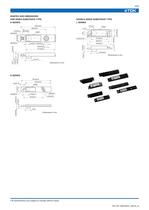
SHAPES AND DIMENSIONS ONE-SIDED SUBSTRATE TYPE A SERIES DOUBLE-SIDED SUBSTRATE TYPE L SERIES • All specifications are subject to change without notice. 001-03 / 20070222 / eb372_ts.fm
Open the catalog to page 3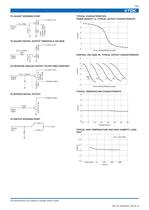
Control input TYPICAL CHARACTERISTICS TONER DENSITY vs. TYPICAL OUTPUT CHARACTERISTIC 5 4 Vout (V) TO ADJUST WORKING POINT Digital output TO ADJUST DIGITAL OUTPUT THRESHOLD VOLTAGE Toner density (Relative scale) CONTROL VOLTAGE VS. TYPICAL OUTPUT CHARACTERISTIC 5 4 TO INCREASE ANALOG OUTPUT FILTER TIME CONSTANT Analog output Toner density (Relative scale) TYPICAL TEMPERATURE CHARACTERISTIC TO BUFFER DIGITAL OUTPUT Digital output TO SWITCH WORKING POINT 0 –10 TYPICAL HIGH TEMPERATURE AND HIGH HUMIDITY LOAD TEST 60˚C, 95 (%) RH Initial value • All specifications are subject to change without notice....
Open the catalog to page 4
PRECAUTIONS Adhere to the following recommendations to ensure stable operation of the programmable toner sensor. Values shown here are guidelines for general design. Detection sensitivity of sensors is influenced by the material and shape of the developer container that the sensor will be used with, and the mechanism for carrying the developer. Refer to separate documents for special design specifications. 1. The quantity of developer (toner carrier) around the sensor face The detection sensitivity will drop when the quantity of developer around the sensor face (D in the diagram below) is low...
Open the catalog to page 5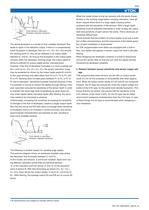
P4 P5 Toner density or equivalent developer magnetic resistance The above illustration is a model of how unstable developer flow leads to ripple in the detection output. If there is a comparatively small fluctuation in developer flow (C0→C1→C0→C2→C0) around the working point C0, this will be reflected in an output ripple between E1 and E2. As long as the fluctuation in the output ripple remains within the developer working range, the output signal filtering is sufficient to ensure stable sensor characteristics. However, if the flow of developer fluctuates in a more unstable pattern, such as C0→C3→C0→C4→C0,...
Open the catalog to page 6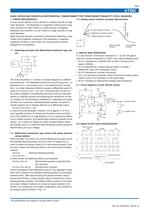
Phase discriminator output BASIC OPERATING PRINCIPLES (DIFFERENTIAL TRANSFORMER TYPE TONER DENSITY/QUANTITY LEVEL SENSORS) 1. OPERATING PRINCIPLE 1-2. Analog output variation by phase discriminator A toner sensor detects a toner density or residual quantity of magV2 netic developer. The developer is a magnetic material and a magnetic resistance is high if there is a small quantity of magnetic V0 (Low quantity of toner) developer and contrarily it is low if there is a large quantity of magV0 (Medium quantity of toner) netic developer. V0 (Much quantity of toner) While the toner density or quantity...
Open the catalog to page 7All TDK Electronics Europe catalogs and technical brochures
 YFF-HC series
5 Pages
 Aluminum electrolytic capacitors
18 Pages
 CK45 series
6 Pages

Archived catalogs
 SATA SSD
3 Pages
 CF CARD
3 Pages
 TDK MLCC CATALOG b11
72 Pages
 Wound Type SMD Inductors (Coils)
12 Pages
 Ferrite Magnets FB
27 Pages
 Pin Terminal Type PFC
14 Pages
 E Series
45 Pages
 Feed-back Type EFS
4 Pages
 Piezoelectric Type LTS, TSP
9 Pages
 Chip Beads STD
29 Pages
 Humidity Sensor CHS Series
11 Pages
 Color Video Camera
2 Pages
 Multilayer Chip Beads
27 Pages
 NTC Thermistors SMD
14 Pages
 Multilayer/Q-up MLG0402Q
5 Pages
 SMD NTCG
14 Pages
 Piezoelectric Receiver RU
2 Pages
 EFE300M / EFE400M 300/400
4 Pages
 PTC Thermistors
28 Pages
 Flip Chip Bonder
1 Page
 EMC and RF testing
4 Pages
 RF Integrated Test Systems
12 Pages
 Microwave Absorbers
16 Pages
 Power supplies catalog
24 Pages
 Planar Cores
8 Pages
 Toroidal Cores
2 Pages
 Ferrite Electrodes
4 Pages


![[BHF/BHP] Series for Barcode Printers, and Label Printers](https://img.directindustry.com/pdf/repository_di/34778/bhf-bhp-series-barcode-printers-label-printers-374455_1mg.jpg)


- Dry transformer
- Encapsulated transformer
- Electronic filter
- Isolation transformer
- Passive electronic filter
- Contactor
- Diode
- Solid-state drive
- TDK ceramic capacitor
- Low-pass electronic filter
- TDK SMD capacitor
- Internal solid-state drive
- Power capacitor
- TDK film capacitor
- TDK RoHS capacitor
- Industrial solid-state drive
- Current capacitor
- High-voltage diode