
- Catalogs
- TDK Electronics Europe
- NTC Thermistors Temperature Sensors for Selective Catalytic Reduction (SCR) Tanks


- Products
- Catalogs
- News & Trends
- Exhibitions
NTC Thermistors Temperature Sensors for Selective Catalytic Reduction (SCR) Tanks

NTC Thermistors Temperature Sensors for Selective Catalytic Reduction (SCR) Tanks
The EPCOS Product Brief 2017 introduces temperature sensors designed for Selective Catalytic Reduction (SCR) systems, which are crucial for reducing nitrogen oxides (NOX) emissions in diesel engines. These sensors are used to prevent urea from freezing, ensuring the SCR system's effectiveness and compliance with Euro 6 emission standards.
Key Features
- Urea resistant, compliant with ISO 22241-1.
- Temperature range from –40°C to +85°C.
- Short response time and leak-tight seal with an O-ring.
- Reduced height for full-scale tank level measurement.
- Customizable solutions, including optimized connectors and bayonet mount designs.
Technical Specifications
- Integrated Urea Temperature Sensor: Temperature range of –40°C to +80°C, response time under 60 seconds, and connector-based design.
- Integrated Urea Temperature Compact Sensor: Similar specifications to the integrated sensor but designed for small urea amounts.
- Outside Temperature Sensor: Temperature range of –40°C to +85°C, compliant with IP6K6 and IPX9K standards, humidity resistant, and cable-based design.
Applications and Compliance
The sensors are essential for maintaining the liquid state of urea in SCR systems, which is necessary for reducing NOX emissions by up to 90%. They are designed to meet the stringent requirements of the Euro 6 emission standard, contributing to environmental protection.
Important Considerations
The document emphasizes that while the sensors are designed for specific applications, customers must verify their suitability for particular uses. Detailed product information is available in data sheets, and adherence to important notes and product-specific cautions is required.
Catalog excerpts
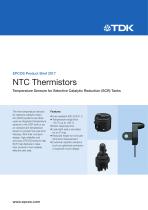
The new temperature sensors for selective catalytic reduction (SCR) systems are either used as integrated temperature sensors in the SCR tank or as an outside tank temperature sensor to protect the urea from freezing. With their compact design, high reliability and accuracy, EPCOS sensors help SCR manufacturers make their products more reliable, effective and safe. • Urea resistant (ISO 22241-1) • Temperature range from -40 °C up to +85 °C • Short response time • Leak-tight seal is provided by an O-ring • Reduced height for full scale tank level measurement • Customer-specific solutions such as optimized connector or bayonet mount design
Open the catalog to page 1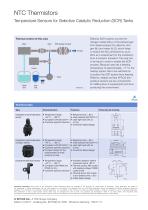
Thermal control of the urea Effective SCR systems convert the nitrogen oxides (NOX) of the exhaust gas from diesel engines into diatomic nitrogen (N2) and water (H2O), which helps to reduce the NOX emissions by up to 90% as a requirement for the mandatory Euro 6 emission standard. The urea has to be liquid in order to enable the SCR process. Because urea has a freezing temperature of approximately -11 °C, the heating system has to be switched on to protect the SCR system from freezing. Effective, reliable and fast EPCOS temperature sensors are key components for fulfilling Euro 6 requirements...
Open the catalog to page 2All TDK Electronics Europe catalogs and technical brochures
 YFF-HC series
5 Pages
 Aluminum electrolytic capacitors
18 Pages
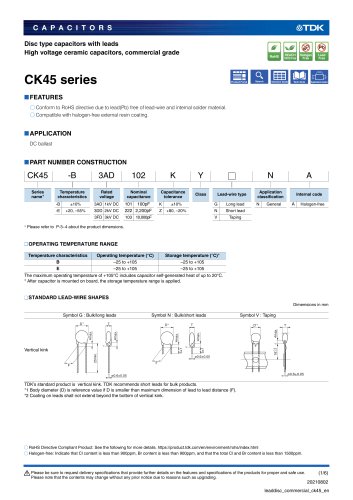 CK45 series
6 Pages
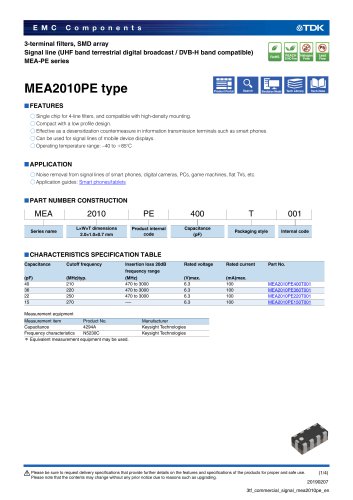

Archived catalogs
 SATA SSD
3 Pages
 CF CARD
3 Pages
 TDK MLCC CATALOG b11
72 Pages
 Wound Type SMD Inductors (Coils)
12 Pages
 Ferrite Magnets FB
27 Pages
 Pin Terminal Type PFC
14 Pages
 E Series
45 Pages
 Feed-back Type EFS
4 Pages
 Piezoelectric Type LTS, TSP
9 Pages
 Chip Beads STD
29 Pages
 Humidity Sensor CHS Series
11 Pages
 Color Video Camera
2 Pages
 Multilayer Chip Beads
27 Pages
 NTC Thermistors SMD
14 Pages
 Multilayer/Q-up MLG0402Q
5 Pages
 SMD NTCG
14 Pages
 Piezoelectric Receiver RU
2 Pages
 EFE300M / EFE400M 300/400
4 Pages
 PTC Thermistors
28 Pages
 Flip Chip Bonder
1 Page
 EMC and RF testing
4 Pages
 RF Integrated Test Systems
12 Pages
 Microwave Absorbers
16 Pages
 Power supplies catalog
24 Pages
 Planar Cores
8 Pages
 Toroidal Cores
2 Pages
 Ferrite Electrodes
4 Pages


![[BHF/BHP] Series for Barcode Printers, and Label Printers](https://img.directindustry.com/pdf/repository_di/34778/bhf-bhp-series-barcode-printers-label-printers-374455_1mg.jpg)


- Transformer
- Dry transformer
- TDK capacitor
- Encapsulated transformer
- Electronic filter
- Isolation transformer
- Passive electronic filter
- Contactor
- Diode
- Solid-state drive
- TDK ceramic capacitor
- Low-pass electronic filter
- TDK SMD capacitor
- Internal solid-state drive
- Power capacitor
- TDK film capacitor
- TDK RoHS capacitor
- Industrial solid-state drive
- Current capacitor
- High-voltage diode