
- Catalogs
- Tanis Brush
- Abrasive Brushes


Abrasive Brushes
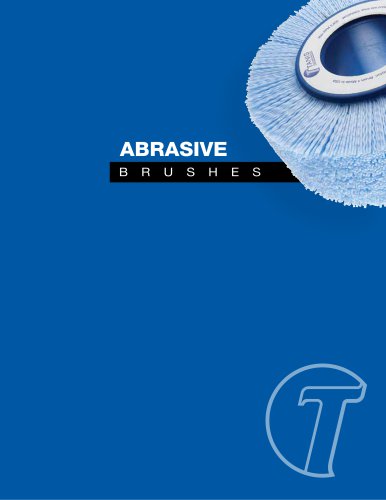
Abrasive Brushes
Tanis, Inc. offers CeramiX® abrasive brushes featuring 3M™ Abrasive Grain 321, known for its ceramic abrasive properties. These brushes are designed for deburring and surface conditioning, with flexibility to conform to irregular surfaces.
The sol gel process used in creating these abrasive grains results in a finer crystalline structure, allowing for self-sharpening and increased productivity due to the grain's ability to fracture into small fragments.
CeramiX® brushes offer fracture toughness, hardness, and self-sharpening qualities, contributing to increased productivity and efficiency.
Available in tube, burr, strip, and disc configurations, CeramiX® brushes are suitable for power tools, robotic cells, and CNC applications, with grit sizes from 46 to 220 and custom design options.
These brushes cut 3 to 5 times faster on ferrous metal surfaces and perform well under high stress and heat conditions, ideal for applications requiring consistent surface finishes and reduced cycle times.
Optimal performance requires maintaining specific RPMs and penetration rates, focusing on the balance between speed, penetration, and abrasive grit size.
Adjustments in diameter, RPM, trim length, filament size, grit size, and filament density can optimize performance. For less aggressive action, reduce filament diameter and grit size, and adjust surface speed.
To optimize performance, adjust filament density, grit size, and surface speed based on desired outcomes. Use coolant or lubricant to prevent filament smearing or melting.
Tanis offers abrasive nylon wheel brushes with CeramiX® and silicon carbide filaments, suitable for machine part deburring and turbine blade finishing, available in various diameters, grit sizes, and trim lengths.
These brushes are used for deburring, surface finishing, cleaning, and edge radiusing in industries like aerospace and manufacturing, including deburring keyways and finishing gear splines.
The document lists part numbers with specifications such as brush diameter, grit, filament diameter, arbor hole, face width, trim length, and maximum RPM for task-specific selection.
The document provides detailed specifications and applications for abrasive brushes by Tanis Brush, including product numbers, dimensions, and recommended uses for CeramiX® and Silicon Carbide brushes.
Brush models are listed with details like diameter, grit, filament diameter, arbor hole size, trim length, and maximum RPM, crucial for selecting the appropriate brush for industrial applications.
Brushes are designed for tasks like deburring cast parts, improving surface finishes, and blending grinding marks, suitable for CNC machining centers and industrial settings.
Brushes are categorized into types such as CeramiX® Shell Mill Holder Disc Brushes, Mini Disc Brushes, Fine Blanking Disc Brushes, Wheel Bench Grinder Brushes, and End Brushes with Bridles.
The document highlights CeramiX® and Silicon Carbide filaments for enhanced cutting action and durability, engineered to maximize productivity and minimize cycle times.
Includes contact information for Tanis Brush and notes on custom sizes and configurations availability.
Arbor Dimensions: Lists various arbors with specific dimensions for width, overall length, and compatibility with different shank sizes.
Air Motor Shanks: Designed for air motors and flexible shafts, capable of accepting single or multiple brushes.
Plastic Bushings: Intended for economical, one-time use to match brush inside diameter with mounting shaft.
Drill Press Shanks: Suitable for use in portable tools and drill presses with 1/4" chuck adaptability.
Catalog excerpts
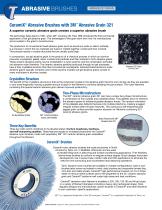
ABRASIVE BRUSHES ABRASIVE GRAIN CeramiX® Abrasive Brushes with 3M™ Abrasive Grain 321 A superior ceramic abrasive grain creates a superior abrasive brush The technology dates back to 1981, when 3M™ Company (St. Paul, MN) introduced the first commercial application of sol gel abrasive grain. The advantages of this grain stem from how it’s manufactured and is evident in the grain’s microstructure. The production of conventional fused abrasive grain (such as aluminum oxide or silicon carbide), is a process in which the raw materials are fused or melted together, cooled and then crushed. This process...
Open the catalog to page 2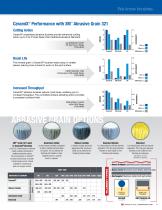
CeramiX® Performance with 3M™ Abrasive Grain 321 Cutting Action CeramiX® proprietary abrasive brushes provide enhanced cutting action up to 3 to 5 times faster than traditional abrasive filaments. ALUMINUM PLATE T6 Aluminum Plate, 1750 RPM Brush Life The mineral grain in CeramiX® brushes wears away in smaller pieces, leaving more mineral to work on the part surface. PERFORATED CRS Perforated CRS A366 Plate, 1750 RPM Increased Throughput CeramiX® abrasive brushes reduce cycle times, enabling you to increase throughput. The controlled surface abrading action provides a consistent surface finish. CRS...
Open the catalog to page 3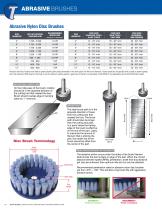
Abrasive Nylon Disc Brushes DISC DIAMETER DISC DIAMETER Abrasive nylon disc brushes work best at speeds allowing fairly deep penetration of the work piece into the brush filaments. Faster speeds do not typically work as well as slower speeds, since the maximum RPM listed on the brush is not the optimum working speed. A good rule of thumb is to stay below 2,500 SFPM in dry applications and 3,500 SFPM with coolant. Disc Brush Terminology The ideal brush path is in the opposite direction of travel from the cutting tool that created the burr. The brush path should also be longer than the cutting...
Open the catalog to page 4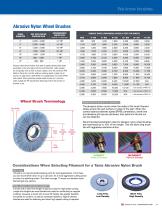
Abrasive Nylon Wheel Brushes WHEEL DIAMETER PENETRATION (POINT OF CONTACT) Abrasive nylon wheel brushes work best at speeds allowing fairly deep penetration of the work piece into the brush filaments. Faster speeds do not typically work as well as slower speeds, since the maximum RPM listed on the brush is not the optimum working speed. A good rule of thumb is to stay below 2,500 SFPM in dry applications and 3,500 SFPM with coolant. When operating multiple wheel brushes on a common shaft, multiply the HP requirements listed above times the number of brushes in use. Face Width Outer Diameter (OD)...
Open the catalog to page 5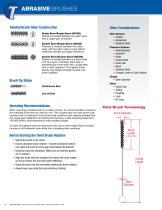
Twisted Brush Stem Construction Other Considerations: Single Stem/Single Spiral (SS/SS) Filament is twisted between two stem wires with a single layer of filament. Double Stem/Single Spiral (DS/SS) Filament is twisted between four stem wires, with two stem wires on each side for additional strength and higher density fill. Double Stem/Double Spiral (DS/DS) Filament is twisted between four stem wires with two layers of bristles. Each layer is perpendicular to the other with a single stem wire in each quadrant. The highest brush density and highest strength twisted wire brush available. Brush Tip...
Open the catalog to page 6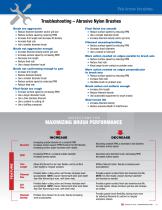
Troubleshooting – Abrasive Nylon Brushes Brush too aggressive Reduce filament diameter and/or grit size Reduce surface speed by reducing RPM Increase trim length and decrease fill density Increase feed rate Use a smaller diameter brush Final finish too smooth Reduce surface speed by reducing RPM Use a smaller diameter brush Increase filament density and/or grit size Filament smearing/melting Reduce surface speed by reducing RPM Decrease brush diameter Use a coolant or lubricant Brush not aggressive enough Increase filament density and/or grit size Increase surface speed by increasing RPM Decrease...
Open the catalog to page 7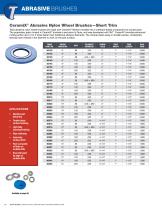
CeramiX® Abrasive Nylon Wheel Brushes—Short Trim Tanis abrasive nylon wheel brushes are made with CeramiX® filament molded into a urethane-based composite hub construction. The proprietary grain mineral in CeramiX® brushes is exclusive to Tanis, and was developed with 3M™. CeramiX® provides enhanced cutting action up to 3 to 5 times faster than traditional abrasive filaments. The mineral wears away in smaller pieces, consistently leaving more mineral in the filament to work on the part surface. TANIS BRUSH APPLICATIONS • Machine part deburring • Turbine blade surface finishing • Light duty cleaning/finishing •...
Open the catalog to page 8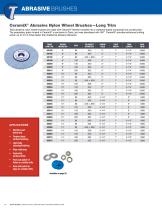
CeramiX® Abrasive Nylon Wheel Brushes—Long Trim Tanis abrasive nylon wheel brushes are made with CeramiX® filament molded into a urethane-based composite hub construction. The proprietary grain mineral in CeramiX® is exclusive to Tanis, and was developed with 3M™. CeramiX® provides enhanced cutting action up to 3 to 5 times faster than traditional abrasive filaments. APPLICATIONS • Machine part deburring • Turbine blade surface finishing • Light duty cleaning/finishing • Edge radiusing • Improving surface finish • Post coat polish of flutes on carbide drills • Hone drill point lip edge on carbide...
Open the catalog to page 10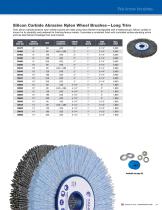
TANIS BRUSH
Open the catalog to page 11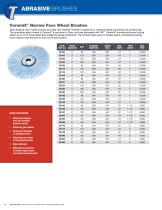
CeramiX® Narrow Face Wheel Brushes Tanis abrasive nylon wheel brushes are made with CeramiX® filament molded into a urethane-based composite hub construction. The proprietary grain mineral in CeramiX® is exclusive to Tanis, and was developed with 3M™. CeramiX® provides enhanced cutting action up to 3 to 5 times faster than traditional abrasive filaments. The mineral wears away in smaller pieces, consistently leaving more mineral in the filament to work on the part surface. APPLICATIONS • Deburring keyways, slots and machine grooves in parts • Deburring gear splines • Honing and finishing of cylindrical...
Open the catalog to page 12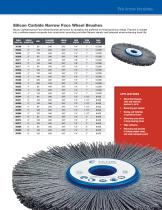
Silicon Carbide Narrow Face Wheel Brushes Silicon Carbide Narrow Face Wheel Brushes are known for durability and preferred for finishing ferrous metals. Filament is molded into a urethane-based composite hub construction providing controlled filament density and balanced wheel enhancing brush life. TANIS BRUSH PART NO. DIAMETER FILAMENT DIAMETER ARBOR HOLE FACE WIDTH TRIM LENGTH • Deburring keyways, slots and machine grooves in parts • Deburring gear splines • Honing and finishing of cylindrical bores • Deburring cross holes in large bearing bores • Edge radiusing • Deburring seal grooves in...
Open the catalog to page 13All Tanis Brush catalogs and technical brochures
 Wood Working Brushes
2 Pages
 Strip and Cylinder Brushes
42 Pages
 Full Catalog
198 Pages
 Artist Brushes
8 Pages
 Twisted Brushes
24 Pages
 Scratch Brushes
8 Pages
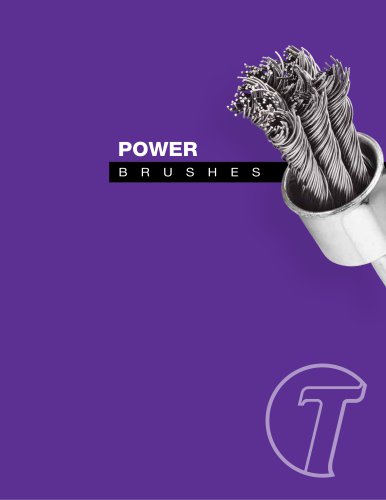 Power Brushes
28 Pages
 Industrial Brushes Catalog
198 Pages
 Strip Catalog
42 Pages
 Wire Wheel Brush
2 Pages
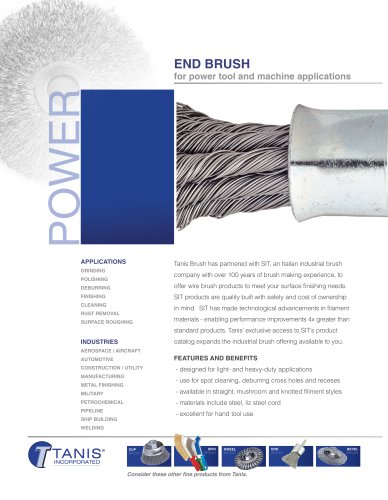 End Brushes
2 Pages
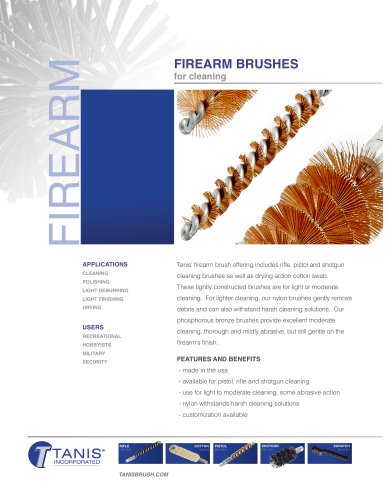 Firearm Brushes
2 Pages




Archived catalogs
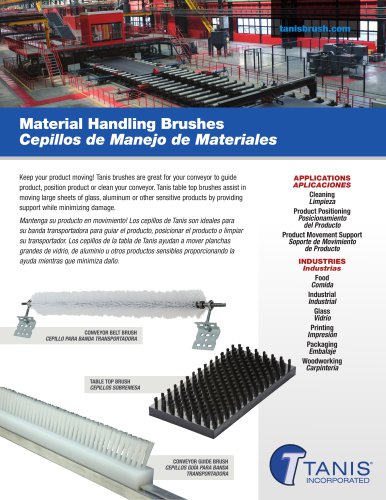
 Material Handling Brushes
6 Pages
- Surface treatment brush
- Washing brush
- Metal brush
- Plastic brush
- Cylindrical brush
- Stainless steel brush
- Strip brush
- Brass brush
- Polypropylene brush
- Aluminum brush
- Polyester brush
- Cleaning tube brush
- Cylindrical spiral brush
- Anti-static brush
- Metal tube brush
- Spiral tube brush
- Guiding brush
- Conveyor brush
- Brass tube brush