
- Catalogs
- TAMPOPRINT GmbH
- HYBRID Pad Printing Machine Case Study


HYBRID Pad Printing Machine Case Study

HYBRID Pad Printing Machine Case Study
TAMPOPRINT has collaborated with ABB to enhance the marking process of safety products, focusing on flexibility for small and very small lot sizes. The integration of hybrid technology has significantly reduced setup times and eliminated operator errors, making cliché storage unnecessary.
The Customer
ABB is a global leader in energy and automation technology, employing around 140,000 people worldwide. Incorrect labeling of safety components can have severe consequences, necessitating a reliable and error-free marking process.
The Problem
ABB faced challenges with small series production, requiring precise and varied print images for different markets. The traditional method involved a large cliché store, which was time-consuming and prone to errors, especially with foreign characters.
The Solution
TAMPOPRINT introduced a hybrid system that produces clichés within the machine, eliminating the need for traditional printing plates. This system is digitally controlled and integrated with ABB's order system, ensuring accurate and efficient production.
Benefits
The hybrid system offers maximum product safety by eliminating operator errors, reducing the scrap rate to nearly zero. It optimizes setup and maintenance times, allowing for faster processing of orders. The system increases efficiency by replacing multiple machines with a single networked system, reducing personnel requirements.
Conclusion
The TAMPOPRINT system is ideal for processing numerous orders with small lot sizes efficiently. It minimizes setup times, prevents operator errors, and provides significant cost savings.
Contact Information
For more information, contact Dietmar Scholz, Head of Sales at TAMPOPRINT GmbH.
Catalog excerpts
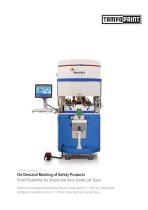
Pad Printing Case Study On-Demand Marking of Safety Products Print Flexibility for Small and Very Small Lot Sizes Hybrid technology dramatically reduces setup times +++ Process integration eliminates operator errors +++ Cliché store becomes superfluous
Open the catalog to page 1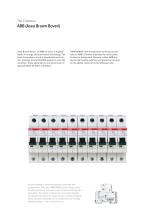
ABB (Asea Brown Boveri) Asea Brown Boveri, or ABB for short, is a global leader in energy and automation technology. The stock corporation, which is headquartered in Zurich, employs around 140,000 people in over 100 countries. These generate an annual turnover of approximately 40 billion US dollars. TAMPOPRINT had already been working successfully for ABB’s German subsidiary for many years. Contact to Switzerland followed, where ABB produces high-quality switches and protective devices for the global market at its Schaffhausen site. Incorrect labeling of safety-relevant parts could have fatal...
Open the catalog to page 2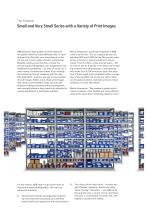
Small and Very Small Series with a Variety of Print Images ABB produces high-quality circuit-breakers for the global market at its Schaffhausen site. In case of doubt, the life of the user may depend on the correct use of such safety-relevant components. Reliable marking must therefore include the precise product designation, pin assignments, and additional characteristics – as well, of course, as a wide variety of certification marks. If you multiply the number of product variations with the over 100 destination countries, you get a huge number of print images. What’s more, these print images...
Open the catalog to page 3
Printing Small Lot Sizes on Demand It works, it lasts and it pays off. Thanks to TAMPOPRINT.
Open the catalog to page 4
The Solution Operator-Independent Cliché Production IN the Machine – Hybrid Technology “Can you make us quicker, more fl exible and more efficient?” Step 2: Full Interconnection of the System “The second step,” TAMPOPRINT’s Head of Development, Stephan Berger, adds, “was ultimately a logical consequence of the first.” We simply thought it through to the end: We already have a system that is digitally controlled, so it must be possible to connect it to the customer’s order system.” Hence, the second half of the project was devoted to developing software. This software development process was ultimately...
Open the catalog to page 6
The Benefits Advantages for the Customer – Efficiency and Security “Of course, projects like this are fun when the solution is so elegant,” Nitschke concludes. “Admittedly, the customer is more interested in the third part of our slogan. ‘It works, it lasts and ... it pays off.’” Maximum product safety: Elimination of operator errors The scrap rate due to incorrect labeling was reduced to almost 0 %. A priceless advantage in the case of safety-relevant components and the resulting liability risks. Outstanding speed: Optimization of setup and maintenance times The networked hybrid system is so...
Open the catalog to page 7
L’essentiel en un seul coup d’œil : Hybrid printing system automatically produces P its own cliché for each print job in a matter of minutes. N ¦ o need for separate cliché production; no setup time between orders. Complete networking makes operator P i ntervention superfluous. O ¦ perator errors are eliminated. Inexpensive clichés come as needed P per order from the cliché band. C ¦ liché store becomes superfluous. Automation and integration cut time P for epeated setup processes. r A ¦ single operator replaces the three or four required previously. Conclusion The system is ideally suited to...
Open the catalog to page 8All TAMPOPRINT GmbH catalogs and technical brochures
 MOF Laser System
8 Pages
 Leads Printing Pads
32 Pages
 Leads Pad Printing Inks
68 Pages
 Leads Pad Printing clichés
32 Pages
 Leads Consumables
32 Pages
 LEADS Pad Printing
60 Pages
 MOF Lasersystem
8 Pages
 TSM Pad Printing Machines
11 Pages
 MODULE ONE M Semi-Automation
2 Pages
 MOF-PROMO HP Laser system
2 Pages
 CLICHE LASER Xi Laser System
2 Pages


- Marking machine
- Laser marking machine
- Automatic marking workstation
- Plastic marking machine
- Pad printing machine
- Compact marking machine
- Pad printing machine with closed ink cup
- Ink
- Laser engraving machine
- Color pad printing machine
- Pad printing machine with hermetic ink cup
- Electropneumatic pad printing machine
- Compact engraving machine
- Pad printing machine with open ink cup
- Rotary pad printing machine
- Compact pad printing machine
- High-speed pad printing machine
- 3-color pad printing machine
- Pad printing ink
- High-quality pad printing machine