
- Catalogs
- TAMPOPRINT GmbH
- Case-Study SPEED Pad Printing Machine


Case-Study SPEED Pad Printing Machine

Case-Study SPEED Pad Printing Machine
MALA Verschlusssysteme GmbH, a leading German manufacturer of aluminum beverage closures, faced challenges with their traditional production methods for aluminum Long Caps. The company sought a more flexible and efficient printing solution to meet the growing demand for high-quality wine closures.
Problem & Task
The existing production process was inflexible and costly, limited to large series due to the offset printing method. This method required pre-production for stock, leading to high storage and logistic costs, and was unsuitable for metallic colors. Additionally, inaccuracies in punching and shaping reduced print quality.
Solution
TAMPOPRINT introduced a two-phase solution:
- Phase 1: Rotary Printing for 360° circular printing of Long Caps, achieving high precision and speed with 15,000 closures per hour.
- Phase 2: High-Speed Flat-Screen Printing for top surfaces, integrating a flat-bed printing machine with the rotary process, setting a world record with 9,000 cycles/hour.
Benefits
The new system offered significant advantages:
- Flexibility: Ability to handle smaller orders and react quickly to inquiries.
- Quality Improvement: Enhanced print image quality, including metallic colors, with reduced registration errors.
- Cost Efficiency: Reduced energy and personnel costs, elimination of pre-production cost risks, and savings on storage space.
Conclusion
The TAMPOPRINT system provided MALA with a competitive edge through improved ergonomics, stability, and efficiency, resulting in lower unit costs and superior print quality. This innovation allowed MALA to maintain a leading position in the market.
Contact Information
For further inquiries, contact Thilo Reichelt, Head of Sales for Closure Marking at TAMPOPRINT.
Catalog excerpts
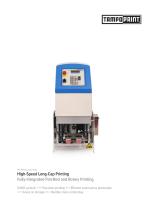
Pad Printing Case Study High-Speed Long-Cap Printing Fully-Integrated Flat-Bed and Rotary Printing 9,000 cycles/h +++ Precision printing +++ Efficient small-series production +++ Saves on storage +++ Handles more orders/day
Open the catalog to page 1
MALA – The Experts for Aluminum Closures MALA Verschlusssysteme GmbH is a typical German “hidden hero”: A medium-size family business, yet still – or perhaps precisely for this reason – one of the biggest names in its sector and currently the world’s third-largest manufacturer of aluminum beverage closures. The company, located in Bad Liebenstein and Wernshausen in Thuringia, has been producing beverage closures since the beginning of the 1990s and is now THE undisputed specialist for aluminum roll-on closures. In the meantime, they have expanded into the USA, serving the American market from...
Open the catalog to page 2
Problem & Task Inflexible and Expensive Production, Limited to Large Series In the past, MALA had been producing aluminum Long Caps by printing very large, flat, unprocessed metal sheets using offset printing. Only when these sheets had been pre-printed, could the closures be punched and shaped. This method brought with it both technical problems as well as organizational and hence economic disadvantages: Minimum production quantities per motif were P very large. I ¦ t was not possible to handle the increasing number of requests for small and special series. Production time was relatively long....
Open the catalog to page 3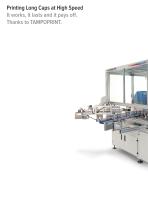
Printing Long Caps at High Speed It works, it lasts and it pays off. Thanks to TAMPOPRINT.
Open the catalog to page 4
The Solution Flat-Bed Printing at Rotary Speeds – The Speed Module The task was to find a better alternative for high-quality and flexible printing. This is where pad printing came into it ... The solution was realized in two phases: Phase 1: Rotary Printing for 360° Printing of ircular Surfaces C The initial request was “only” for 360° circular printing of Long Caps after shaping (deep-drawing). This was realized by means of rotary pad printing. The two-lane TOP SPIN rotary pad printer prints 15,000 closures per hour – in four colors and with the highest precision, too. Phase 2: Add-On High-Speed...
Open the catalog to page 6
The Benefits Advantages for the Customer – Efficiency and Security “Of course it’s fun setting records,” Head of Development, Stephan Berger, concludes. And board member Oliver Nitschke, himself an engineer, agrees: “The SPEED module is a world champion that works, lasts, and pays off.” He then adds, however: “As usual, the customer is primarily interested in the third part of our slogan. It had to pay off for him. And it did, too. In a big way.” The advantages for the customer are indeed considerable: ☑☑ Flexibility: The customer can now react quickly and fl exibly to inquiries. The minimum...
Open the catalog to page 7
Order flexibility P S ¦ mall and medium-sized orders can now be handled. P Production speed E ¦ ven with the flat-bed module, the system runs at the speed of a rotary printer. Cuts storage space P N ¦ o necessity to stockpile P Competitive edge L ¦ ow unit costs, small-series capability, print quality, and speed give the user a clear advantage in the market place. Conclusion Thanks to its small-series capability, low unit costs, short setup times, and excellent print quality at top speeds, the system is ideally suited to giving the customer a decisive lead over its competitors – and consequently...
Open the catalog to page 8All TAMPOPRINT GmbH catalogs and technical brochures
 MOF Laser System
8 Pages
 Leads Printing Pads
32 Pages
 Leads Pad Printing Inks
68 Pages
 Leads Pad Printing clichés
32 Pages
 Leads Consumables
32 Pages
 LEADS Pad Printing
60 Pages
 MOF Lasersystem
8 Pages
 TSM Pad Printing Machines
11 Pages
 MODULE ONE M Semi-Automation
2 Pages
 MOF-PROMO HP Laser system
2 Pages
 CLICHE LASER Xi Laser System
2 Pages


- Marking machine
- Laser marking machine
- Automatic marking workstation
- Plastic marking machine
- Pad printing machine
- Compact marking machine
- Pad printing machine with closed ink cup
- Ink
- Laser engraving machine
- Color pad printing machine
- Pad printing machine with hermetic ink cup
- Electropneumatic pad printing machine
- Compact engraving machine
- Pad printing machine with open ink cup
- Rotary pad printing machine
- Compact pad printing machine
- High-speed pad printing machine
- 3-color pad printing machine
- Pad printing ink
- High-quality pad printing machine