
- Catalogs
- Taiyo Yuden
- The Fundamental Technical Knowledge of Passive Components


- Products
- Catalogs
- News & Trends
- Exhibitions
The Fundamental Technical Knowledge of Passive Components

The Fundamental Technical Knowledge of Passive Components
Catalog excerpts
Chapter III: Electro-Magnetic Compatibility (EMC) TAIYO YUDEN CO., LTD. http://www.ty-top.com
Open the catalog to page 1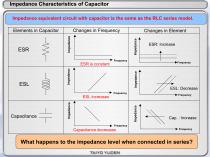
Impedance Characteristics of Capacitor Impedance equivalent circuit with capacitor is the same as the RLC series model. Changes in Frequency Changes in Element Impedance Capacitance decreases What happens to the impedance level when connected in series?
Open the catalog to page 3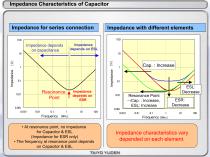
Impedance Characteristics of Capacitor Impedance for series connection Impedance with different elements 100 インピーダンス [Ω] Impedance Impedance depends on capacitance Resonance Point 周波数 [MHz] Frequency • At resonance point, no impedance for Capacitor & ESL (Impedance for ESR only) • The frequency at resonance point depends on Capacitor & ESL Resonance Point →Cap. : Increase, ESL: Increase 0.01
Open the catalog to page 4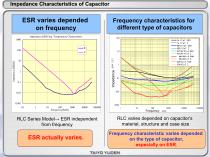
Impedance Characteristics of Capacitor ESR varies depended on frequency Frequency characteristics for different type of capacitors Impedance,ESR Freq.-Temperature Characteristic 周波数 [kHz] Frequency RLC Series Model→ ESR independent from frequency RLC varies depended on capacitor’s material, structure and case size Frequency characteris
Open the catalog to page 5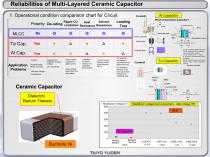
1. Operational condition comparison chart for Circuit u Vertical style © Horizontal style Electrolytic paper Electrolysis solution Ca, Ck: positive/negative pole cap. Da,Dk: rectification from negative pole’s oxidization coating La,Lk: Inductance for +,- leads R: resistance of electrolsis solution and paper Ra,Rk: Inside resistance of forward direction from +,-poles’ oxidization coating <Surface mounted> Ceramic Capacitor Breakdown Voltage (V) Breakdown voltage level comparison: rated voltage 10V 500 Forward direction
Open the catalog to page 6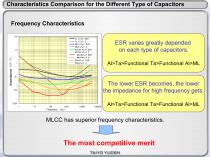
Characteristics Comparison for the Different Type of Capacitors Frequency Characteristics 100 インピーダンス・ESR [Ω] Impedance ESR varies greatly depended on each type of capacitors. Al>Ta>Functional Ta>Functional Al>ML The lower ESR becomes, the lower the impedance for high frequency gets. Al>Ta>Functional Ta>Functional Al>ML
Open the catalog to page 7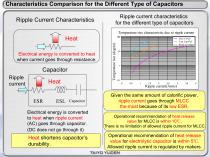
Characteristics Comparison for the Different Type of Capacitors Ripple Current Characteristics Ripple current characteristics for the different type of capacitors リップル電流対部品温度上昇の比較 Temperature rise characteristic due to ripple current Capacitor Ripple current Temperature rise (degree) Electrical energy is converted to heat when current goes through resistance. M LCC47uF 積層コン47μF Tant.Cap47uF タンタル47μF POSCAP100μF POSCAP100uF リップル電流(Arms) Ripple current(Arms) Given the same amount of calorific power, ripple current goes through MLCC the most because of its low ESR. Electrical energy is converted...
Open the catalog to page 8
The Basic Knowledge of Circuits TAIYD YUDEN
Open the catalog to page 9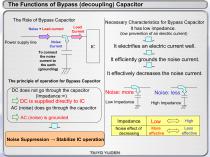
The Functions of Bypass (decoupling) Capacitor The Role of Bypass Capacitor Noise + Load current Load Current Power supply line |=!>——sr<=>-Noise Current To connect the noise current to the earth (grounding) Necessary Characteristics for Bypass Capacitor It has low impedance. (low prevention of an electric current) d It electrifies an electric current well. d It efficiently grounds the noise current. d It effectively decreases the noise current. The principle of operation for Bypass Capacitor f DC does not go through the capacitor " (Impedance:^) DC is supplied directly to IC AC (noise) does...
Open the catalog to page 10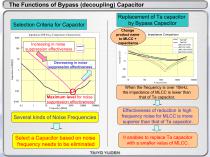
The Functions of Bypass (decoupling) Capacitor Replacement of Ta capacitor by Bypass Capacitor Selection Criteria for Capacitor 1000 Increasing in noise suppression effectiveness Decreasing in noise suppression effectiveness Change product name 100 to MLCC + capacitance 10 Impedance,ESR Freq.-Temperature Characteristic Maximum level for noise suppression effectiveness When the frequency is over 10kHz, the impedance of MLCC is lower than that of Ta capacitor. Several kinds of Noise Frequencies Effectiveness of reduction in high frequency noise for MLCC is more superior than that of Ta capacitor....
Open the catalog to page 11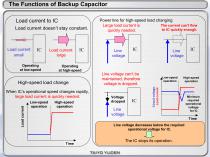
The Functions of Backup Capacitor Load current doesn’t stay constant. Load current: small Load current: large High-speed load change Load current When IC’s operational speed changes rapidly, large load current is quickly needed. Low-speed operation High-speed operation Power line for high-speed load changing The current can’t flow Large load current is to IC quickly enough. quickly needed. Line voltage Line voltage Line voltage can’t be maintained, therefore voltage is dropped. Voltage dropped Line voltage Low-speed operation High-speed operation Circuit voltage, Load current Minimum required...
Open the catalog to page 12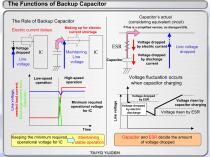
The Functions of Backup Capacitor Capacitor’s actual (considering equivalent circuit) The Role of Backup Capacitor Electric current delays Line voltage Line voltage, needed load current, Discharge current from Capacitor Voltage dropped by electric current Low-speed operation Maintaining Line voltage Minimum required operational voltage for IC Voltage dropped by discharge current Line voltage dropped Voltage fluctuation occurs when capacitor charging High-speed operation Line voltage Voltage dropped ∗This is a simplified version, so disregard ESL Making up for electric current shortage Voltage...
Open the catalog to page 13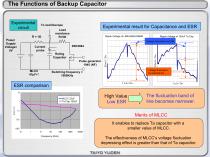
The Functions of Backup Capacitor Experimental circuit R = 1Ω Power Supply Voltage= 5V Experimental result for Capacitance and ESR タンタル100μFのリップル電圧 Ripple Voltage of 100uF Ta Cap ESR による電圧変動 Voltage fluctuation by ESR Pulse generator 1945 (NF) MLCC 47µF∗7 Rating Capacitor Current probe Voltage fluctuation 容量による電圧変動 by capacitance Switching frequency = 1000KHz 1μS/Div MLCC 22uF 積層コン22μF Ta Cap 100uF タンタル100μF The fluctuation band of line becomes narrower. It enables to replace Ta capacitor with a smaller value of MLCC.
Open the catalog to page 14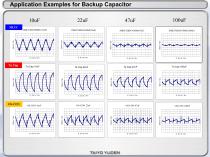
Application Examples for Backup Capacitor OSコン 10μF 50mV/Div 50mV/Div OSコン 47μF OSコン 100μF 50mV/Div 2.5μS/Div
Open the catalog to page 15
The Basic Knowledge of Power Supply Circuit TAIYD YUDEN
Open the catalog to page 16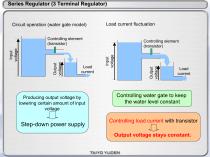
Series Regulator (3 Terminal Regulator) Circuit operation (water gate model) Load current fluctuation Controlling element (transistor) Controlling element (transistor) Load current Load current Producing output voltage by lowering certain amount of input voltage 4a Step-down power supply Controlling water gate to keep the water level constant Controlling load current with transistor Output voltage stays constant.
Open the catalog to page 17All Taiyo Yuden catalogs and technical brochures
 HV-6V221MF61Q-R2
2 Pages
 JMK063BJ474MP-F
3 Pages
 JMK063BJ474KP-F
3 Pages
 JMK063ABJ105MP-F
3 Pages
 JMK063ABJ105KP-F
3 Pages
 PMK063EBJ475MP-F
3 Pages
 Common Mode Choke Coils
52 Pages
 Ferrite Power Inductors
81 Pages
 Axial Leaded Ceramic Capacitors
26 Pages
 Metal Power Inductors (MCOILTM)
32 Pages
 Multilayer Ceramic Capacitors
49 Pages
 Filter/Coil/Transformer
33 Pages
 Multilayer Chip Varistors
9 Pages
 BD-R
BD-R4 Pages
 DVD-R/DVD+R/DVD-R DL
5 Pages
 Ring Varistors
6 Pages
 Cylinder type PAS Capacitor
4 Pages
 Coin type PAS Capacitor
7 Pages
 Chip Antenna
8 Pages
 Ferrite Cores
7 Pages
 Wound Torroids and Beads
33 Pages
 Axial Leaded Ceramic Capacitors
21 Pages
 Radial Leaded Inductors
15 Pages
 High Current Leaded Inductors
13 Pages
 Leaded Ferrite Beads Inductors
13 Pages
 Axial Leaded Inductors
30 Pages
 MULTILAYER CHIP INDUCTORS
19 Pages
 Balun Transformers
7 Pages
 Wound Chip Inductors LB series
13 Pages
 SMD Inductors Low Profile Type
14 Pages
 WOUND CHIP POWER INDUCTORS
9 Pages
 Wound Inductors (chip/SMD)
56 Pages
 Wireless Module
7 Pages
 Ferrite Chip Beads
47 Pages
 Leaded Inductors
29 Pages
 Multilayer Chip Inductors
33 Pages
 Axial Leaded Ceramic Capacitors
21 Pages
 Multilayer Ceramic Capacitors
45 Pages
 CCFL Inverter(KLS-170A-RH)
2 Pages
 CCFL Inverter(KLS-150A-RH)
2 Pages
 CCFL Inverter(KBI-B02D-RH)
2 Pages
 CCFL Invertor(LS6D0812A-RH)
2 Pages
 CCFL Invertor(LS530-RH)
2 Pages
 CCFL Invertor(LS655-RH)
2 Pages
 CCFL Inverter(LS720A-RH)
2 Pages
 CCFL Inverter(LS700-RH)
2 Pages
 Wireless Module
12 Pages
 CCFL Inverter(SIPF-200A-RH)
2 Pages
 CCFL Inverter(SIPF-150-RH)
2 Pages
 CCFL Inverter(LS460-RH)
2 Pages
 CCFL Inverter(LS380-RH)
2 Pages


![Radial Leaded Inductors[LHL] LHL08TB1R0N](https://img.directindustry.com/pdf/repository_di/20329/radial-leaded-inductors-lhl-lhl08tb1r0n-668548_1mg.jpg)




Archived catalogs
 CD-R
CD-R4 Pages
- Electronic filter
- Passive electronic filter
- Low-pass electronic filter
- SMD capacitor
- Power capacitor
- RoHS capacitor
- Current capacitor
- Compact antenna
- WLAN antenna
- Voltage capacitor
- Cylindrical capacitor
- Multilayer capacitor
- Switching power supply capacitor
- Frequency inductor
- Band-pass electronic filter
- Chip capacitor
- Resistance capacitor