
- Catalogs
- Taber Industries
- TABER Shear / Scratch Tester

TABER Shear / Scratch Tester

TABER Shear / Scratch Tester
Catalog excerpts

Shear/Scratch Tester 550/551 Surface Finish Testing Precision instrument measures damage to surfaces not classified as ordinary wear. Using interchangeable tools, the Taber Shear / Scratch Tester is used to measure the susceptibility of material surfaces to marring, shearing, gouging, scratching, scraping, engraving, and other similar physical damage not classified as ordinary wear. Established tester can be used in diverse applications. Useful in quality control as well as materials and product development, the applications are diverse. The Shear / Scratch Tester is ideal for evaluating adhesive qualities of surface coatings, detecting the lack of homogeneity in comparative materials, rating similar or competitive materials, or analyzing the effects of age under controlled environmental conditions. Test a wide range of products. Precision, calibrated weights provide a flexible testing range for a variety of products. The Shear / Scratch Tester can test rigid organic materials, adhesive coatings, paints, powder coatings, anodized materials, soft metals, synthetics, linoleum, laminates, plastics, glass, plus many others.
Open the catalog to page 1
Shear/Scratch Tester 550/551 Surface Finish Testing Available In Two Models: Model 550 115V, 60Hz Turntable speed 0.5 rpm Model 551 230V, 50Hz Turntable speed 5 rpm Shear / Scratch Tester Includes: 500 Gram Calibrated Weight ( 2 each) S-20 Precision Ground Tungsten Carbide Tool Conical Diamond Tool 10x Measuring Magnifier Spirit Bubble Level Hex Wrench Standard Features: Constant speed motor Balanced, calibrated scale beam Variable load from 0 - 1000 grams Adjustable gage block tests up to 1/2"(12.5mm) thick specimens Soft touch ON/OFF switch Interchangeable tools Interchangeable Tools: S-20...
Open the catalog to page 2All Taber Industries catalogs and technical brochures
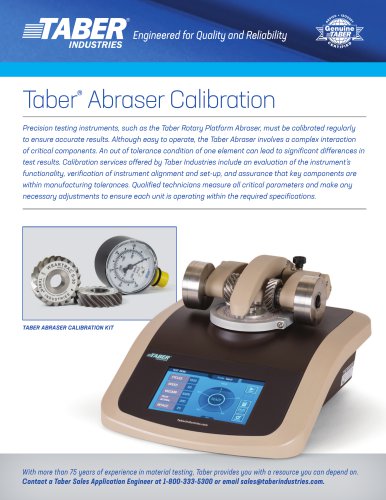 Taber Abraser - Calibration
2 Pages
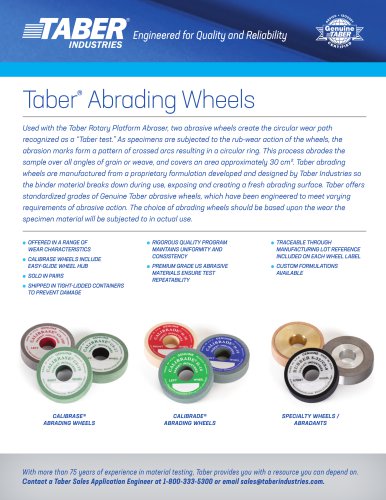 Taber Abrading Wheels
2 Pages
 Model 430/530
2 Pages
 Model 414/514
1 Page
 Falling Sand Abrasion Tester
2 Pages
 Model M2211
2 Pages
 Crockmeter
2 Pages
 Fabric Stiffness Tester
2 Pages
 Taber Grit Feeder Attachment
2 Pages
 Webbing Abrasion Tester
2 Pages
 Reciprocating Abraser
2 Pages
 Heavy Duty Linear Abraser
2 Pages
 TABER Optical Micrometer
2 Pages


Archived catalogs
 TABER Linear Abraser
2 Pages
 TABER Multi-Media Abraser
2 Pages


- Test machine
- Automated testing machine
- Material test machine
- Automatic test kit
- Micrometer
- Manual test equipment
- Taber Industries pressure transducer
- Resistance testing machine
- Taber Industries analog pressure transducer
- Mechanical testing machine
- Taber Industries membrane pressure transducer
- Torsion testing machine
- Manual testing machine
- Taber Industries stainless steel pressure transducer
- Taber Industries relative pressure transducer
- Precision test kit
- Material test kit
- Taber Industries DC pressure transducer
- Taber Industries gas pressure transducer
- Leather testing machine