


TMA

TMA
The Discovery TMA 450 by TA Instruments is a cutting-edge Thermomechanical Analyzer designed for high performance, sensitivity, and versatility, catering to the demands of high-performing materials in challenging applications.
The TMA 450 features a non-contact, friction-free motor for precise force application, a high-resolution measurement transducer, and advanced testing modes such as Modulated TMA, Dynamic TMA, Creep, and Stress Relaxation. It includes a Mechanical Cooling Accessory for controlled cooling and is supported by TRIOS software for enhanced user experience.
Equipped with a low-mass furnace for precise temperature control, a quartz sample stage, and a Linear Variable Differential Transducer, the TMA 450 ensures accurate dimension change measurements. The force motor provides controlled force application for quality measurements across various deformation modes.
The TMA 450 supports various test fixtures including expansion, penetration, tension, compression, and 3-point bending, allowing comprehensive analysis of material properties such as thermal expansion and mechanical behavior.
An ergonomic touch screen interface and TRIOS software offer extensive data analysis capabilities, supporting multiple instrument control, real-time data analysis, and seamless calibration processes.
Compliant with ASTM and ISO standards, the TMA 450 is suitable for applications in coatings, laminates, and automotive components, providing insights into material behavior for harsh environments.
The Discovery TMA 450 is a versatile tool for thermomechanical analysis, offering advanced features and comprehensive testing capabilities for scientists and engineers.
The document outlines various TMA techniques and their applications, focusing on measuring material properties under different conditions.
These tests monitor displacement or strain under constant force during a linear temperature increase, measuring intrinsic material properties.
Force is increased while strain is measured at a constant temperature, generating force/displacement plots and assessing modulus.
Strain is kept constant while monitoring the force required during a temperature ramp, useful for assessing shrinkage forces in materials like films and fibers.
CTE measures mechanical expansion or contraction with temperature changes, with formulas and examples provided for calculation, particularly for aluminum.
3-point bending tests determine the deflection temperature under load (DTUL) for materials like PVC, predicting material performance.
Dynamic TMA (DTMA) and modulated TMA (MTMA) provide insights into viscoelastic properties and separate overlapping transitions.
These tests involve ramping stress or strain and measuring the resulting strain or stress at a constant temperature, providing stress/strain plots and modulus information.
Sinusoidal force and temperature ramp measure viscoelastic properties like storage modulus, loss modulus, and damping factor.
This technique separates simultaneous expansion and contraction events, useful for detecting glass transitions and stress relaxation events.
The MCA 70 provides a broad temperature range for TMA operations, enabling cyclic heating/cooling experiments.
Detailed specifications for the Discovery TMA 450EM and TMA 450 include temperature range, precision, sample size, and force range.
Catalog excerpts

DISCOVER the WORLD’S FINEST THERMOMECHANICAL ANALYZER
Open the catalog to page 1
DISCOVER a TMA that delivers Superior Performance Unmatched Sensitivity Maximum Versatility
Open the catalog to page 2
Thermomechanical Analysis TA Instruments invites you to experience the finest in Thermomechanical Analyzers, the Discovery TMA 450. Discover the advanced engineering and attention to detail that provides enhancements in every aspect of performance and a new level of user experience. Featuring advanced testing capabilities and the widest range of fixtures, the Discovery TMA is sure to meet and exceed your expectations. It’s never been easier to get great TMA data! Features and Benefits: • Non-contact, friction-free motor delivers forces from 0.001 N to 2 N enabling measurements on the widest range...
Open the catalog to page 3
Instrument Design Furnace TA Instruments’ engineering experience in design and integration of critical furnace, dimension measurement, and atmosphere-control components meld with powerful, flexible TRIOS software to ensure configuration flexibility and Sample Stage maximum versatility on the Discovery TMA 450. Furnace The TMA 450 features a highly-responsive low-mass furnace designed for the most precise control of temperature from -150°C to 1000°C and stable heating rates in the range of 0.1 to 100 °C/min. The furnace ensures the superior baseline performance required for accurate dimension...
Open the catalog to page 4
Test Fixtures Expansion Expansion Expansion measurements determine a material’s coefficient of thermal expansion (CTE), glass transition temperature (Tg), and compression modulus. A flat-tipped standard expansion probe is placed on the sample (a small static force may be applied), and the sample is subjected to a temperature program. Probe movement records sample expansion or contraction. This test is used with most solid samples. The larger surface area of the macro-expansion probe facilitates analysis of soft or irregular samples, powders, and films, and the dilatometer fixture allows the determination...
Open the catalog to page 5
“APP Style” Touch Screen Touch Screen Features and Benefits: TA’s innovative touch screen, • Ergonomic design for enhanced accessibility and productivity making operation easier than ever with enhanced One-TouchAway™ functionality. • Packed with functionality to simplify instrument operation • Resilient, responsive touch screen for an enhanced user experience The One-Touch-Away™ interface includes: • Start/stop controls • Real-time signals and plot • Active method viewing • Temperature settings • Probe and force calibrations • Probe position and sample measurement settings • System information...
Open the catalog to page 6
TRIOS Software TA Instruments' state-of-the-art software package uses cutting-edge technology for instrument control, data collection, and data analysis for thermal analysis and rheology. The intuitive user interface allows you to simply and effectively program experiments, and move easily between processing experiments and viewing and analyzing data. The Most VERSATILE CONTROL and ANALYSIS SOFTWARE! TRIOS Features: Control multiple instruments with a single PC and software package Overlay and compare results across techniques including TMA, DMA, DSC, TGA, SDT, and rheometers Unlimited licenses...
Open the catalog to page 7
Thermomechanical analysis (TMA) measures material dimensional changes under controlled conditions of force, atmosphere, time and temperature. In the typical operation of a TMA, a small sample with parallel and flat surfaces is placed on a quartz stage near a thermocouple. A quartz probe is lowered against the specimen with a constant applied force. As the sample is heated or cooled, changes in dimension are measured by monitoring the motion of the quartz probe. Meeting and exceeding industry standards* for testing, the Discovery TMA 450 provides information about the material’s coefficient of...
Open the catalog to page 8
Standard Tests The three most commonly used experiments are included on the Discovery TMA 450 as standard tests; these include the temperature ramp, force ramp and isostrain test templates. Coefficient of Thermal Expansion The most common property measured on a TMA is the coefficient of thermal expansion (CTE).The CTE describes the mechanical expansion or contraction of a material at different temperatures. It is an important property of a material, and negligence to take into account the effect temperature has on the physical size of materials has been known to cause product failures and delamination....
Open the catalog to page 9
This example demonstrates the use of the expansion probe to accurately measure small CTE changes in an aluminum sample over a 200°C temperature range. TRIOS software permits analysis of the curve slope using a variety of methods to compute the CTE at a selected temperature or over a range. Point-to-Point Method α= 27.6 µm/m˚C Average Method α= 26.8 µm/m˚C Accurate Coefficient of Thermal Expansion Measurements Aluminum Expansion Probe Size: 7.62 µm Prog.: 5˚C/min Atm.: N2 Material Performance and Selection The figure to the left is an example of a 3-point bending test (flexure probe) plot indicate...
Open the catalog to page 10
Stress/Strain Test Creep and Stress Relaxation Strain Stress Creep and Stress Relaxation Stress or strain is ramped, and the resulting strain or stress is measured at a constant temperature. Using customer-entered sample geometry factors, the data provides both stress/strain plots and related modulus information. In addition, calculated modulus can be displayed as a TMA can also measure viscoelastic properties using transient (creep or stress Strain / Stress Stress (Strain) Stress/Strain Tests relaxation) tests. In a creep experiment, input stress is held constant, and resulting strain is monitored...
Open the catalog to page 11
TA's industry-leading Modulated TMATM efficiently separates simultaneous expansion and contraction in a material. Through deconvolution of the total dimensional change, an event such as the glass transition occurring in the same temperature region as stress relaxation is easily revealed. In Modulated TMATM (MTMATM), the sample experiences the combined effects of a sinusoidal temperature oscillation overlaid on the traditional linear ramp. The output signals (after Fourier transformation of the raw data) are total displacement and the change in thermal expansion coefficient. Modulated TMA separates...
Open the catalog to page 12All TA Instruments catalogs and technical brochures
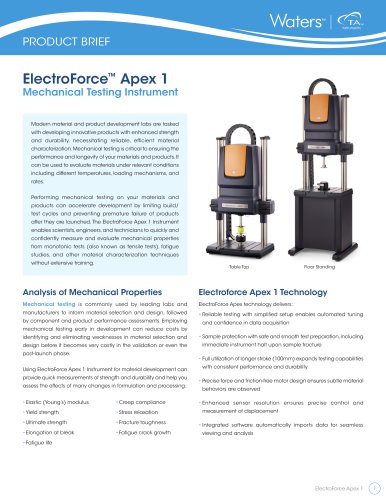 ElectroForce™ Apex 1
6 Pages
 DCR_series
16 Pages
 RSDSC-DSC-ITC
54 Pages
 HEATING MICROSCOPE - HSML
2 Pages
 HEATING MICROSCOPE - HSM
2 Pages
 Broch DHR Accessories
73 Pages
 Discovery SA
17 Pages
 Discovery Hybrid Rheometer
23 Pages
 DMA 3200 - High Force DMA
13 Pages
 SDT
SDT28 Pages
 TGA
TGA26 Pages
 DILATOMETRY
13 Pages
 ISOTHERMAL CALORIMETRY
34 Pages
 MICROCALORIMETRY: ITC & DSC
44 Pages
 VAPOR SORPTION ANALYSIS
8 Pages
 RUBBER TESTING
19 Pages
 RSA-G2 SOLIDS ANALYZER
28 Pages
 DMA
DMA23 Pages
 Discover DSC SYSTEMS
20 Pages
 RUBOTHERM SERIES DYNTHERM® TGA
22 Pages
 IsoSORP®
13 Pages
 BROCH-DSDT
28 Pages
 HIGH PERFORMANCE TGA SYSTEMS
26 Pages
 ARES-G2 RHEOMETER
36 Pages
 AIR CHILLER SYSTEM
4 Pages
 TAM AIR ISOTHERMAL CALORIMETRY
23 Pages
 MICROCALORIMETRY: TAM IV & 48
48 Pages
 Nano DSC and DSC Auto
14 Pages
 ARES-G2 RHEOMETER
16 Pages
 VTI-SA+
6 Pages
 Discovery TGA Brochure
19 Pages
 Discovery DSC Brochure
14 Pages
 Microcalorimetry
60 Pages
 Thermal Analysis
68 Pages


Archived catalogs
 DILATOMETRY PUSH-ROD AND OPTICAL
23 Pages
- Test machine
- TA Instruments gas analyzer
- Measuring device
- Concentration analyzer
- Automation software solution
- Monitoring analyzer
- Liquids analyzer
- Test stand
- Process software
- TA Instruments automatic analyzer
- Real-time software
- Microscope
- Computer-aided design software
- Automated testing machine
- Material test machine
- Cloud-based software
- Control software
- Indentation hardness tester
- TA Instruments benchtop analyzer