
- Catalogs
- TA Instruments
- TA-Instruments-Discovery-TMA450-Brochure-EN


TA-Instruments-Discovery-TMA450-Brochure-EN
TA-Instruments-Discovery-TMA450-Brochure-EN
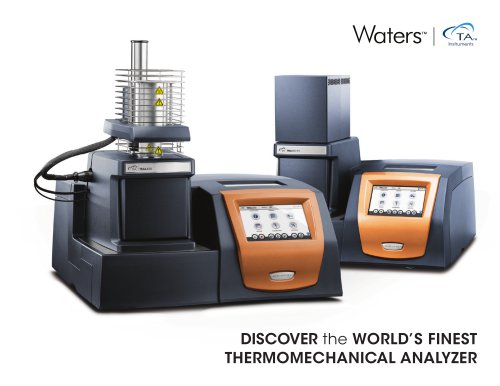
The document introduces the Discovery TMA 450, a Thermomechanical Analyzer by TA Instruments, known for its superior performance, sensitivity, and versatility. It highlights the advanced engineering and user-friendly experience provided by the instrument.
- Non-contact, friction-free motor offering forces from 0.001 N to 2 N for diverse sample measurements.
- High-resolution measurement transducer for precise dimensional change measurement.
- Advanced testing modes including Modulated TMA, Dynamic TMA, Creep, and Stress Relaxation.
- Mechanical Cooling Accessory for temperature control without liquid nitrogen.
- TRIOS software for instrument control, data analysis, and reporting.
- Innovative touch screen interface for enhanced usability.
- Five-year furnace warranty for quality assurance.
The TMA 450 provides detailed information on material properties such as coefficient of linear thermal expansion, shrinkage, softening, and glass transition temperatures, meeting industry standards like ASTM and ISO.
- Furnace: Low-mass furnace for precise temperature control from -150°C to 1000°C.
- Sample Stage: Made of quartz, optimized for a wide operational range.
- Displacement Transducer: Provides 15 nm resolution and ±2.5 mm dynamic range.
- Friction-Free Force Motor: Provides controlled force for quality measurements.
- Expansion: Measures thermal expansion, glass transition temperature, and compression modulus.
- Penetration: Focuses on small sample areas for precise measurement of glass transition and softening behavior.
- Tension: Assesses stress/strain properties of films and fibers.
- 3-Point Bending: Determines bending properties of stiff materials.
The TMA 450 RH is designed for controlled relative humidity experiments, offering a broad range of RH and temperature capabilities, including a gas humidifier and a heated vapor transfer line.
- Assessing CHE: Measures the coefficient of hygroscopicity for materials like Kapton.
- Comparing Hygroscopicity: Evaluates the hygroscopicity of advanced polymers.
- Detecting Tg: Tracks changes in glass transition temperature due to water uptake.
- Shrinking on Drying: Measures forces involved in material shrinkage during drying.
- Ergonomic design enhances accessibility and productivity.
- Functionality simplifies instrument operation.
- Resilient, responsive touch screen improves user experience.
- Intuitive interface for programming experiments and data analysis.
- Allows control of multiple instruments with a single PC.
- Features include one-click analysis, automated report generation, and data export in various formats.
- TRIOS Guardian offers electronic signatures for audit trails.
- Advanced data collection system saves all relevant signals and settings.
- TRIOS JSON Export Feature integrates data with lab systems and data science tools.
- Measures material dimensional changes under controlled conditions.
- Provides information on CTE, shrinkage, softening, and more.
- Standard tests include temperature ramp, force ramp, and isostrain.
- Advanced tests include stress ramp, strain ramp, and modulated TMA.
- TMA is used for understanding material compatibility and suitability in harsh environments.
- Standard applications include measuring CTE, phase transition temperatures, and stress-strain curves.
- Advanced applications provide insights into storage and loss moduli, damping properties, and relaxation behavior.
The document provides a detailed analysis of the capabilities and applications of the TMA 450EM, a thermal mechanical analyzer used for testing polymeric films and fibers. It highlights various advanced operational tests and the benefits of using the TMA 450EM for material analysis.
The TMA 450EM can function as a mini tensile tester, determining tensile modulus through stress-strain relationships. It offers a temperature range of -150 to 1000°C with a precision of ±1°C and a heating rate of 0.1 to 150°C/min. The maximum sample size for solid materials is 26 mm (L) x 10 mm (D), and for films/fibers, it varies based on static or dynamic operation.
The TMA 450EM includes Modulated TMA™ (MTMA™) for separating simultaneous expansion and contraction, Dynamic TMA for viscoelastic properties, and Creep/Stress Relaxation tests for transient conditions. These tests provide insights into the mechanical behavior of materials under various conditions.
Creep tests measure strain over time under constant stress, while stress relaxation tests measure stress decay under constant strain. These tests are crucial for understanding material behavior in applications where stress changes are expected.
This technique separates total dimensional changes into reversing and non-reversing signals, aiding in the detection of events like glass transitions. It is particularly useful for analyzing overlapping transitions in materials.
Dynamic TMA applies a sinusoidal force and temperature ramp to measure viscoelastic properties such as storage modulus (E’), loss modulus (E”), and tan δ. This method is effective for analyzing materials like polyethylene terephthalate (PET) films.
The MCA 70 accessory allows for unattended TMA and MTMA operations over a broad temperature range, facilitating cyclic heating/cooling experiments. It features a two-stage refrigeration system with a temperature range of -70°C to 400°C.
The document outlines the controlled cooling rates and operational tests available with the TMA 450EM, emphasizing its precision and sensitivity in various testing scenarios.
TA Instruments has a global presence with offices in the Americas, Europe, Asia, and Australia, ensuring widespread availability and support for their products.
Catalog excerpts
DISCOVER the WORLD’S FINEST THERMOMECHANICAL ANALYZER Dynamic Vapor Sorption Analyzer
Open the catalog to page 1
DISCOVER a TMA that delivers Superior Performance Unmatched Sensitivity Maximum Versatility
Open the catalog to page 2
DISCOVERY TMA THERMOMECHANICAL ANALYSIS TA Instruments invites you to experience the finest in Thermomechanical Analyzers, the Discovery TMA 450. Discover the advanced engineering and attention to detail that provides enhancements in every aspect of performance and a new level of user experience. Featuring advanced testing capabilities and the widest range of fixtures, the Discovery TMA 450 is sure to meet and exceed your expectations. It’s never been easier to get great TMA data! Features and Benefits: • Non-contact, friction-free motor delivers forces from 0.001 N to 2 N enabling measurements...
Open the catalog to page 3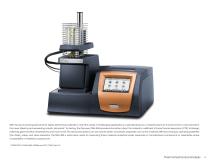
With the ever-increasing demands for higher performing materials to meet the needs of challenging applications, understanding how a material reacts to its environment is more important than ever. Meeting and exceeding industry standards* for testing, the Discovery TMA 450 provides information about the material’s coefficient of linear thermal expansion (CTE), shrinkage, softening, glass transition temperatures, and much more.The advanced options can be used to obtain viscoelastic properties such as the material’s stiffness (modulus), damping properties (tan delta), creep, and stress relaxation....
Open the catalog to page 4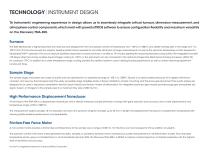
TECHNOLOGY INSTRUMENT DESIGN TA Instruments’ engineering experience in design allows us to seamlessly integrate critical furnace, dimension measurement, and atmosphere-control components, which meld with powerful TRIOS software to ensure configuration flexibility and maximum versatility on the Discovery TMA 450. Furnace The TMA 450 features a highly-responsive low-mass furnace designed for the most precise control of temperature from -150°C to 1000°C and stable heating rates in the range of 0.1 to 100°C/min. The furnace ensures the superior baseline performance required for accurate dimension...
Open the catalog to page 5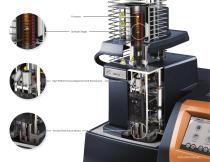
Sample Stage High Performance Displacement Transducer Friction-Free Force Motor Instrument Design
Open the catalog to page 6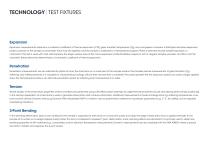
TECHNOLOGY TEST FIXTURES Expansion Expansion measurements determine a material’s coefficient of thermal expansion (CTE), glass transition temperature (Tg), and compression modulus. A flat-tipped standard expansion probe is placed on the sample (a small static force may be applied), and the sample is subjected to a temperature program. Probe movement records sample expansion or contraction. This test is used with most solid samples. The larger surface area of the macro-expansion probe facilitates analysis of soft or irregular samples, powders, and films, and the volumetric fixture allows the determination...
Open the catalog to page 7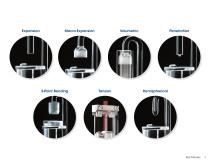
Test Fixtures
Open the catalog to page 8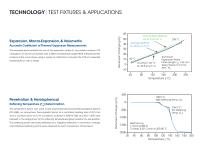
TECHNOLOGY TEST FIXTURES & APPLICATIONS Expansion, Macro-Expansion, & Volumetric Accurate Coefficient of Thermal Expansion Measurements This example demonstrates the use of the expansion probe to accurately measure CTE changes in an aluminum sample over a 200°C temperature range. TRIOS software permits analysis of the curve slope using a variety of methods to compute the CTE at a selected temperature or over a range. Point-to-Point Method α= 27.6 µm/m˚C Average Method α= 26.8 µm/m˚C Softening Temperature (Ts) Determination The penetration fixture was used to test polycarbonate/acrylonitrile-butadiene-styrene...
Open the catalog to page 9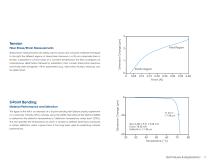
Tension Fiber Stress/Strain Measurements Stress/strain measurements are widely used to assess and compare materials. The figure to the right the different regions of stress/strain behavior in a 25 mm polyamide fiber in tension, subjected to a force ramp at a constant temperature. The fiber undergoes an instantaneous deformation followed by retardation, then a linear stress/strain response, and finally yield elongation. Other parameters (e.g., yield stress, Young’s modulus) can be determined. Yield Region 3-Point Bending Material Performance and Selection The figure to the left is an example of...
Open the catalog to page 10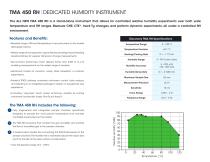
The ALL NEW TMA 450 RH is a stand-alone instrument that allows for controlled relative humidity experiments over both wide temperature and RH ranges. Measure CHE, CTE*, track Tg changes, and perform dynamic experiments, all under a controlled RH environment. Features and Benefits: • Broadest range of RH and Temperature of any instrument on the market (See graph below). • Widest range of low-expansion quartz fixtures providing industry-leading baseline flatness for superior dimension change measurements. • Non-contact, friction-free motor delivers forces from 0.001 N to 2 N enabling measurements...
Open the catalog to page 11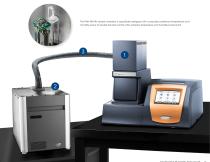
The TMA 450 RH sample chamber is specifically designed with a precisely positioned temperature and humidity sensor to provide the best control of the sample s temperature and humidity environment.
Open the catalog to page 12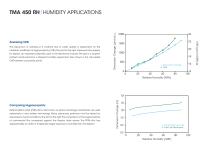
The expansion or swelling of a material due to water uptake is dependent on the material’s coefficient of hygroscopicity (CHE). The plot to the right measures this property for Kapton, an important polyimide used in the electronics industry. The plot is a sorption isotherm produced from a stepped humidity experiment. Also shown is the calculated CHE between successive points. Comparing Hygroscopicity Perflurosulfonic Acid (PFSA) films, also known as proton exchange membranes, are used extensively in new battery technology. Many advanced polymers must be tested for responses to humid conditions....
Open the catalog to page 13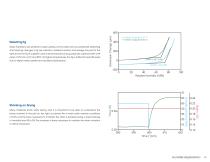
Detecting Tg Glass transitions are sensitive to water uptake, as the water acts as a plasticizer. Detecting and tracking changes in Tg are critical to material function and storage. The plot to the right shows the Tg of a gelatin used in pharmaceutical drug capsules captured with a RH ramp of 2%/min at 37 and 50°C. At higher temperatures, the Tg is shifted to lower RH levels due to higher water uptake and resultant plasticization. 600 Gelatin Capsule @ 37˚C Gelatin Capsule @ 50˚C forces involved. In the plot on the right, a polymer film is held under isostrain conditions of 0.2% and the force...
Open the catalog to page 14All TA Instruments catalogs and technical brochures
 DIL_805
9 Pages
 TA-Instruments-DIL-Brochure-EN
25 Pages
 TA-Instruments-HR-Brochure-EN
50 Pages
 TA-Instruments-HP-Brochure-EN
34 Pages
 TA-Instruments-DCR-Brochure-EN
26 Pages
 ta_rubber_testing
19 Pages
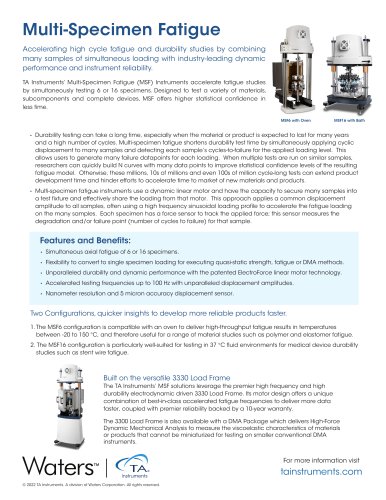 MSF-Cutsheet
2 Pages
 BROCH-TAM-lV
49 Pages
 BROCH-HT-VIS-413
11 Pages
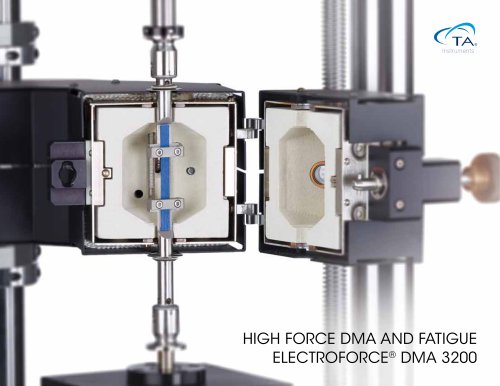 BROCH-EF-DMA3200
13 Pages
Archived catalogs
 Thermal Analysis
68 Pages
 Microcalorimetry
60 Pages
 Discovery DSC Brochure
14 Pages
 Discovery TGA Brochure
19 Pages
 VTI-SA+
6 Pages
 ARES-G2 RHEOMETER
16 Pages
 Nano DSC and DSC Auto
14 Pages
 MICROCALORIMETRY: TAM IV & 48
48 Pages
 TAM AIR ISOTHERMAL CALORIMETRY
23 Pages
 AIR CHILLER SYSTEM
4 Pages
 ARES-G2 RHEOMETER
36 Pages
 HIGH PERFORMANCE TGA SYSTEMS
26 Pages
 BROCH-DSDT
28 Pages
 IsoSORP®
13 Pages
 RUBOTHERM SERIES DYNTHERM® TGA
22 Pages
 Discover DSC SYSTEMS
20 Pages
 DMA
23 Pages
 RSA-G2 SOLIDS ANALYZER
28 Pages
 RUBBER TESTING
19 Pages
 VAPOR SORPTION ANALYSIS
8 Pages
 TMA
15 Pages
 MICROCALORIMETRY: ITC & DSC
44 Pages
 ISOTHERMAL CALORIMETRY
34 Pages
 DILATOMETRY
13 Pages
 TGA
26 Pages
 SDT
28 Pages
 DMA 3200 - High Force DMA
13 Pages
 Discovery Hybrid Rheometer
23 Pages
 Discovery SA
17 Pages
 Broch DHR Accessories
73 Pages
 HEATING MICROSCOPE - HSM
2 Pages
 HEATING MICROSCOPE - HSML
2 Pages
 RSDSC-DSC-ITC
54 Pages
 DCR_series
16 Pages
 ElectroForce™ Apex 1
6 Pages
 DILATOMETRY PUSH-ROD AND OPTICAL
23 Pages


- Test machine
- Measuring device
- TA Instruments gas analyzer
- Concentration analyzer
- Automation software solution
- Monitoring analyzer
- Analysis software solution
- Liquids analyzer
- Test stand
- Process software
- TA Instruments automatic analyzer
- Real-time software
- Microscope
- Computer-aided design software
- Material test machine
- Automated testing machine
- Cloud-based software
- Indentation hardness tester
- Control software
- TA Instruments benchtop analyzer