
- Catalogs
- TA Instruments
- TA-Instruments-DIL-Brochure-EN


TA-Instruments-DIL-Brochure-EN
TA-Instruments-DIL-Brochure-EN
Catalog excerpts
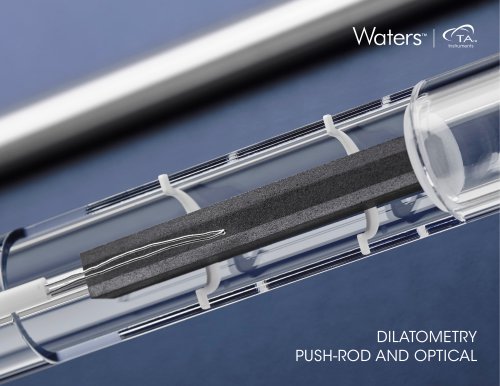
DILATOMETRY PUSH-ROD AND OPTICAL
Open the catalog to page 1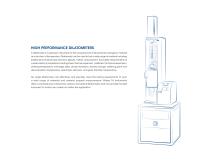
HIGH PERFORMANCE DILATOMETERS A dilatometer is a precision instrument for the measurement of dimensional changes in material as a function of temperature. Dilatometry can be used to test a wide range of material including traditional and advanced ceramics, glasses, metals, and polymers. It provides measurements of a wide variety of properties including linear thermal expansion, coefficient of thermal expansion, sintering temperature, shrinkage steps, phase transitions, density change, softening point and decomposition temperature, anisotropic behavior, and glass transition temperature. No single...
Open the catalog to page 3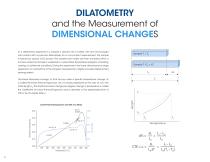
DIMENSIONAL CHANGES In a dilatometry experiment, a sample is placed into a holder with one end brought into contact with a push-rod. Alternatively, for a non-contact measurement, the sample is framed by optical CCD sensors. The sample and holder are then enclosed within a furnace where the sample is subjected to a prescribed temperature program of heating, cooling, or isothermal conditions. During the experiment, the linear dimensional change (expansion or contraction) of the sample is measured by a highly accurate displacement sensing system. The linear dimension change, AL, that occurs under...
Open the catalog to page 4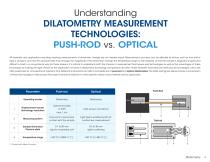
All materials and applications requiring exacting measurements of dimension change are not created equal. Measurement accuracy can be affected by factors such as how soft or rigid a sample is and how this physical state may change, the magnitude of the dimension change, the temperature range or rate required, or that the sample is irregularly shaped and difficult to load in a conventional way. For these reasons, it is critical to understand both the choices in measurement techniques and technologies as well as the advantages of these techniques for making the right choice for the application...
Open the catalog to page 5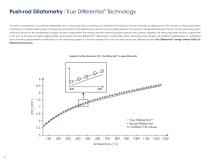
Push-rod Dilatometry True Differential™ Technology The main components of a push-rod dilatometer are a measuring head consisting of a displacement sensor and force controller to apply load to the sample, a measuring system consisting of a sample holding tube and push-rod connected to the displacement sensor, and a movable furnace. The sample is sandwiched between the end of the measuring system and the push-rod. As the temperature changes during an experiment, the sample and the measuring system expand and contract together. The measuring head records a signal that is the sum of all these changes....
Open the catalog to page 6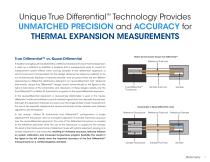
Unique True Differential™ Technology Provides UNMATCHED PRECISION and ACCURACY for THERMAL EXPANSION MEASUREMENTS True DifferentialTM vs. Quasi-Differential Waters TA Instruments Unique True DifferentialTM Reference Push-rod In traditional single push-rod dilatometry, a reference standard of known thermal expansion is used as a calibrant to establish a baseline that is subsequently used to correct for measurement system effects when running samples. In the “differential” approach, a second push-rod is incorporated into the design, allowing the reference calibrant to be run simultaneously leading...
Open the catalog to page 7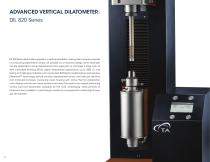
ADVANCED VERTICAL DILATOMETER DIL 820 Series DIL 820 Series dilatometers operate in a vertical orientation making them uniquely capable of conducting experiments simply not possible on a horizontal design. Some examples include applications where displacement from expansion or shrinkage is large such as Rate Controlled Sintering (RCS), higher temperature applications up to 2000 °C, and testing of challenging materials such as powders. 820 Series models feature exclusive True Differential™ technology, optical encoder displacement sensor, new fast-cool dynamic and motorized furnaces, measuring...
Open the catalog to page 8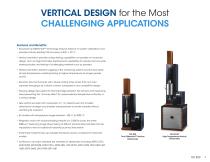
• Exclusive True Differential™ technology reduces reliance on system calibrations and provides industry leading CTE accuracy of 0.01 x 10⁻⁶ K-1 • Vertical orientation provides unique testing capabilities not possible on horizontal design, such as large frictionless displacement capabilities for precise and accurate sintering studies, and testing of challenging materials such as powders • Vertical orientation prevents sagging of the measuring systems and furnace tubes at high temperatures, enabling testing to higher temperatures for longer periods of time • Dynamic fast-cool furnaces with natural...
Open the catalog to page 9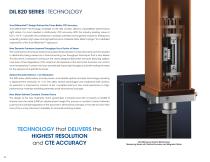
DIL 820 SERIES TECHNOLOGY True Differential™ Design Delivers Ten Times Better CTE Accuracy True Differential™ technology, available on DIL 822 models, delivers unparalleled performance right where it is most needed in dilatometry: CTE accuracy. With the industry leading value of 0.01 x 10⁻⁶ K-1, it provides the confidence in analysis scientists and engineers require for testing and evaluating today’s high value and high-performance materials. Note: Refer to page 7 for a detailed explanation of the True Differential TM approach. New Dynamic Furnaces Improve Throughput by a Factor of Seven The...
Open the catalog to page 10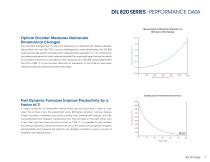
DIL 820 SERIES PERFORMANCE DATA Measurement of Nanoscale Expansion on 650 micron Thick Sample Optical Encoder Measures Nanoscale Dimensional Changes being those with very low CTE’s, can be challenging for some dilatometers. The DIL 820 series incorporate optical encoders with a displacement resolution of 1 nm, making the accurate measurement of such materials possible.The upper right graph shows the results of a sample of Alumina of only 650 µm thick measured on a DIL 822 vertical dilatometer from RT to 1200 °C. It can be seen here that an expansion of only 2.26 µm was easily The accurate measurement...
Open the catalog to page 11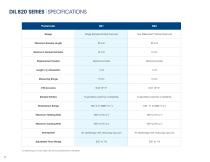
(*) Depending on furnace option. See furnace specifications for full details.
Open the catalog to page 12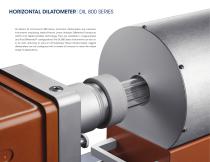
HORIZONTAL DILATOMETER DIL 800 SERIES All Waters TA Instruments 800 Series horizontal dilatometers are precision instruments employing state-of-the-art Linear Variable Differential Transducer (LVDT) and digital amplifier technology. They are available in single-sample and True Differential™ configurations. The DIL 800 Series instruments can be run in air, inert, reducing, or vacuum atmospheres. These industry tested, rugged dilatometers can be configured with a variety of furnaces to meet the widest range of applications.
Open the catalog to page 14All TA Instruments catalogs and technical brochures
 DIL_805
9 Pages
 TA-Instruments-HR-Brochure-EN
50 Pages
 TA-Instruments-HP-Brochure-EN
34 Pages
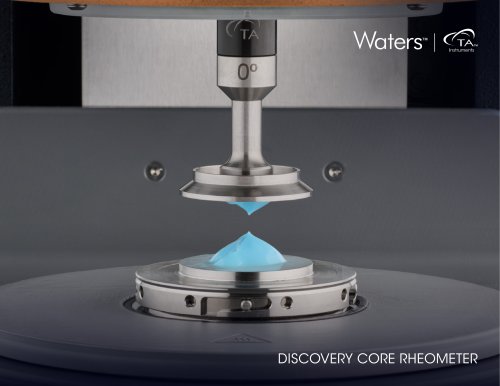 TA-Instruments-DCR-Brochure-EN
26 Pages
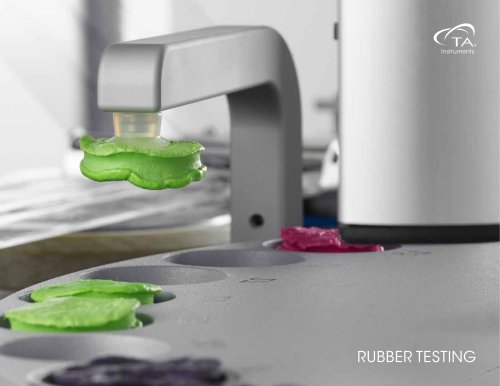 ta_rubber_testing
19 Pages
 MSF-Cutsheet
2 Pages
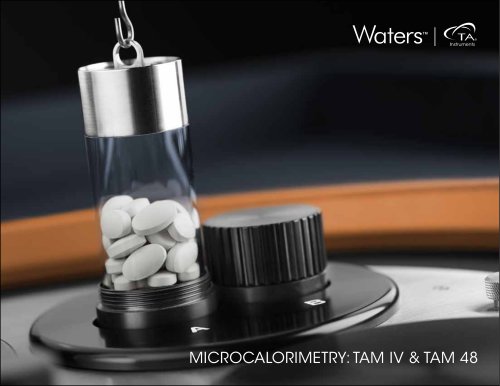 BROCH-TAM-lV
49 Pages
 BROCH-HT-VIS-413
11 Pages
 BROCH-EF-DMA3200
13 Pages
Archived catalogs
 Thermal Analysis
68 Pages
 Microcalorimetry
60 Pages
 Discovery DSC Brochure
14 Pages
 Discovery TGA Brochure
19 Pages
 VTI-SA+
6 Pages
 ARES-G2 RHEOMETER
16 Pages
 Nano DSC and DSC Auto
14 Pages
 MICROCALORIMETRY: TAM IV & 48
48 Pages
 TAM AIR ISOTHERMAL CALORIMETRY
23 Pages
 AIR CHILLER SYSTEM
4 Pages
 ARES-G2 RHEOMETER
36 Pages
 HIGH PERFORMANCE TGA SYSTEMS
26 Pages
 BROCH-DSDT
28 Pages
 IsoSORP®
13 Pages
 RUBOTHERM SERIES DYNTHERM® TGA
22 Pages
 Discover DSC SYSTEMS
20 Pages
 DMA
23 Pages
 RSA-G2 SOLIDS ANALYZER
28 Pages
 RUBBER TESTING
19 Pages
 VAPOR SORPTION ANALYSIS
8 Pages
 TMA
15 Pages
 MICROCALORIMETRY: ITC & DSC
44 Pages
 ISOTHERMAL CALORIMETRY
34 Pages
 DILATOMETRY
13 Pages
 TGA
26 Pages
 SDT
28 Pages
 DMA 3200 - High Force DMA
13 Pages
 Discovery Hybrid Rheometer
23 Pages
 Discovery SA
17 Pages
 Broch DHR Accessories
73 Pages
 HEATING MICROSCOPE - HSM
2 Pages
 HEATING MICROSCOPE - HSML
2 Pages
 RSDSC-DSC-ITC
54 Pages
 DCR_series
16 Pages
 ElectroForce™ Apex 1
6 Pages
 DILATOMETRY PUSH-ROD AND OPTICAL
23 Pages


- Test machine
- Measuring device
- TA Instruments gas analyzer
- Concentration analyzer
- Automation software solution
- Monitoring analyzer
- Analysis software solution
- Liquids analyzer
- Test stand
- Process software
- TA Instruments automatic analyzer
- Real-time software
- Microscope
- Computer-aided design software
- Material test machine
- Automated testing machine
- Cloud-based software
- Indentation hardness tester
- Control software
- TA Instruments benchtop analyzer