
- Catalogs
- TA Instruments
- MSF-Cutsheet


MSF-Cutsheet
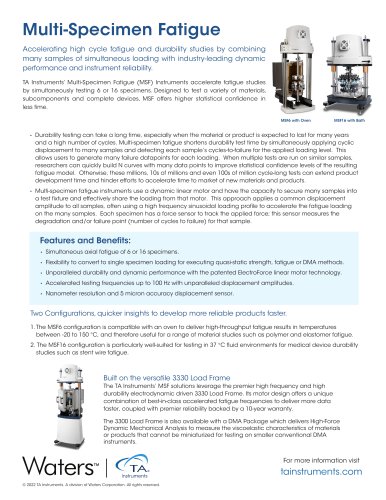
MSF-Cutsheet
- Simultaneous testing of 6 or 16 specimens for axial fatigue.
- Flexibility to switch to single specimen loading for various testing methods.
- Utilizes patented ElectroForce linear motor technology for superior durability and dynamic performance.
- Testing frequencies up to 100 Hz with high displacement amplitudes.
- High precision with nanometer resolution and 5-micron accuracy displacement sensor.
- MSF6 Configuration: Compatible with an oven for testing at temperatures between -20 to 150 °C, suitable for materials like polymers and elastomers.
- MSF16 Configuration: Ideal for testing in 37 °C fluid environments, particularly for medical device durability studies such as stent wire fatigue.
- Maximum displacement of 25 mm across all configurations.
- Maximum force per sample: 3,000 N for single, 225 N for MSF6, and 100 N for MSF16.
- Maximum test frequency of 100 Hz.
- Built on the 3330 Load Frame, known for high frequency and durability.
- Offers a DMA Package for high-force dynamic mechanical analysis.
Catalog excerpts
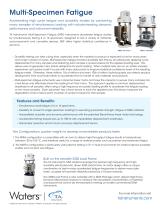
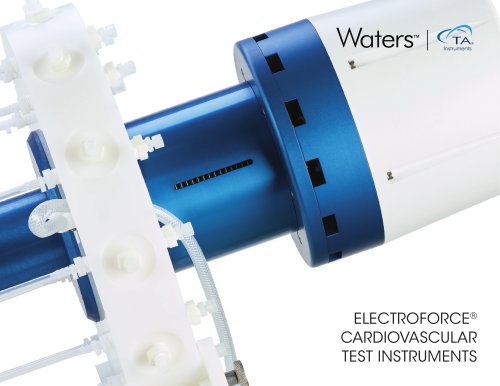
Multi-Specimen Fatigue Accelerating high cycle fatigue and durability studies by combining many samples of simultaneous loading with industry-leading dynamic performance and instrument reliability. TA Instruments’ Multi-Specimen Fatigue (MSF) Instruments accelerate fatigue studies by simultaneously testing 6 or 16 specimens. Designed to test a variety of materials, subcomponents and complete devices, MSF offers higher statistical confidence in less time. MSF6 with Oven • Durability testing can take a long time, especially when the material or product is expected to last for many years and a high number of cycles. Multi-specimen fatigue shortens durability test time by simultaneously applying cyclic displacement to many samples and detecting each sample’s cycles-to-failure for the applied loading level. This allows users to generate many failure datapoints for each loading. When multiple tests are run on similar samples, researchers can quickly build N curves with many data points to improve statistical confidence levels of the resulting fatigue model. Otherwise, these millions, 10s of millions and even 100s of million cycle-long tests can extend product development time and hinder efforts to accelerate time to market of new materials and products. • Multi-specimen fatigue instruments use a dynamic linear motor and have the capacity to secure many samples into a test fixture and effectively share the loading from that motor. This approach applies a common displacement amplitude to all samples, often using a high frequency sinusoidal loading profile to accelerate the fatigue loading on the many samples. Each specimen has a force sensor to track the applied force; this sensor measures the degradation and/or failure point (number of cycles to failure) for that sample. Features and Benefits: • Simultaneous axial fatigue of 6 or 16 specimens. • Flexibility to convert to single specimen loading for executing quasi-static strength, fatigue or DMA methods. • Unparalleled durability and dynamic performance with the patented ElectroForce linear motor technology. • Accelerated testing frequencies up to 100 Hz with unparalleled displacement amplitudes. • Nanometer resolution and 5 micron accuracy displacement sensor. Two Configurations, quicker insights to develop more reliable products faster. 1. The MSF6 configuration is compatible with an oven to deliver high-throughput fatigue results in temperatures between -20 to 150 °C, and therefore useful for a range of material studies such as polymer and elastomer fatigue. 2. The MSF16 configuration is particularly well-suited for testing in 37 °C fluid environments for medical device durability studies such as stent wire fatigue. Built on the versatile 3330 Load Frame The TA Instruments’ MSF solutions leverage the premier high frequency and high durability electrodynamic driven 3330 Load Frame. Its motor design offers a unique combination of best-in-class accelerated fatigue frequencies to deliver more data faster, coupled with premier reliability backed by a 10-year warranty. The 3300 Load Frame is also available with a DMA Package which delivers High-Force Dynamic Mechanical Analysis to measure the viscoelastic characteristics of materials or products that cannot be miniaturized for testing on smaller conventional DMA instruments. For more information visit tainstruments.com © 2022 TA Instruments. A division of Waters Corporation.
Open the catalog to page 1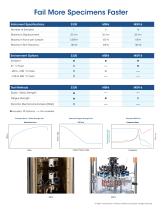
Environment Options Instrument Specifications Ambient 37 °C Fluid -20 to +150 °C Oven Test Methods Quasi - Static Strength Fatigue Strength Dynamic Mechanical Analysis (DMA) i Included, O Optional, — Not available © 2022 TA Instruments. A division of Waters Corporation. All rights reserved.
Open the catalog to page 2All TA Instruments catalogs and technical brochures
 DIL_805
9 Pages
 TA-Instruments-DIL-Brochure-EN
25 Pages
 TA-Instruments-HR-Brochure-EN
50 Pages
 TA-Instruments-HP-Brochure-EN
34 Pages
 TA-Instruments-DCR-Brochure-EN
26 Pages
 ta_rubber_testing
19 Pages
 BROCH-TAM-lV
49 Pages
 BROCH-HT-VIS-413
11 Pages
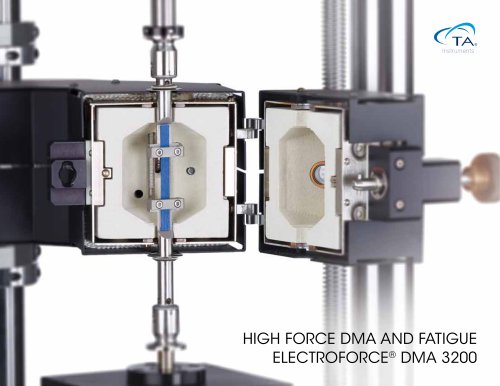 BROCH-EF-DMA3200
13 Pages
Archived catalogs
 Thermal Analysis
68 Pages
 Microcalorimetry
60 Pages
 Discovery DSC Brochure
14 Pages
 Discovery TGA Brochure
19 Pages
 VTI-SA+
6 Pages
 ARES-G2 RHEOMETER
16 Pages
 Nano DSC and DSC Auto
14 Pages
 MICROCALORIMETRY: TAM IV & 48
48 Pages
 TAM AIR ISOTHERMAL CALORIMETRY
23 Pages
 AIR CHILLER SYSTEM
4 Pages
 ARES-G2 RHEOMETER
36 Pages
 HIGH PERFORMANCE TGA SYSTEMS
26 Pages
 BROCH-DSDT
28 Pages
 IsoSORP®
13 Pages
 RUBOTHERM SERIES DYNTHERM® TGA
22 Pages
 Discover DSC SYSTEMS
20 Pages
 DMA
23 Pages
 RSA-G2 SOLIDS ANALYZER
28 Pages
 RUBBER TESTING
19 Pages
 VAPOR SORPTION ANALYSIS
8 Pages
 TMA
15 Pages
 MICROCALORIMETRY: ITC & DSC
44 Pages
 ISOTHERMAL CALORIMETRY
34 Pages
 DILATOMETRY
13 Pages
 TGA
26 Pages
 SDT
28 Pages
 DMA 3200 - High Force DMA
13 Pages
 Discovery Hybrid Rheometer
23 Pages
 Discovery SA
17 Pages
 Broch DHR Accessories
73 Pages
 HEATING MICROSCOPE - HSM
2 Pages
 HEATING MICROSCOPE - HSML
2 Pages
 RSDSC-DSC-ITC
54 Pages
 DCR_series
16 Pages
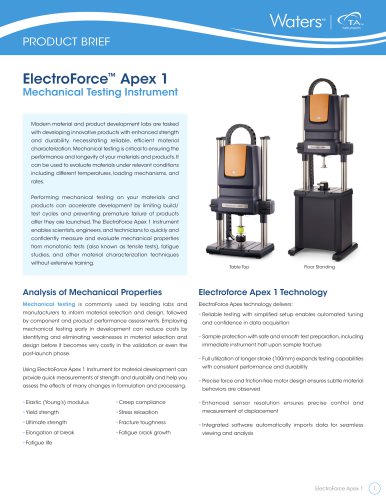 ElectroForce™ Apex 1
6 Pages
 DILATOMETRY PUSH-ROD AND OPTICAL
23 Pages


- Test machine
- Measuring device
- TA Instruments gas analyzer
- Concentration analyzer
- Automation software solution
- Monitoring analyzer
- Analysis software solution
- Liquids analyzer
- Test stand
- Process software
- TA Instruments automatic analyzer
- Real-time software
- Microscope
- Computer-aided design software
- Material test machine
- Automated testing machine
- Cloud-based software
- Indentation hardness tester
- Control software
- TA Instruments benchtop analyzer