
- Catalogs
- T&B electronic GmbH
- Spark switch

- Company
- Products
- Catalogs
- News & Trends
- Exhibitions
Spark switch

Spark switch
Catalog excerpts

Spark sensor Fire protection and predictive maintenance in one. Simple monitoring of fire risks Sparks and embers in machining processes cause enormous fire damage every year. However, anyone who has never had a fire in production is unable to assess the specific risks in their own company. This is why industrial and craft businesses are often unsure whether and what fire risks are present in their machines or systems. If it is not yet clear whether it is worth investing in an automatic extinguishing system, the first step can be an evaluation. In such cases in particular, a simple process monitoring system with a spark sensor is suitable – as a starting point and as minimum protection for the company and the environment. Minimum protection increases safety Predictive maintenance On the one hand, the spark sensor makes it easy to determine the actual danger posed by sparks or glowing embers during operation. At the same time, it ensures a minimum level of safety for production and personnel against fires and explosions. The spark sensor is also used for predictive maintenance. If the spark sensor detects ignition sources conspicuously often, this can be an indication that the tool is starting to wear or that there are faults in the machine. Both the investment and the outlay are manageable and affordable, even for small businesses. This real-time process monitoring gives users a constant overview of all processes and enables immediate action to be taken in the event of deviations and errors. It is then possible to get to the bottom of the cause in good time and rectify the problem before further damage occurs.
Open the catalog to page 1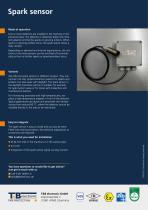
Spark sensor Mode of operation One or more detectors are installed in the machine or the extraction pipe. The detector or detectors detect the infrared radiation emitted by sparks or glowing embers. When sparks or glowing embers occur, the spark sensor closes a relay contact. Depending on demand and internal requirements, the machine or the entire process can be switched off automatically so that no further sparks or glowing embers occur. Variants We offer the spark sensors in different versions. They can monitor not only closed extraction systems for sparks and embers, but also areas with daylight....
Open the catalog to page 2All T&B electronic GmbH catalogs and technical brochures
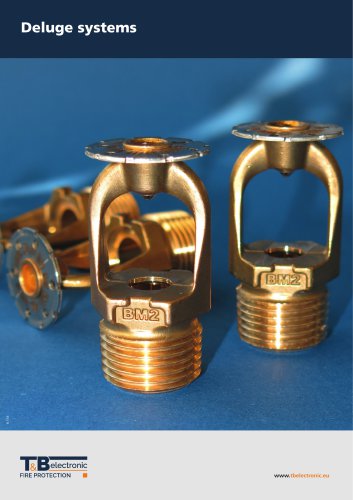 Deluge systems
8 Pages
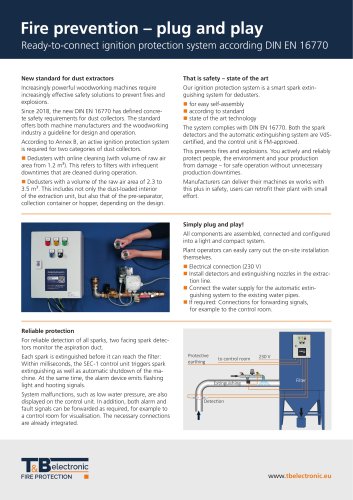 Ignition protection system
2 Pages
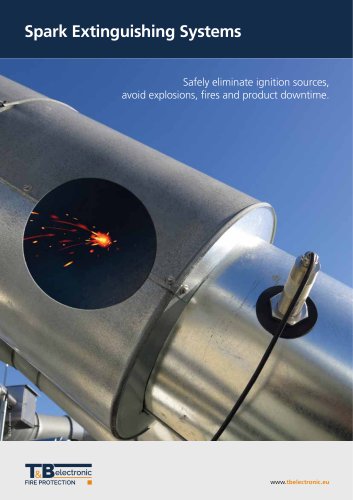 Spark extingushing systems
4 Pages
- Industrial detector
- Monitoring detector
- Infrared detector
- Detector with alarm
- Compact detector
- Explosion-proof detector
- Process detector
- Real-time detector
- Optical detector
- Detector with audible alarm
- Detector with visual alarm
- Fire extinguishing system
- Security detector
- Heat detector
- Fire detector
- Fire detection and alarm unit
- Spark detector
- Electrical field detector
- Automatic fire detection and alarm unit
- Filter monitoring detector