
- Catalogs
- Synventive Molding Solutions
- Sprue Bushing / Single Nozzle 04 S01


Sprue Bushing / Single Nozzle 04 S01

Sprue Bushing / Single Nozzle 04 S01
Overview
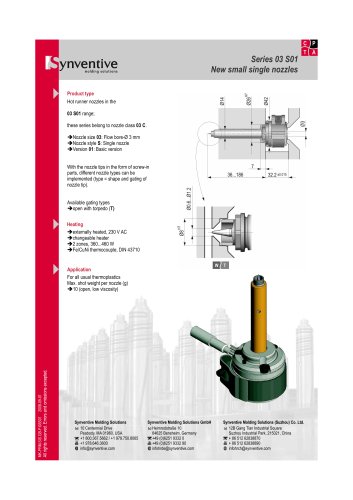
This document provides comprehensive technical specifications, design guidelines, and configuration instructions for the Synventive 04 S01 series hot runner nozzles, focusing on dimensional data, nozzle tip variants, heating zones, and application recommendations for thermoplastic materials.
1. Product Description and Classification
- Series & Type: 04 S01 series, single nozzle, open style with a 4 mm flow bore diameter.
- Nozzle Versions: Basic version succeeding the CA ... E series.
- Nozzle Tip Types: Multiple gating types including open, open with torpedo, and valve gate options.
- Heating Zones: Typically 2 zones numbered from nozzle tip to head, with power ratings up to 410 W per zone.
- Thermocouple: Fe/CuNi type compliant with DIN 437 standard.
- Operating Voltage: 230 V AC externally heated.
- Application: Suitable for all common thermoplastics; maximum shot weight per nozzle is 70 g for open, low viscosity materials.
2. Dimensional Specifications and Tolerances
- Key Dimensions: Nozzle length (L), head height (H), bore diameters (Dt), centring diameters, and radii (R) are precisely defined with tolerances.
- Tolerances: General tolerances follow DIN ISO 2768-mK standard.
- Length Range: Nozzle lengths vary from 36 mm to 126 mm depending on length code and tip shape.
- Cut Out Details: Specific dimensions for mould plate cut outs, nozzle tips, and locking pin groove/bore ensure correct installation and rotation prevention.
3. Nozzle Tip Variants and Gating Types
Several nozzle tip shapes and gating types are described, each optimized for different processing windows and material characteristics:
- Y01T: Open with torpedo, version 01 for medium to wide process windows.
- Y02T: Open with torpedo, version 02 for narrow to medium process windows.
- Y03T: Open with torpedo, version 03 designed for abrasive materials.
- F01T: Open with torpedo, version 01 with a different tip shape (F) for medium to wide process windows.
- Additional Series: F02T, F03T, W01T, W02T, and X01T series with specific tip shapes and cooling requirements; some optimized for abrasive materials.
All variants require cooling around or opposite the nozzle tip and must be positioned so the nozzle tip front contacts the plastic directly.
4. Configuration and Selection Guidelines
- Nozzle Description Completion: Users must specify series, type, length code, and heater zone power based on provided tables and schematic drawings.
- Length Code: Corresponds to specific nozzle lengths or ranges depending on series.
- Heater Zones: Numbered from nozzle tip; power ratings standardized up to 410 W per zone.
- Drawings: Provided illustrations are schematic and not to scale but serve as essential configuration references.
5. Installation and Application Notes
- Locking Pin Groove/Bore: Prevents nozzle rotation; detailed dimensions referenced (page 2 of original document).
- Mould Plate Cut Outs: Must follow specified dimensions for proper nozzle and connection fit.
- Surface and Shape Tolerances: Critical for sealing and mechanical stability.
- Consultation: Recommended for specific applications or deviations from standard configurations.
6. Standards and References
- General tolerances and surface finish requirements comply with DIN ISO 2768-mK.
- Thermocouple specifications follow DIN 437.
- Further design and application details are available in the Synventive Hot Runner Guide.
Critical Parameters and Limitations
- Maximum nozzle length: up to 126 mm depending on tip and length code.
- Maximum nozzle contact radius: 40 mm.
- Maximum length tolerance: ±0.05 mm.
- Maximum heater power per zone: 410 W.
- Maximum shot weight per nozzle: 70 g for open, low viscosity materials.
Summary
This document serves as a detailed technical reference for selecting, specifying, and installing Synventive 04 S01 series hot runner nozzles. It highlights the importance of precise dimensional control, multiple nozzle tip options tailored to processing needs, and adherence to international standards to ensure optimal performance in thermoplastic injection molding applications.
Catalog excerpts

tr.row {} td.cell {} div.block {} div.paragraph {}
Open the catalog to page 3
tr.row {} td.cell {} div.block {} div.paragraph {}
Open the catalog to page 4
tr.row {} td.cell {} div.block {} div.paragraph {}
Open the catalog to page 5
tr.row {} td.cell {} div.block {} div.paragraph {}
Open the catalog to page 6
tr.row {} td.cell {} div.block {} div.paragraph {}
Open the catalog to page 7
tr.row {} td.cell {} div.block {} div.paragraph {}
Open the catalog to page 8
tr.row {} td.cell {} div.block {} div.paragraph {}
Open the catalog to page 9
tr.row {} td.cell {} div.block {} div.paragraph {}
Open the catalog to page 11All Synventive Molding Solutions catalogs and technical brochures
 Series 06 S
4 Pages
 Series 12 S
4 Pages
 Mixing & Filter Nozzles
12 Pages


Archived catalogs
 Examples of Hot Runners in use
20 Pages
 Hot Runner Systems
7 Pages
 Manifold Nozzles, Threaded
5 Pages
 Manifolds VH
6 Pages
 Manifolds VF
6 Pages
 Manifolds VC
45 Pages
 Manifolds VD
6 Pages
 Manifolds VE
6 Pages
 Manifolds VI
6 Pages
 Hot Runner Guide
34 Pages
 Threaded / Screw Fit 22 E02
17 Pages
 Threaded / Screw Fit T16
16 Pages
 Support Ring / Face Fit SR16
16 Pages
 Threaded / Screw Fit 16 E01
17 Pages
 Support Ring / Face Fit 04 C01
16 Pages
 Support Ring / Face Fit 04 C03
16 Pages
 Support Ring / Face Fit SR8
11 Pages
 Dynamic Feed
14 Pages
 Support Ring / Face Fit SR24
14 Pages
 Support Ring / Face Fit SR20
22 Pages
 Machine Nozzles
12 Pages
 Threaded / Screw Fit 07 E01
15 Pages
 Threaded / Screw Fit 12 E01
17 Pages
 Hot Halves
6 Pages
 Threaded / Screw Fit 16 E02
17 Pages
 Threaded / Screw Fit 22 E01
17 Pages
 Valve Gate
20 Pages
 Threaded / Screw Fit T20
21 Pages
 Threaded / Screw Fit T24
13 Pages






- Actuator
- Linear actuator
- Digital temperature control
- Liquid nozzle
- Temperature controller
- Digital temperature controller
- Pack unit
- Automation temperature controller
- Electric hydraulic power unit
- Screw-in single nozzle
- Multi-channel manifold
- Pneumatic actuator
- Industrial tip
- Temperature control unit
- Double-acting actuator
- Digital temperature control unit
- Plastic nozzle
- Control actuator
- Compact hydraulic power unit
- Standard actuator