
- Catalogs
- Synventive Molding Solutions
- Mixing & Filter Nozzles


Mixing & Filter Nozzles

Mixing & Filter Nozzles
Catalog excerpts
Machine Nozzles molding solutions
Open the catalog to page 1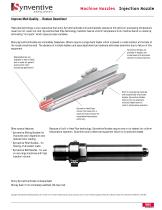
Machine Nozzles Injection Nozzle Improve Melt Quality... Reduce Downtime! Heat pipe technology is your assurance that every Synventive Nozzle will automatically operate at the optimum processing temperature; never too hot, never too cold. Synventive Heat Pipe technology transfers heat at uniform temperature from machine barrel to nozzle tip, eliminating “hot spots” which cause process variables. Many Synventive Nozzles are completely heaterless. Others require a single band heater which is placed in a safe location at the back of the nozzle (machine end). The absence of multiple heaters and associated...
Open the catalog to page 2
Machine Nozzles Heat Pipe Technology The Superconductor for Heat Transfer! The Heat Pipe is a hollow or evacuated chamber, inside of which is a liquid and a capillary wick, which acts as a transport device. The phenomena of evaporation, condensation, and surfacetension pumping of liquid in the wick are used to transfer latent heat of vaporization continuously from one region to another. No external forces are required to activate the Heat Pipe; only a heat source is necessary. All Synventive Nozzles include a location for a heater band and thermocouple. If you choose to operate the Synventive...
Open the catalog to page 3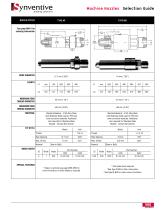
Machine Nozzles Selection Guide NOZZLE STYLES See page MN11 for ordering information BORE DIAMETER LENGTH MINIMUM REAR THREAD DIAMETER MAXIMUM REAR THREAD DIAMETER Standard Material - 4140 Alloy Steel (420 Stainless Steel used for PVC and other corrosive materials. Additional cost required for Stainless Steel Nozzles - Contact Synventive) Standard Material - 4140 Alloy Steel (420 Stainless Steel used for PVC and other corrosive materials. Additional cost required for Stainless Steel Nozzles - Contact Synventive) Metric Thread Rear Opening Rear Opening SPECIAL FEATURES * Heater is optional (see...
Open the catalog to page 4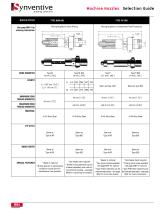
Machine Nozzles Selection Guide NOZZLE STYLES See page MN11 for ordering information TYPE M/M-BIG TYPE F/F-BIG Mixing Nozzles for Color Mixing BORE DIAMETER *Heater is optional *Mixing element is permanently bonded to nozzle bore for maintenance free operation *One heater band required *M-BIG mixing elements can be ordered separately and used on conventional nozzles - see page MN8 for machining information Mixing Nozzles for Contaminant Free Processing MINIMUM REAR THREAD DIAMETER MAXIMUM REAR THREAD DIAMETER MATERIAL BAND HEATER SPECIAL FEATURES *One heater band required *Heater is optional...
Open the catalog to page 5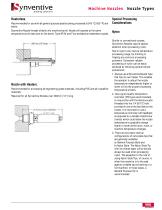
Machine Nozzles Nozzle Types Heaterless. Recommended for use with all general purpose plastics being processed at 343 °C [650 °F] and below. Synventive Nozzle threads directly into machine barrel. Nozzle will operate at the same temperature as the last zone on the barrel. Type AP, M and F are available as heaterless nozzles. Special Processing Considerations Nylon Similar to conventional nozzles, Synventive Nozzles require special attention when processing nylon. Due to nylon’s very narrow temperature processing range, tip drooling or freezing are common processing problems. Consistent reliable...
Open the catalog to page 6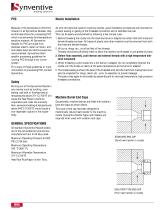
Nozzle Installation Because of the temperature uniformity inherent in all Synventive Nozzles, they are the ideal choice for processing PVC, which is an extremely time/temperature sensitive material. All Synventive Nozzles for PVC are made from stainless steel to resist corrosion, and one heater band and thermocouple are recommended. Synventive offers specific processing guidelines for running PVC through a hot runner system. As with conventional injection machine nozzles, good installation procedures are important to prevent seizing or galling of the threaded connection and to facilitate removal....
Open the catalog to page 7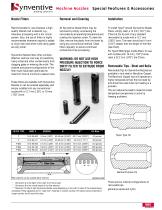
Machine Nozzles Special Features & Accessories Nozzle Filters Recommended for use whenever a high quality filtered melt is desired, e.g., whenever processing with a hot runner system. Also, the use of filters is highly recommended whenever regrind is added to virgin resin and when mold cavity gates are very small. All Synventive Nozzle filters may be removed by simply unscrewing the removable tip at operating temperature and rotating the injection screw. To clean the filter, remove the plastic from the insert by using any conventional method. Clean filters regularly to ensure continued contaminant-free...
Open the catalog to page 8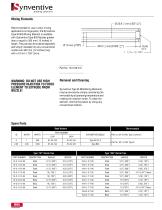
Mixing Elements Recommended for use in color mixing applications on large parts, the Synventive Type M-BIG Mixing Element is available with Synventive Type BIG Nozzles greater than or equal to 300 mm [12 inches] in length. They can also be ordered separately and simply installed into any conventional nozzle over 300 mm [12 inches] long with a 19 mm [.750”] bore. WARNING: DO NOT USE HIGH PRESSURE INJECTION TO FORCE ELEMENT TO EXTRUDE FROM NOZZLE! Synventive Type M-BIG Mixing Elements may be removed by simply unscrewing the removable tip at operating temperature and rotating the injection screw....
Open the catalog to page 9
Machine Nozzles Start-up and Operation Start-Up Sufficient soak time must be given to allow the Synventive Nozzle to reach operating temperature prior to operation. 1. If the Synventive Nozzle is already in the cold barrel prior to start-up, then the nozzle will reach operating temperature at nearly the same time as the barrel. It is good practice to have the nozzle tip away from the mold during warm up. If possible, check the condition of the plastic in the tip of the nozzle. This would be the last portion to soften and is a direct indication that everything is up to temperature. 2. If the Synventive...
Open the catalog to page 10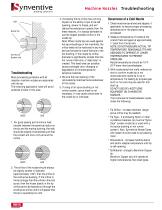
Machine Nozzles Troubleshooting 3. Increasing the tip orifice has a strong impact on the ability of tips to be self opening, slower to freeze, and will reduce the resistance to plastic flow. For these reasons, it is always advisable to use the largest possible orifice in the nozzle tip. Note: When nozzle tips are used against hot sprue bushings or hot manifolds, the orifice need not be restricted in any way and can be sized to match the bore in the hot bushing. If the nozzle tip orifice diameter is significantly smaller than the hot runner inlet bore, a “dead area” is created. This dead area...
Open the catalog to page 11All Synventive Molding Solutions catalogs and technical brochures
 Series 06 S
4 Pages
 Series 12 S
4 Pages


Archived catalogs
 Examples of Hot Runners in use
20 Pages
 Hot Runner Systems
7 Pages
 Manifold Nozzles, Threaded
5 Pages
 Manifolds VH
6 Pages
 Manifolds VF
6 Pages
 Manifolds VC
45 Pages
 Manifolds VD
6 Pages
 Manifolds VE
6 Pages
 Manifolds VI
6 Pages
 Hot Runner Guide
34 Pages
 Threaded / Screw Fit 22 E02
17 Pages
 Threaded / Screw Fit T16
16 Pages
 Support Ring / Face Fit SR16
16 Pages
 Threaded / Screw Fit 16 E01
17 Pages
 Support Ring / Face Fit 04 C01
16 Pages
 Support Ring / Face Fit 04 C03
16 Pages
 Support Ring / Face Fit SR8
11 Pages
 Dynamic Feed
14 Pages
 Support Ring / Face Fit SR24
14 Pages
 Support Ring / Face Fit SR20
22 Pages
 Machine Nozzles
12 Pages
 Threaded / Screw Fit 07 E01
15 Pages
 Threaded / Screw Fit 12 E01
17 Pages
 Hot Halves
6 Pages
 Threaded / Screw Fit 16 E02
17 Pages
 Threaded / Screw Fit 22 E01
17 Pages
 Valve Gate
20 Pages
 Threaded / Screw Fit T20
21 Pages
 Threaded / Screw Fit T24
13 Pages






- Actuator
- Linear actuator
- Digital temperature control
- Liquid nozzle
- Temperature controller
- Digital temperature controller
- Pack unit
- Automation temperature controller
- Electric hydraulic power unit
- Screw-in single nozzle
- Multi-channel manifold
- Pneumatic actuator
- Industrial tip
- Temperature control unit
- Double-acting actuator
- Digital temperature control unit
- Plastic nozzle
- Control actuator
- Compact hydraulic power unit
- Hydraulic actuator