
- Catalogs
- Syntron Material Handling
- Vibrator Flowaids

Vibrator Flowaids

Vibrator Flowaids
Syntron® Vibrators are engineered to enhance material flow from bins, hoppers, and chutes, improving productivity and reducing costs. They come in two main types: electromagnetic and electric rotary vibrators, suitable for diverse industries and environments.
These vibrators are suitable for continuous and intermittent operations, featuring adjustable controls for optimal material flow. They are maintenance-free due to the lack of moving parts and are mostly dust-tight and waterproof, ensuring durability. Key benefits include adjustable vibration force and a variety of sizes for specific applications.
These motor-driven vibrators reduce noise levels and are enclosed for reliable operation in tough environments. They have adjustable eccentric weights to fit various applications.
The document details specifications for various models, including dimensions, weight, input amps, and speed for both 50 Hz and 60 Hz operations. Models range from compact units like V-2 and V-4 to larger units like V-500, designed for specific applications based on wall thickness and material capacity.
Vibrator selection is based on the thickness of the bin or chute wall and the capacity in the tapered portion of the bin. An application tabulation table assists in selecting the appropriate model. For applications exceeding rated capacity, multiple vibrators may be needed.
Syntron® Vibrators provide a comprehensive solution for maintaining material flow in industrial settings, with various models to meet specific needs. Their robust design and ease of use make them a reliable choice for enhancing productivity and reducing manual labor.
The document provides detailed specifications for various models of electric rotary vibrators, categorized by phase, RPM, and voltage requirements. Models are divided into single-phase and three-phase categories.
Models such as AMV1-70BM and AMV1-50AM operate at 220-240V with different frequency settings.
Models like AMV2-70BO and AMV2-50AQ operate at higher voltages and are designed for three-phase power.
Specifications for 2-pole and 4-pole models are listed, indicating differences in RPM and other performance metrics.
Detailed dimensions are provided for each model, crucial for ensuring proper installation and compatibility with existing systems.
The document emphasizes 4-bolt and 6-bolt mounting configurations, essential for optimal performance and safety.
This technical document serves as a comprehensive guide for selecting and installing electric rotary vibrators, providing all necessary specifications and dimensions to ensure compatibility and performance.
The document provides detailed specifications for electric rotary vibrators, including models with 4 and 6 bolt mounting options, operating at 1,200 RPM and 1,800 RPM, 60Hz, and 460V.
Each model is listed with specific attributes such as weight, centrifugal force, static moment, max input power, max current, temperature class, and cable entry dimensions.
The document includes overall reference dimensions for the vibrators, detailing measurements such as length, width, and height in inches for various models.
These vibrators are suitable for industrial applications requiring precise vibration control, with options for different mounting configurations and power requirements.
The document provides specifications for electric rotary vibrators, including models VV171B/8 and VV221B/8, with details such as dimensions, bolt configurations, and operational parameters.
The document outlines procedures for mounting Syntron® Electric Rotary Vibrators, emphasizing the importance of selecting and installing vibrators based on application requirements.
For optimal performance, vibrators should be mounted at specific positions depending on the type of bin or hopper.
Syntron Material Handling is highlighted as a leader in vibration technology, offering reliable and low-maintenance equipment. Contact information for offices in Saltillo, Mississippi, and Changshu, China, is provided.
Catalog excerpts

Syntnon Material Handling
Open the catalog to page 1
Syntron Vibrators . . . . . . . . . . . . . . . . . . . . . . . . . . . . . . . . . . . . . . . . 3 Electromagnetic Vibrators . . . . . . . . . . . . . . . . . . . . . . . . . . . . . . 4 Electric Rotary Vibrators . . . . . . . . . . . . . . . . . . . . . . . . . . . . . . 14
Open the catalog to page 2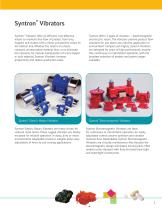
Syntron Vibrators offer an efficient, cost-effective means to maintain free flow of product from bins, hoppers and chutes, with a direct and positive result on the bottom line. Whether the need is to ensure constant, uninterrupted material flow, or to eliminate the necessity for manual manipulation of a bin, hopper or bulk material, Syntron Vibrators increase productivity and reduce production costs. Syntron Electric Rotary Vibrators Syntron Electric Rotary Vibrators are motor driven for reduced noise levels. These rugged vibrators are totally enclosed for reliable operation in dusty, dirty or...
Open the catalog to page 3
Syntron® Electromagnetic Vibrators Keep Your Materials Flowing Efficiently and Economically Syntron® Electromagnetic Vibrators from Syntron Material Handling offer an economical means of maintaining the flow of bulk materials from bins, hoppers and chutes. They come with an easily adjustable control which provides flexibility and assures optimum flow for the type of material being handled. Furthermore, Syntron Electromagnetic Vibrators can be operated continuously or intermittently depending upon the specific requirements. To assure the highest standard of quality, Syntron Electromagnetic Vibrators...
Open the catalog to page 4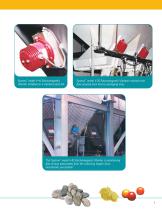
Syntron model V-41 Electromagnetic Vibrator installed on a stainless steel bin. Syntron model V-20 Electromagnetic Vibrators maintain the flow of pasta from bins to packaging lines. This Syntron model V-85 Electromagnetic Vibrator is maintaining flow of dust particulates from the collecting hopper of an electrostatic precipitator.
Open the catalog to page 5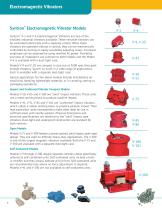
Syntron® Electromagnetic Vibrator Models • • a V-2 V-4 Syntron® V-2 and V-4 Electromagnetic Vibrators are two of the smallest industrial vibrators available. These versatile vibrators can be controlled electrically with a separate control. When these vibrators are operated without a control, they can be mechanically controlled by turning an easily accessible adjusting screw. Increased amplitude can be obtained by using rectified AC power. Flexibility and ease of installation are common to both models and the Model V-4 is available with a dust-tight case. Models V-9 and V-20 are compact in size,...
Open the catalog to page 6
Syntron® model V-20 Electromagnetic Vibrator ensures controlled feed from hopper to extruder. The primary consideration in vibrator selection is the thickness of the bin or chute waLL. Once the proper vibrator model has been seLected from the AppLication Tabulation Table, compare the capacity in the tapered portion of the bin with the rated capacity shown in the table. If the rated capacity is exceeded, multiple vibrators may be required, depending on the materiaL being handled. Stiffeners used to reinforce the bin or chute may also affect the seLection or preferred location of the vibrator....
Open the catalog to page 7
When ordering, specify 50 or 60 Hz operation. Refer to control information, page 10. For other voltage requirements, contact Syntron Material Handling.
Open the catalog to page 8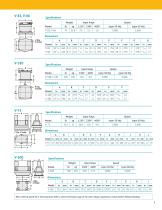
When ordering, specify 50 or 60 Hz operation. Refer to control information, page 10. For other voltage requirements, contact Syntron Material Handling.
Open the catalog to page 9
• Standard in the model listed * Conductor controls are also available in open chassis models for ease in mounting in your system controls. Note: Some open chassis models have reduced amperage capability. Contact Syntron Material Handling for details.
Open the catalog to page 10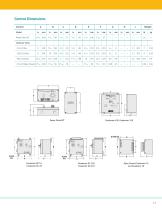
Open Chassis Conductor 15 and Conductor 28
Open the catalog to page 11
Mounting Syntron® Electromagnetic Vibrators Correct Location of electromagnetic vibrators is of prime importance in obtaining maximum efficiency from the selected model. Note: Operate vibrators on hoppers only when the hopper is open to flow. Otherwise, vibration may pack the hopper contents. Curved Surfaces To mount a vibrator to a curved surface, select a bracket made from a channel section or a bent plate. A center gusset is required for all totally enclosed vibrators, and two blocks of sufficient height to contact the curved surface are required for Models V-75 and V-500. The selected gusset...
Open the catalog to page 12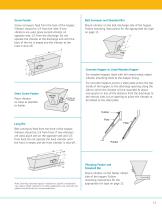
Screw Feeder Belt Conveyor and Standard Bin Screw conveyors feed from the back of the hopper. Vibrator should be 1/3 from the inlet. If two vibrators are used, place second vibrator on opposite side, 1/3 from the discharge. Do not operate the vibrator at the discharge end until the back of the bin is empty and the vibrator at the inlet is shut off. Mount vibrator on the belt discharge side of the hopper. Follow mounting instructions for the appropriate bin type on page 12. Concrete Hopper or Lined Wooden Hopper For wooden hoppers lined with thin sheet metal, attach vibrator mounting bolts to...
Open the catalog to page 13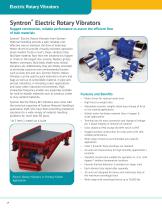
Syntron® Electric Rotary Vibrators from Syntron Material Handling provide a safe, reliable, cost-effective way to maintain the flow of materials. Motor-driven to provide virtually noiseless operation (most models 76 db or less*), these vibrators help facilitate material flow from the smallest bin, hopper or chute to the largest silo, screens, feeders, grizzly feeders, conveyors, fluid beds, shake-outs, helical elevators, etc. Additionally, they are totally enclosed to eliminate concerns over environmental factors such as dust, dirt and rain. Syntron Electric Rotary Vibrators can be used to pack...
Open the catalog to page 14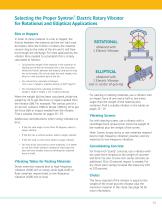
Selecting the Proper Syntron Electric Rotary Vibrator for Rotational and Elliptical Applications Bins or Hoppers In order to move material in a bin or hopper, the friction between the material and the bin wall must be broken. Once the friction is broken, the material cannot cling to the sides of the bin and it will flow out through the discharge. For most applications, the vibrator force needed to accomplish this is simply calculated as follows: • Calculate the weight of the material in the transition or sloping part of the bin. Normally, this is the only place where the friction between the...
Open the catalog to page 15All Syntron Material Handling catalogs and technical brochures
 Syntron® Vibrating Conveyors
24 Pages
 Vibrating Screens Catalog
36 Pages
 Screw Conveyor Catalog
6 Pages
 Bin Vibrator Catalog
30 Pages
 Paper Joggers Catalog
20 Pages
 Material Handling
2 Pages
 Syntron Vibrating Tables
6 Pages
 Syntron Vibrators
48 Pages
 Syntron Screen Feeders
6 Pages
 Belt Conveyor Idler
160 Pages
 Syntron High Velocity
2 Pages
 Syntron Jogger
20 Pages
 Syntron Vibrating Screens
36 Pages
 CEMA Series E4000 Idlers
36 Pages
 CEMA Series C2000 Idlers
22 Pages
 CEMA Series B2000 Idlers
22 Pages
 Ball Bearing Idlers
8 Pages
 Working with Isolation
20 Pages
 Aggregates
20 Pages
 Coal Handling
20 Pages
 Syntro-Flo
2 Pages
 Link-Belt Bucket Elevator
26 Pages
 Working with Hoppers
28 Pages
 Syntron Power Pulse Control
2 Pages
 C2000
C20002 Pages
 Link-Belt Screw Conveyor
101 Pages
 Link-Belt Underground
32 Pages
 Link-Belt Idler
160 Pages
 Syntron® Vibrators
48 Pages


Archived catalogs
 PowerPulse WT
2 Pages
 HV-10
HV-102 Pages