- Catalogs
- Synopsys, Inc.
- RSoft Photonic Device Tools

RSoft Photonic Device Tools
RSoft Photonic Device Tools
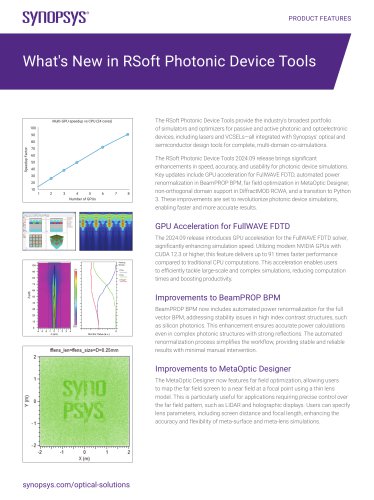
- GPU Acceleration for FullWAVE FDTD: The introduction of GPU acceleration using NVIDIA GPUs with CUDA 12.3 or higher significantly boosts simulation speed, achieving up to 91 times faster performance than CPU computations. This is particularly beneficial for large-scale and complex simulations.
- BeamPROP BPM Improvements: Automated power renormalization is now available for full vector BPM, improving stability and accuracy in high index contrast structures like silicon photonics. This feature simplifies workflows and ensures reliable results.
- MetaOptic Designer Enhancements: Far field optimization is now possible, allowing precise control over far field patterns using a thin lens model. This is useful for applications such as LIDAR and holographic displays, with customizable lens parameters for enhanced simulation accuracy.
- DiffractMOD RCWA Updates: Support for non-orthogonal simulation domains has been added, improving efficiency for hexagonal and other non-orthogonal lattice structures. This reduces computational domain size and enhances simulation accuracy and convergence.
- Python Interface Update: Transition to Python 3 ensures compatibility with modern environments, introducing new functions for material definition, component properties, and simulation control, enhancing the Python API's power and user-friendliness.
Catalog excerpts
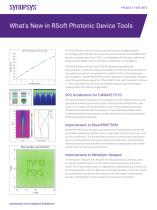
PRODUCT FEATURES What's New in RSoft Photonic Device Tools The RSoft Photonic Device Tools provide the industry's broadest portfolio of simulators and optimizers for passive and active photonic and optoelectronic devices, including lasers and VCSELs—all integrated with Synopsys' optical and semiconductor design tools for complete, multi-domain co-simulations. Multi-GPU speedup vs CPU (24 cores) 100 90 Speedup Factor The RSoft Photonic Device Tools 2024.09 release brings significant enhancements in speed, accuracy, and usability for photonic device simulations. Key updates include GPU acceleration for FullWAVE FDTD, automated power renormalization in BeamPROP BPM, far field optimization in MetaOptic Designer, non-orthogonal domain support in DiffractMOD RCWA, and a transition to Python 3. These improvements are set to revolutionize photonic device simulations, enabling faster and more accurate results. GPU Acceleration for FullWAVE FDTD The 2024.09 release introduces GPU acceleration for the FullWAVE FDTD solver, significantly enhancing simulation speed. Utilizing modern NVIDIA GPUs with CUDA 12.3 or higher, this feature delivers up to 91 times faster performance compared to traditional CPU computations. This acceleration enables users to efficiently tackle large-scale and complex simulations, reducing computation times and boosting productivity. Improvements to BeamPROP BPM BeamPROP BPM now includes automated power renormalization for the full vector BPM, addressing stability issues in high index contrast structures, such as silicon photonics. This enhancement ensures accurate power calculations even in complex photonic structures with strong reflections. The automated renormalization process simplifies the workflow, providing stable and reliable results with minimal manual intervention. Improvements to MetaOptic Designer The MetaOptic Designer now features far field optimization, allowing users to map the far field screen to a near field at a focal point using a thin lens model. This is particularly useful for applications requiring precise control over the far field pattern, such as LIDAR and holographic displays. Users can specify lens parameters, including screen distance and focal length, enhancing the accuracy and flexibility of meta-surface and meta-lens simulations.
Open the catalog to page 1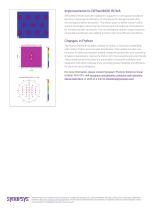
Improvements to DiffractMOD RCWA DiffractMOD RCWA has been updated to support non-orthogonal simulation domains, improving the efficiency of simulations for hexagonal and other non-orthogonal lattice structures. This allows users to define custom lattice vectors and angles, enhancing the accuracy and convergence of simulations for complex periodic structures. The non-orthogonal domain support reduces computational domain size, leading to faster and more efficient simulations. Changes in Python The Python interface has been updated to Python 3, ensuring compatibility with modern Python environments...
Open the catalog to page 2All Synopsys, Inc. catalogs and technical brochures
 Synopsys IP Portfolio
16 Pages
 LynxNXT Automation System
3 Pages
 Synopsys TestMAX
2 Pages
 PrimeSim
2 Pages