

WHITEPAPER ROLLER MILL DRIVE

WHITEPAPER ROLLER MILL DRIVE
The document discusses the advancements in roller mill drive technology, emphasizing the benefits of using counter-rotating rolls at different speeds to control pressure and shear independently. This setup enhances throughput and selective grinding, leading to sophisticated multi-stage grinding processes.
Historical Context
Grinding of cereal grains dates back 27,000 years, initially using grinding stones. The principle of one stationary and one moving grinding surface has evolved over time, culminating in the roller grinding technology of the 18th century. Modern roller mills, like SWISCA's ROMIL, use servo-controlled gap adjustments and electronic interfaces for precision.
Technical Aspects
The "overdrive" mechanism in roller mills involves coupling two roll speeds using spur gears. This design efficiently transfers braking power from the slow roll back to the fast roll, optimizing mechanical power circulation. The torque ratio, influenced by speed and tension between rolls, is crucial for determining braking power.
Efficiency and Flexibility
While pressure can be easily adjusted, varying shear by altering speed ratios is costly and complex. The document compares fixed overdrive systems with individual roll drives, highlighting the higher power requirements and losses in the latter.
Economic Considerations
Individual roll drives offer variability but at the cost of higher energy losses and technical complexity. Fixed overdrive systems are more energy-efficient, with mechanical feedback of braking energy.
Conclusion
Energy efficiency in roller mills can be achieved through optimized mill diagrams and energy-efficient machinery. While individual roll drives allow for product-specific variability, they incur higher energy losses. The document advocates for traditional belt drive systems combined with modern control technologies for optimal energy efficiency.
Author Information
The document is authored by Dipl. Ing. Heinz Brand, Founder/CEO of SWISCA AG.
Catalog excerpts

ROLLER MILL DRIVE
Open the catalog to page 1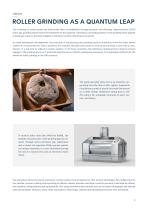
ROLLER GRINDING AS A QUANTUM LEAP The crushing of cereal grains has historically been accomplished through pressure and shearing. Approximately 27,000 years ago, grinding stones were first employed for this purpose. Utilizing an oscillating motion of the grinding stone against a stationary surface, the grain trapped in between could be effectively processed. In many subsequent developments, the principle of maintaining one grinding surface stationary while the other moves relative to it was preserved. This is achieved, for example, through a horizontal or vertical pair of disks, a cone with a...
Open the catalog to page 2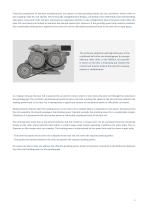
From the perspective of machine manufacturers, one aspect of roller grinding stands out: the „overdrive,“ which refers to the coupling of the two roll speeds. The technically straightforward design, consisting of two differently sized intermeshing spur gears at one end of the roll pair, represents an ingenious solution. In the configuration typical for grain roller mills, the slow roll must always be braked to maintain the desired speed ratio. However, if the grinding speed ratio remains constant, the considerable braking force applied to the slow roll can be efficiently transferred back to the...
Open the catalog to page 3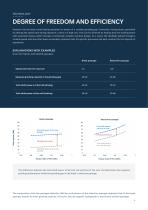
DEGREE OF FREEDOM AND EFFICIENCY Pressure can be easily varied during operation by means of a variable grinding gap. Conversely, varying shear, generated by altering the speed ratio during operation, comes at a high cost. This can be achieved by feeding back the braking power with associated losses and/or through a technically complex machine design. As a result, the flexibility gained through a variable speed ratio has often been overlooked, optimized only for specific processes and kept constant for the majority of operations. EXPLANATIONS WITH EXAMPLES Given two typical, well-utilized passages:...
Open the catalog to page 4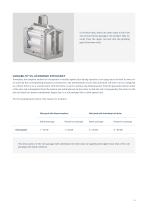
In 8-roller mills, which are often used in the first and second break passages, the product falls directly from the upper roll pair into the grinding gap of the lower rolls. VARIABILITY VS. ECONOMIC EFFICIENCY Nowadays, the simplest method to incorporate a variable speed ratio during operation is to equip each roll with its own motor and link the corresponding frequency converters in the intermediate circuit This individual roll drive can be configured as a direct drive or as a remote motor with belt drive. In such a system, the braking power from the generator-driven motor of the slow roll is...
Open the catalog to page 5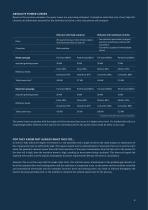
ABSOLUTE POWER LOSSES Based on the previous examples, the power losses are now being estimated. It should be noted that even if very high efficiencies are deliberately assumed for the individual roll drive, a very clear picture still emerges: Roll pack with fixed overdrive Roll pack with individual roll drive IE3 asynchronous motor (mains operation) with belt drive on fast roll Belt overdrive – Two identical permanent magnet synchron synchronus motors with converters. – Converter coupled in intermediate circuit. Break passage required grinding power Total power loss* Reduction passage required...
Open the catalog to page 6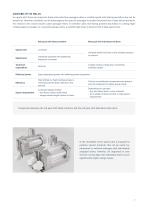
VARIABILITY IN MILLS In a grain mill, there are numerous break and reduction passages where a variable speed ratio during operation may not be beneficial. However, variability can be advantageous for specific passages to enable the production of specialized products. For instance, this could include a grist passage where, in extreme cases, the fluting position (back/back to cutting edge/ cutting edge) is changed, or a smooth passage where a notably high shear is desired with a high-speed ratio. Roll pack with fixed overdrive Speed ratio Roll pack with individual roll drive Constant Variable within...
Open the catalog to page 7
SUMMARY Energy efficiency can be achieved through the optimization of the mill diagram and the use of energy-efficient machinery. The recovery of energy, which must first be added to a system, leads to poorer energy efficiency. The power losses are greater with individual roller drive, as energy recovery for this application is not energy efficient. If the variability of the speed ratio is required for the production of special products, this can be easily implemented for selected passages with individually assigned motors. The technical simplicity and high efficiency of the traditional belt...
Open the catalog to page 8All Swisca ag catalogs and technical brochures
 ELECTRICAL FLAP BOX EFLAP
2 Pages
 CONTROL UNIT VISCA
2 Pages
 ROLLER MILL ROMIL
6 Pages
 CERVO
CERVO3 Pages
 INSCA
INSCA3 Pages
 MICRO
MICRO5 Pages
 GRANO
GRANO5 Pages
 DOSWA
DOSWA3 Pages
- Digital weighing scale
- Kilogram weighing scale
- Weighing scale with LCD display
- Horizontal lump breaker
- Industrial balance
- Automatic dispensing system
- Food lump breaker
- Flow controller
- Precision weighing scale
- Solid dosing unit
- Dispensing system for the food industry
- High-precision dosing unit
- Balance for the food industry
- Floor scale
- Laboratory scale
- Continuous dosing unit
- Lump breaker for the food industry
- Volumetric flow regulator