
- Catalogs
- Swan Analytical Instruments
- Effects of Steam Sample Degassing on CCGT Station Start-up Profile


Effects of Steam Sample Degassing on CCGT Station Start-up Profile

Effects of Steam Sample Degassing on CCGT Station Start-up Profile
The document explores the impact of carbon dioxide on steam cation conductivity and evaluates the effectiveness of degassed cation conductivity monitoring for assessing steam quality, particularly in peak load power plants.
Abstract
The paper highlights the use of degassed cation conductivity (DGCC) to improve steam purity assessments by removing dissolved gases, which is especially useful during power station start-ups.
Methods of Degassing
Boiling was selected as the method for degassing water samples due to its reliability. The study was conducted at South Humber Bank power station using high-pressure steam samples.
Instrument Used
The Swan AMD Degassed Cation Conductivity Monitor was employed, featuring a reboiler after a cation exchange column, to measure specific, cation, and degassed cation conductivity.
Preliminary Investigation
Initial tests established a baseline for degassed cation conductivity at 0.18 µS · cm–1, showing faster return to baseline compared to traditional methods during start-ups.
Primary Investigation
The study on gas turbines GT21 and GT22 demonstrated that the monitor provided more reliable steam purity data, allowing earlier synchronization of the steam turbine.
Benefits and Cost Analysis
Degassed cation conductivity monitoring reduces the time between gas turbine start-up and steam turbine synchronization, offering economic benefits such as increased profit margins, improved efficiency, and carbon credit savings, along with environmental advantages by reducing emissions.
Conclusion
The study concludes that degassed cation conductivity monitoring enhances gas turbine start-up processes, providing economic and environmental benefits.
Specifications and Procedures
The document emphasizes the reliability of the degassed cation conductivity monitor in indicating steam purity and stabilizing start-up profiles.
Economic and Operational Benefits
This technique decreases the time to achieve correct steam conditions, increases efficiency, reduces corrosion risk, and decreases annual turbine operating hours.
Conclusion
Degassed cation conductivity monitoring optimizes start-up profiles and reduces risks from corrosive contaminants, offering significant operational and economic advantages.
References and Acknowledgements
The document includes references and acknowledges contributions from individuals and organizations, including Paul Kelk and Swan Analytical Instruments.
Author Information
Authored by Peter J. Clark, a Chemical Engineering undergraduate at the University of Birmingham, awarded the BIAPWS Undergraduate Award in 2009.
Contact Information
Contact details for Peter J. Clark and the publisher, PPCHEM AG, are provided for further inquiries.
Catalog excerpts

SPECIAL PRINT PPCHEM SPECIAL PRINT The Journal of All Power & Plant Chemistry Areas Sampling, Monitoring, Analytics Effects of Steam Sample Degassing on CCGT Station Start-up Profile Peter J. Clark PowerPlant Chemistry 2010, 12(4), 246–251 ANALYTICAL INSTRUMENTS Conductivity monitor with pH value and alkalizing reagent concentration calculation AMI Deltacon DG Automatic and continuous measurement of total, cation and degassed cation conductivity. Re-boiler according to Larson-Lane (ASTM D4519-94). Swan Analytische Instrumente AG CH-8340 Hinwil ∙ www.swan.ch [email protected] Water Steam Cycles PPCHEM JOURNAL ▪ SPECIAL PRINT (2021) PPCHEM® Journal ▪ www.ppchem.com ▪ SPECIAL PRINT (2021) ▪ PowerPlant Chemistry 2010, 12(4
Open the catalog to page 1
PPChem SPECIAL PRINT PPCHEM Effects of Steam Sample Degassing on CCGT Station ANALYTICS SAMPLING, MONITORING, Start-up Profile Effects of Steam Sample Degassing on CCGT Station Start-up Profile Peter J. Clark ABSTRACT Many power stations dose feedwater with oxygen scavengers such as carbohydrazide; these compounds remove the dissolved oxygen but release inorganic carbon dioxide into the water. The effect of carbon dioxide upon corrosion levels is a controversial subject and as such is not within the scope of the work discussed in this paper. The effect of carbon dioxide upon conductivity measurements...
Open the catalog to page 2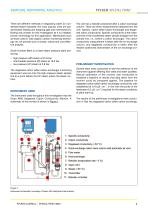
SAMPLING,MONITORING, ANALYTICS There are different methods of degassing water (or condensed steam) samples; the most popular ones are predominantly heating and stripping (gas and membrane) [1]. Boiling was chosen for this investigation as it is a reliable, proven technology for this application. Membranes such as those used in total organic carbon monitoring technology do not provide such a simple, robust and cost effective analysis. South Humber Bank is a triple steam pressure plant producing - high pressure (HP) steam at 91.6 bar - intermediate pressure (IP) steam at 19.3 bar - low pressure...
Open the catalog to page 3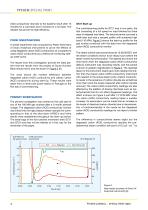
PPChem PPCHEM SPECIAL PRINT Effects of Steam Sample Degassing on CCGT Station Start-up Profile ACE) conductivity returned to the baseline result after 15 minutes for a cold start and 5 minutes for a hot start. The reboiler has proven its high efficiency. PRIOR INVESTIGATIONS A similar experiment was conducted by Pedro Wuhrmann of Swan Analytical Instruments to prove the effects of using degassed cation (ACE) conductivity as compared to cation (ACE) conductivity as a method of monitoring startup water purity. The results from this investigation provide the ideal pattern that the results from the...
Open the catalog to page 4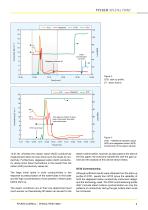
PPCHEM SPECIAL PRINT PPChem Effects of Steam Sample Degassing on CCGT Station Start-up Profile Time [h:min] Time taken for DGCC to show lower conductivity than aftercation techniques Time [h:min] 12:51:00, whereas the classic cation (ACE) conductivity measurement does not even show such low levels of conductivity. Furthermore, degassed cation (ACE) conductivity values show fewer fluctuations in the results than the cation (ACE) conductivity values do. Figure 4: GT21 – Difference between cation (ACE) and degassed cation (ACE) conductivity of the steam sample. steam turbine earlier; however, as...
Open the catalog to page 5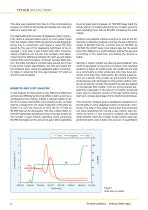
PPCHEM PPChem SPECIAL PRINT Effects of Steam Sample Degassing on CCGT Station Start-up Profile This data was collected from Day 3 of the commissioning program for GT22 so the profile and results are more suitable for a warm start-up. It is observable that the levels of degassed cation conductivity reach a required steam purity at much earlier times than the classic cation (ACE) conductivity levels (Figure 5). Using this in conjunction with Figure 4 gives the time saved by the use of the degassing technique to be on average 1 hour after a gas turbine (GT) start. However, steam conditions are not...
Open the catalog to page 6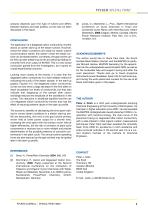
PPChem PPCHEM SPECIAL PRINT Effects of Steam Sample Degassing on CCGT Station Start-up Profile analysis depends upon the type of turbine and differs between stations and load profiles, so this has not been discussed in this report. CONCLUSION The application of a degassed cation conductivity monitor allows an earlier start-up of the steam turbine. However, whilst the steam conditions are ready for steam turbine synchronization earlier, this doesn't mean the steam turbine can be started earlier; conversely, the gas turbine can be fired up later preserving its life and allowing trading for a shorter...
Open the catalog to page 7
PPCHEM SPECIAL PRINT Imprint PPCHEM® journal ISSN 1438-5325 (Print) ISSN 2571-9475 (Online) Publisher: PPCHEM AG P.O. Box 433 8340 Hinwil Switzerland Phone: +41 44 940 23 00 E-mail: [email protected] Editor in Chief: T. Werder (Switzerland) [email protected] International Advisory Board: Professor A. Bursik (Germany) R. B. Dooley (UK) Structural Integrity Associates, Inc. M. Gruszkiewicz (USA) Oak Ridge National Laboratory Professor D. D. Macdonald (USA) U.C. Berkeley B. Stellwag (Germany) R. Svoboda (Switzerland) M. Rziha (Switzerland) PPCHEM AG F. U. Leidich (Germany) D. Addison (New Zealand)...
Open the catalog to page 8All Swan Analytical Instruments catalogs and technical brochures
 AMI ISE Universal
2 Pages
 AMI Hydrazine
2 Pages
 AMI Codes-II TC
2 Pages
 AMI Codes-II
2 Pages
 AMI CACE
2 Pages
 AMI pH/Redox
2 Pages
 An Introduction for Non-Chemists
19 Pages
 Pautbac II
2 Pages
 Opal
Opal2 Pages
 TOC Evolution VUV
2 Pages
 Topaz Analyzer
2 Pages
 Automated Quality Assurance
6 Pages
 Seven Sins of Steam Sampling
16 Pages


- Flowmeter
- Temperature probe
- Liquid flow monitor
- SWAN gas analyzer
- Measuring device
- SWAN concentration analyzer
- SWAN monitoring analyzer
- Resistance temperature sensor
- SWAN liquids analyzer
- SWAN automatic analyzer
- SWAN solids analyzer
- SWAN process analyzer
- Portable analyzer
- SWAN continuous analyzer
- Waterproof temperature sensor
- Water flow monitor
- SWAN water analyzer
- Oxygen analyzer
- SWAN integration analyzer
- Stainless steel temperature transducer