


- Company
- Products
- Catalogs
- News & Trends
- Exhibitions
Baler - Jono

Baler - Jono
The JONO baler is a fully automatic system designed to compact various materials into bales. The process involves compacting the materials and then tying them into bales.
Once the material reaches the desired fill level in the filling chamber, the baler's cover closes automatically. The main ram then compresses the materials while the baler is refilled from the feed belt. After reaching the foremost position, the ram retracts, and the pressed material is loaded into the intermediate hopper. The baler cover opens to refill the compression chamber, and this cycle repeats until the desired bale length is achieved. Photocells detect the procedure, and the wire device ties the bale by moving around it, cutting, and connecting the wires.
- Model: S-120KV
- Dimensions: Length 9948 mm, Width 2390 mm, Height 3035 mm
- Pressing Force: Pre-compressing flap 2x20 t
- Drive Power: 90 kW
- Max. Press Power: 290 bar
- Main Hydraulic Cylinder Working Length: 2600 mm
- Specific Press Force: 15.1 kg/cm²
- Pressing Force: 120/1200 T or kN
- Volume/Cycles: 2.9 m³
- Cycle Times: Without Material 20 sec, Twisting 14 sec
- Performance: 30 kg/m³ (13-16 t/h), 50 kg/m³ (20-25 t/h), 100 kg/m³ (28-32 t/h)
The baler's cover ensures a closed press channel, allowing for more material to be compressed per cycle without the need for cutting. This results in lower maintenance costs as there is no need to replace cutting blades. The bales produced are more compact and rectangular, making them easier to stack. The fill opening matches the press chamber's dimensions, enhancing efficiency. Throughput capacity may vary based on the material.
Catalog excerpts
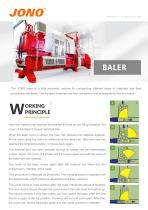
PRODUCT INTRODUCTION BALER The JONO baler is a fully automatic system for compacting different types of materials and their processing into bales. The handled materials are first compacted and subsequently tied into bales. ORKING PRINCIPLE After the material has reached the desired fill level on the filling chamber, the cover of the baler is closed automatically. When the baler cover is closed, the main ram presses the materials together. At the same time the baler is refilled from the feed belt. After the ram has reached the foremost position, it moves back again. The material that has been pressed enough is loaded into the intermediate hopper above; the cover of the baler will then open again and refill the cover of the baler with the material. The cover of the baler closes again after the material has fallen into the compression chamber of the baler. This procedure is detected by photocells. The whole process is repeated until the desired bale length (which is adjustable) has been reached. The cover stops in front position after the cycle mentioned above is finished. The wire device moves through the cover around the bale, from the bottom up. The device accepts a wire from below and from above the baler. After the wire device is again in the top position, the wires are cut and connected. After that, the press ram moves backward again and the whole process is repeated.
Open the catalog to page 1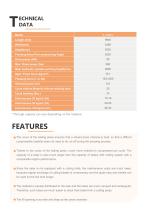
ECHNICAL DATA Pressing force Pre-compressing flap(t) Main hydraulic cylinder-working length(mm) Spec. Press force (kg/cm²) Cycle without Material without twisting (sec) *Through capacity can vary depending on the material. FEATURES The cover of the bailing press ensures that a closed press channel is built, so that a difficult compressible material does not need to be cut off during the pressing process. Thanks to the cover of the bailing press, much more material is compressed per cycle. The capacity of a baler is also much larger than the capacity of balers with cutting system with a comparable...
Open the catalog to page 2All Suzhou JONO Environmental Technology Co., LTD catalogs and technical brochures
 Pulping Machine - Jono
2 Pages
 Rotary Belt Conveyor - Jono
2 Pages
 Bag Opener/Crusher -Jono
2 Pages
 Leo Primary Shredder - Jono
2 Pages
 Draco Bag Opener - Jono
2 Pages
 Rotary Air Separator - Jono
2 Pages
 Trommel Screen - Jono
2 Pages
 Vibrating Screen - Jono
2 Pages
 Stepped 3D Screen - Jono
2 Pages
 Star Screen - Jono
2 Pages



Archived catalogs
 LHASA-JONO ENVIRO
4 Pages
 Can Reverse Vending Machine
2 Pages
 Mobile Trommel Screen - Jono
2 Pages
 Flip-flow Screen - Jono
2 Pages
 Ballistic Screen - Jono
2 Pages
 Disc Screen - Jono
2 Pages
 AI Sorter-Jono
2 Pages
 JONO
JONO17 Pages





- Rail conveyor
- Vessel
- Transport rail conveyor
- Belt conveyor
- Crushing plant
- Horizontal conveyor
- Drying system
- Solids separator
- Screening unit
- Feeder
- Centrifugal classifier
- Industrial tank container
- Cylindrical reservoir
- Waste shredder
- Vertical tank
- Sorting machine
- Mobile crushing plant
- Electric drive conveyor
- Inclined conveyor
- Eddy current separator