
- Catalogs
- Supertouch
- How Fit Is Your Kit

How Fit Is Your Kit
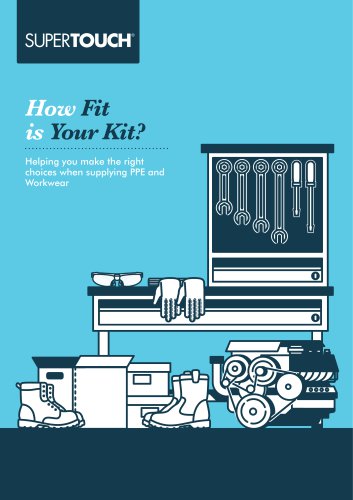
How Fit Is Your Kit
This guide emphasizes the critical role of selecting appropriate Personal Protective Equipment (PPE) tailored to specific industry needs to ensure employee safety and business efficiency. It warns against the risks of improper PPE, which can lead to decreased productivity and increased injury risk.
PPE must be suitable for the risks involved, fit the wearer correctly, and comply with relevant directives. Proper selection and maintenance are crucial for safety and productivity. Engaging employees in PPE selection and education can enhance the safety culture.
Footwear is essential in preventing slips and trips, common workplace accidents. Proper selection involves understanding the work environment, potential contaminants, specific hazards, and wearer mobility. The guide provides examples of suitable footwear for different industries, emphasizing the importance of matching footwear to specific conditions and hazards.
This section likely covers the importance of selecting appropriate eyewear to protect against specific workplace hazards, ensuring proper fit and compliance with safety standards.
This section addresses the selection of gloves based on specific tasks and hazards, ensuring they provide adequate protection without compromising dexterity or comfort.
Proper maintenance and education on PPE use are essential to ensure ongoing protection and compliance. A proactive approach to PPE management can prevent safety issues and enhance workplace efficiency.
The guide underscores the importance of selecting and maintaining the right PPE to protect employees and enhance business performance. It advocates for a comprehensive approach to PPE management, involving all organizational levels.
S1 to S5 safety standards outline various protective features for footwear, including antistatic properties, energy absorption, and resistance to fuel oil and water. S3 and S5 include additional penetration resistance and cleated outsoles.
To maintain safety footwear, replace them when toe caps or fastening systems are damaged, or when sole grips are worn by 50%. Store them away from sunlight and in dry, airy places to prevent material deterioration.
Proper specification of safety eyewear is crucial to prevent eye strain, fatigue, and headaches. Consider the working environment, lens color, and coatings to ensure comfort and compliance. EN standards such as EN 166 and EN 172 provide guidelines for safety eyewear specifications.
Different tasks require specific gloves, and standards like EN 420, EN 388, and EN 374 ensure gloves meet safety requirements for comfort, chemical resistance, and mechanical protection. The EN 388:2016 standard includes tests for abrasion, cut, tear, and puncture resistance, with updated methods for more accurate assessments.
Regular assessment of PPE, including footwear, eyewear, and gloves, is essential to ensure safety and compliance in the workplace. Understanding and adhering to relevant safety standards can significantly reduce the risk of injury.
This document discusses the importance of testing cut-rated gloves using the TDM-100 test, introduced in the 2016 update of the EN 388 Standard, and provides guidance on selecting appropriate gloves based on cut resistance levels.
The document outlines the TDM-100 test, which measures the force required to cut through a glove sample. It provides a comparison of different Newton ratings and their ideal applications, ranging from light material handling to heavy-duty metal stamping.
It highlights the cost implications of over-specifying disposable nitrile gloves and suggests that careful specification based on job requirements can lead to significant savings. The document emphasizes the benefits of Ultra Nitrile gloves, which offer improved dexterity, comfort, and environmental benefits.
The document stresses the importance of maintaining PPE to ensure its protective qualities remain intact. It advises regular checks and proper storage to prevent degradation. The responsibility for PPE maintenance lies with employers, as per the PPE at Work Regulations 1992.
Key tips include instructing employees on proper PPE use, understanding its necessity and limitations, and ensuring PPE remains appropriate for the job. Regular consultation with suppliers and specialists is recommended to maintain safety standards.
Proper specification, maintenance, and education regarding PPE are crucial for ensuring employee safety and operational efficiency. The document underscores the importance of a proactive approach to PPE management.
Catalog excerpts
How Fit is Your Kit? Helping you make the right choices when supplying PPE and Workwear
Open the catalog to page 1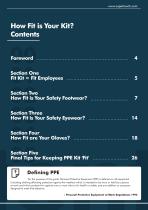
Section Three Section Four Section Five For the purpose of this guide, Personal Protective Equipment (PPE) is defined as: all equipment (including clothing affording protection against the weather) which is intended to be worn or held by a person at work and which protects him against one or more risks to his health or safety, and any addition or accessory designed to meet that objective. - Personal Protective Equipment at Work Regulations 1992
Open the catalog to page 3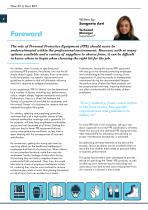
Written by: Sangeeta Aeri Technical Manager Supertouch® The role of Personal Protective Equipment (PPE) should never be underestimated within the professional environment. However, with so many options available and a variety of suppliers to choose from, it can be difficult to know where to begin when choosing the right kit for the job. For starters, when it comes to specifying and purchasing PPE products, the phrase ‘one size fits all’ simply doesn’t apply. Every industry, from construction to the food sector, has specific requirements and guidelines to adhere to that will ultimately influence...
Open the catalog to page 4
Section One Fit Kit =Fit Employees Explaining the key to improving safety performance within a business The Personal Protective Equipment at Work Regulations 1992 are a set of guidelines created under the Health and Safety at Work, etc. Act 1974 (HSWA), which came into force in Great Britain on 1 January 1993. Within them, they place a duty of care on every employer to provide suitable PPE to employees who may be placed at risk to their health or safety while at work. According to Regulation 4, PPE kit is only considered 'suitable' or fit if: • It is appropriate for the risk or risks involved...
Open the catalog to page 5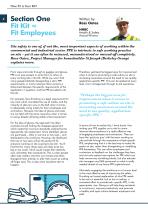
Written by: Ross Oates NHBC Health & Safety Award Winner Site safety is one of, if not the, most important aspects of working within the commercial and industrial sector. PPE is intrinsic to safe working practice on site – yet it can often be misused, misunderstood or missed-off completely. Ross Oates, Project Manager for housebuilder St Joseph (Berkeley Group) explains more. From caps and coats through to goggles and gloves, PPE is an ever-present in some form or other on every working site in the UK. While you won’t find many people blatantly disregarding a site’s PPE requirements, in many...
Open the catalog to page 6
Section Two How Fit is your Footwear? Suitable footwear for each industry, standards and best practice for maintenance
Open the catalog to page 7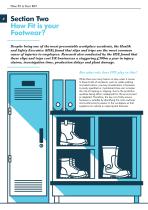
Section Two How Fit is your Footwear? Despite being one of the most preventable workplace accidents, the Health and Safety Executive (HSE) found that slips and trips are the most common cause of injuries to employees. Research also conducted by the HSE found that these slips and trips cost UK businesses a staggering £500m a year in injury claims, investigation time, production delays and plant damage. But what role does PPE play in this? While there are many factors at play when it comes to these kinds of accidents, such as visible cabling and obstructions, one key consideration is footwear....
Open the catalog to page 8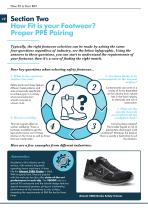
Section TwoHow Fit is your Footwear? Proper PPE Pairing Typically, the right footwear selection can be made by asking the same four questions regardless of industry, see the below infographic. Using the answers to these questions, you can start to understand the requirements of your footwear, then it’s a case of finding the right match. Four key questions when selecting safety footwear.. 1. What is the common surface/terrain? Safety boots and shoes feature different tread patterns and sole compounds specifically to achieve grip in a variety of environments from smooth concrete to uneven mud....
Open the catalog to page 10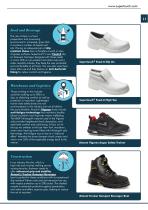
11 Food and Beverage The risk of slips in a food preparation and processing environment is increased, given that it involves a number of liquids and oils. Having an adequate pair of slip resistant shoes here is therefore crucial in case of greasy surfaces. Supertouch®’s own Food-X slip on footwear has been designed with these needs in mind. With an oil-resistant anti-static sole and a water-resistant outsole, they keep the user protected and comfortable at all times. You can also wipe them clean after use and they feature an anti-bacterial lining for odour control and hygiene. Supertouch® Food-X...
Open the catalog to page 11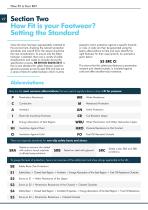
Section TwoHow Fit is your Footwear? Setting the Standard Once the shoe has been appropriately matched to the environment, checking the relevant protection standards and overall fit for the wearer should be the next consideration. To ensure only the fittest footwear is selected, there are a variety of safety classifications and codes to consider during the specification process. BS EN ISO 20345:2011 is the current standard for safety footwear (used for general purpose) across Europe (EN) and sets out a series of tests for safety footwear which must be passed to claim protection against a specific...
Open the catalog to page 12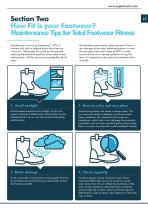
Section Two How Fit is your Footwear? Maintenance Tips for Total Footwear Fitness According to a survey by Supertouch®, 49% of workers only look to replace boots once they are ‘worn out’. Worryingly, this could be dramatically reducing the protective qualities of the safety shoes, making them unfit for use and increasing the risk of injury. We therefore recommend replacing boots if there is any damage to toe caps, fastening systems or once the sole grips have worn away by 50%. In order to ensure they are in tip-top condition during this time, it’s important to also store and maintain them correctly....
Open the catalog to page 13
Section Three How Fit is your Safety Eyewear? Exploring how to avoid eye injuries in the workplace, eyewear suggestions based on use and safety eyewear standards
Open the catalog to page 14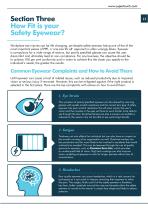
Section Three How Fit is your Safety Eyewear? Workplace eye injuries can be life changing, yet despite safety eyewear being one of the of the most important pieces of PPE, a ‘one size fits all’ approach is often wrongly taken. Eyewear is compulsory for a wide-range of sectors, but poorly specified glasses can cause the user discomfort and ultimately lead to non-compliance. For any business, the objective should be to achieve 100 per cent conformity and in order to achieve this the closer you specify to the individual’s needs, the greater the results. Common Eyewear Complaints and How to Avoid...
Open the catalog to page 15All Supertouch catalogs and technical brochures
 Food Solutions Brochure
20 Pages
 Construction Solutions Brochure
24 Pages
 Weld-Tex FR Catalogue
8 Pages
 Supertouch Catalogue
246 Pages
 Ladies Workwear
10 Pages
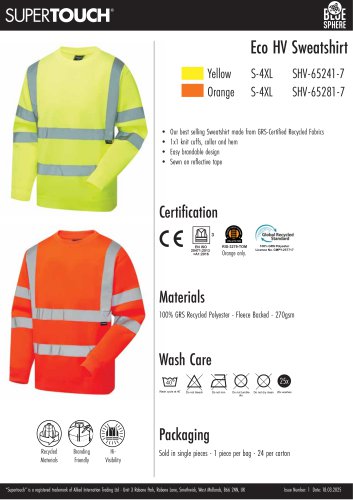 Eco HV Sweatshirt
1 Page
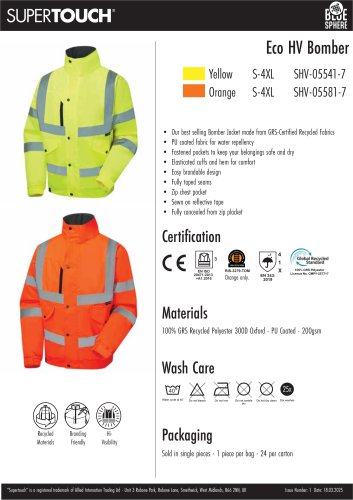 Eco HV Bomber
1 Page
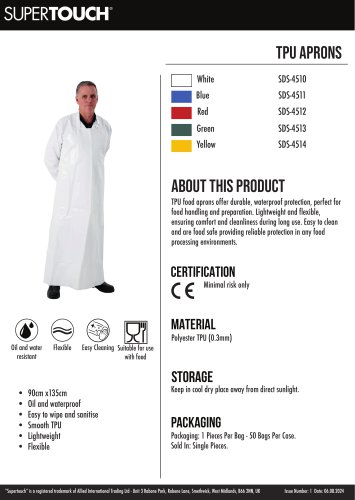 TPU APRONS - PE45
1 Page
- Fabric clothing
- Polyester clothing
- Anti-slip safety shoes
- Cotton clothing
- Filter cartridge
- Mechanical protection safety shoes
- Anti-perforation safety shoes
- Industrial filter cartridge
- Fine filter cartridge
- Waterproof clothing
- Work jacket
- Chemical protection safety shoes
- Waterproof safety shoes
- Work coveralls
- Oil-resistant safety shoes
- Thermal protection clothing
- Work pants
- Chemical protection clothing