
- Catalogs
- Sunnen Products Company
- X-SP-5061


X-SP-5061

X-SP-5061
Honing Condition Solutions: This section tackles common problems like stones not cutting due to glazing or loading, poor stone life, and slow stock removal. Solutions include adjusting cutting pressure, selecting different stone hardness or grit, and ensuring proper lubricity of honing fluids.
Stone Recommendations: Detailed advice is provided for selecting stones based on material type and bore diameter, including specific stone codes for optimal performance and longevity.
Mandrel Recommendations: Guidance is given for choosing the right mandrel based on bore diameter and material type, ensuring proper alignment and effective honing.
Surface Finish Guidelines: A table is included showing approximate surface finishes achievable with different grit sizes and abrasive types, tailored for materials like hard steel, soft steel, cast iron, and aluminum.
Honing Oils and Coolants: The guide stresses the importance of using clean, full-strength Sunnen Industrial Honing Oil to avoid common honing issues, advising against diluting or contaminating the oil.
Conclusion: The Sunnen Honing Guide is a vital resource for troubleshooting and optimizing honing processes, providing clear steps to address specific challenges and ensure high-quality finishes and efficient operations.
Catalog excerpts

START HERE… How to use the Sunnen Honing Guide Use this Guide to choose the condition or application problem from this selection that most closely resembles the question(s) or problem(s) that you are experiencing and click your pointing device. You will be able to move or return to the previous section or another menu by clicking on the BLUE title of each section, Each page of the Guide can be turned forwards and backwards by clicking on the buttons located in the lower corners of the page. Click Here To Start Use this button to return to the Main Menu F Copyright Sunnen Products Company 2001 All Rights Reserved
Open the catalog to page 1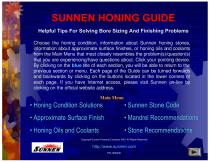
SUNNEN HONING GUIDE Helpful Tips For Solving Bore Sizing And Finishing Problems Choose the honing condition, information about Sunnen honing stones, information about approximate surface finishes, or honing oils and coolants from the Main Menu that most closely resembles the problem(s)/question(s) that you are experiencing/have questions about. Click your pointing device. By clicking on the blue title of each section, you will be able to return to the previous section or menu. Each page of the Guide can be turned forwards and backwards by clicking on the buttons located in the lower corners of...
Open the catalog to page 2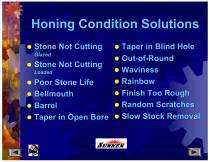
Honing Condition Solutions ® Stone in Blind Hole Glazed ® Out-of-Round ® Stone Not Cutting ® Waviness Loaded ® Rainbow ® Poor Stone Life ® Finish Too Rough ® Bellmouth ® Random Scratches ® Barrel ® Taper in Open Bore ® Slow Stock Removal
Open the catalog to page 3
Stone Not Cutting – Stone Glazed* Step 1 Sharpen A or J stone with MAN-700 diamond dresser; use LNB-700 Dressing stick on all other stones Increase cutting pressure Increase stroking speed Use softer stone (one with lower hardness number) Increase lubricity of honing fluid. Use recommended Sunnen Honing Oil/Coolant* * Many honing problems, such as poor cutting action, poor stone life, and rough finish, are caused by the wrong honing oil, insufficient honing oil, dirty honing oil, or contaminated honing oil. Use only clean, full-strength Sunnen Industrial Honing Oil. Make sure that the honing...
Open the catalog to page 4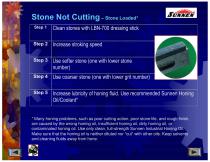
Stone Not Cutting – Stone Loaded* Step 1 Clean stones with LBN-700 dressing stick Increase stroking speed Use softer stone (one with lower stone number) Use coarser stone (one with lower grit number) Increase lubricity of honing fluid. Use recommended Sunnen Honing Oil/Coolant* * Many honing problems, such as poor cutting action, poor stone life, and rough finish, are caused by the wrong honing oil, insufficient honing oil, dirty honing oil, or contaminated honing oil. Use only clean, full-strength Sunnen Industrial Honing Oil. Make sure that the honing oil is neither diluted nor “cut” with other...
Open the catalog to page 5
Slow Stock Removal* Step 1 Increase spindle and stroke RPM Increase cutting pressure Use softer stone (one with lower stone hardness number) Use coarser grit stone (one with lower grit number) Increase lubricity of honing fluid. Use recommended Sunnen Honing Oil/Coolant* * Many honing problems, such as poor cutting action, poor stone life, and rough finish, are caused by the wrong honing oil, insufficient honing oil, dirty honing oil, or contaminated honing oil. Use only clean, full-strength Sunnen Industrial Honing Oil. Make sure that the honing oil is neither diluted nor “cut” with other oils....
Open the catalog to page 6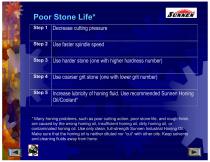
Poor Stone Life* Step 1 Decrease cutting pressure Use faster spindle speed Use harder stone (one with higher hardness number) Use coarser grit stone (one with lower grit number) Increase lubricity of honing fluid. Use recommended Sunnen Honing Oil/Coolant* * Many honing problems, such as poor cutting action, poor stone life, and rough finish, are caused by the wrong honing oil, insufficient honing oil, dirty honing oil, or contaminated honing oil. Use only clean, full-strength Sunnen Industrial Honing Oil. Make sure that the honing oil is neither diluted nor “cut” with other oils. Keep solvents...
Open the catalog to page 7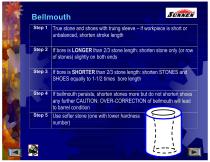
True stone and shoes with truing sleeve – if workpiece is short or unbalanced, shorten stroke length If bore is LONGER than 2/3 stone length: shorten stone only (or row of stones) slightly on both ends If bore is SHORTER than 2/3 stone length: shorten STONES and SHOES equally to 1-1/2 times bore length If bellmouth persists, shorten stones more but do not shorten shoes any further CAUTION: OVER-CORRECTION of bellmouth will lead to barrel condition Step 5 Use softer stone (one with lower hardness number) Step 4
Open the catalog to page 8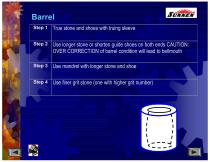
True stone and shoes with truing sleeve Use longer stone or shorten guide shoes on both ends CAUTION: OVER CORRECTION of barrel condition will lead to bellmouth Use mandrel with longer stone and shoe Use finer grit stone (one with higher grit number)
Open the catalog to page 9
Taper In Open Bore Step 1 True stone and shoes with truing sleeve Change stroke to tight end of the bore is stroked off the stone further Reverse the workpiece on the mandrel more often If power stroking, make sure spindle and stroker are in alignment
Open the catalog to page 10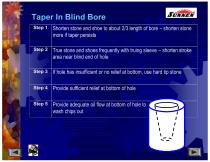
Taper In Blind Bore Step 1 Shorten stone and shoe to about 2/3 length of bore – shorten stone more if taper persists True stone and shoes frequently with truing sleeve – shorten stroke area near blind end of hole If hole has insufficient or no relief at bottom, use hard tip stone Provide sufficient relief at bottom of hole Provide adequate oil flow at bottom of hole to wash chips out
Open the catalog to page 11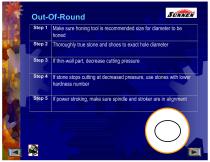
Make sure honing tool is recommended size for diameter to be honed Thoroughly true stone and shoes to exact hole diameter If thin-wall part, decrease cutting pressure If stone stops cutting at decreased pressure, use stones with lower hardness number If power stroking, make sure spindle and stroker are in alignment
Open the catalog to page 12
Use honing tool with sufficient stone length to bridge waviness (or lands and ports in bore)
Open the catalog to page 13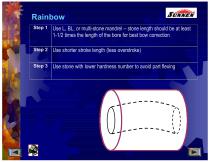
Use L, BL, or multi-stone mandrel – stone length should be at least 1-1/2 times the length of the bore for best bow correction Use shorter stroke length (less overstroke) Use stone with lower hardness number to avoid part flexing
Open the catalog to page 14All Sunnen Products Company catalogs and technical brochures
 MBB-166
4 Pages
 HTB - S Series
3 Pages
 SV-30 series
8 Pages
 SH-4000
1 Page
 SV-15
SV-158 Pages
 Portable Hones and Accessories
20 Pages
 DH SERIES
8 Pages
 SV-2400 Series
8 Pages
 Precision Honing Supplies_2020
203 Pages
 SHDD Series
8 Pages
 PG Bore Gaging System
8 Pages
 CGT KROSSGRINDING®
14 Pages
 Portable Hones
34 Pages
 GHSS GHTS
16 Pages
 corporate brochure
16 Pages
 Small Engines
5 Pages
 Cylinder Liners
5 Pages
 Gears
Gears5 Pages
 Hydraulics
5 Pages
 Fuel Injectors
5 Pages
 HTD Heavy Duty Tube Hone
4 Pages
 HTC Series Honing
4 Pages
 SH-6000
8 Pages
 SH-5000
8 Pages
 SH-4000
8 Pages
 SSH-1680
2 Pages
 SV-15 Vertical Hone
8 Pages
 SV-2500 series
8 Pages
 CH-100
6 Pages
 Sunnen Portable Hones
20 Pages




Archived catalogs
 GNH Giant Portable Hone
1 Page
 MMT High Production
2 Pages
 GHTS GHSS Engine
4 Pages
 Portahones
6 Pages
 Heavy-Duty Push Tools
60 Pages
 SHO Honing Oil
2 Pages
 2C Tooling
2 Pages
 Multi-Stone (MMT) Tools
2 Pages
 X-SP-5070: 21 Case Histories
24 Pages
 GH Tooling Catalog
60 Pages
 X-SP-9003: Dial Bore Gages
8 Pages
 GNH
GNH1 Page
 MPS
MPS9 Pages
 M-series
12 Pages
 Precision Honing Supplies
199 Pages


- Chuck
- Measuring machine
- High-performance lubricant
- SUNNEN mineral lubricant
- Industrial oil
- High-performance oil
- Micrometer
- SUNNEN mineral oil
- Metal lubricant
- High-precision measurement system
- Metal oil
- Oil for automotive applications
- Cutting oil
- SUNNEN abrasive stone
- Diameter measurement system
- Extreme pressure oil
- Low-viscosity lubricant
- Inside micrometer
- Bore micrometer