1. Catalogs
  2. Sunnen Products Company
  3. Precision Honing Supplies_2020
video corpo

Precision Honing Supplies_2020

Precision Honing Supplies_2020
1 / 203 PagesView full catalog

Precision Honing Supplies_2020

Product catalog summary
Overview: Sunnen Products Company, established in 1924, is a leader in precision bore creation, sizing, and finishing equipment. With a global presence, Sunnen offers a comprehensive range of honing supplies and solutions tailored for various industries.
Global Commitment: Sunnen emphasizes innovation, quality, and service, supported by a robust network of over 40 authorized distributors worldwide. Their headquarters in St. Louis, Missouri, is equipped with advanced production and quality control systems.
Product Offerings: Sunnen provides a wide array of honing machines, tooling, abrasives, fixtures, honing oils, bore gages, and accessories. Their catalog is designed to help customers easily identify and order the necessary supplies.
Technical Expertise: Sunnen's field sales engineers and distributors are factory-trained, offering technical support backed by Sunnen Technical Centers and high-tech metrology instrumentation.
Honing Solutions: Sunnen offers solutions for manual and automated honing processes, including multi-stroke and single-pass systems. They also provide specialized systems for deep hole machining, skiving, and roller burnishing.
Product Categories: The catalog is organized into sections covering various honing units, abrasives, tooling, machine accessories, gaging systems, honing fluids, and technical data. Each section provides detailed specifications and selection guides.
Key Recommendations: For specific applications like bowed holes, counterbores, tandem lands, and keyways, Sunnen provides tailored honing unit recommendations to ensure optimal performance and precision.
Technical Data: The catalog includes a stone code explanation chart, surface finish guide, and instructions for altering honing units, ensuring users can achieve the desired honing performance.
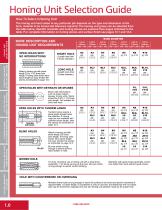
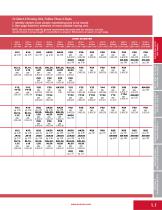
Honing Unit Selection Guide: This document provides a comprehensive guide for selecting the appropriate honing unit based on bore type, dimension, material, and required tolerance. The selection process involves identifying the sketch that resembles the bore to be honed and referring to the corresponding page for the most suitable honing unit. It is crucial to ensure that the stone length fits the general requirements and that the mandrel shank is long enough if a counterbore is present.
Bore Diameter Specifications: The document lists bore diameter ranges from 9.40 mm to 152.40 mm (0.370" to 6.000") with corresponding honing unit pages for selection. Specific mandrels and honing stones are detailed for each diameter range.
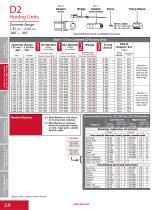
Honing Unit Components: The honing units consist of various components such as mandrels, wedges, truing sleeves, and adapters. The document specifies the diameter range for each component and provides ordering information for complete honing units.
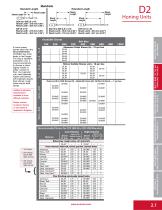
Stone Selection: Different types of stones are recommended based on the material to be honed, including aluminum oxide, silicon carbide, diamond, and CBN stones. The document provides guidance on selecting stones for specific mandrels and materials, emphasizing the importance of matching stone hardness to material hardness.
Additional Features: Special features such as diamond-plated super mandrels and extended shank mandrels are available for specific applications. Tandem "In-Line" mandrels are also discussed for sizing multiple bores in perfect alignment.
Recommendations and Best Practices: The document advises replacing worn wedges or wedge guides to prevent taper in the bore. It also suggests considering stone hardness and grit size for long or repetitive production runs to optimize performance and longevity.
Honing Unit Selection Guide: This document provides a comprehensive guide for selecting honing units, specifically focusing on pedestal machines, plated tooling, cylinder honing, and portable abrasives. It includes detailed specifications for various honing units and their components.
Specifications:
  • Diameter Range: 6.22 mm – 7.82 mm (.245" – .308").
  • Mandrel Options: Steel mandrels with soft or hardened shoes, and bronze mandrels for fine finishes.
  • Stone Length: 57.15 mm (2.25 in.).
Procedures:
  • Order components for complete honing units, including mandrels, truing sleeves, adapters, alignment bushings, and honing stones.
  • Use appropriate mandrel and stone combinations based on material and application requirements.
Norms and Recommendations:
  • Use steel mandrels with hardened shoes for production honing or hard materials.
  • Bronze mandrels are recommended for very fine finishes and exotic metals.
  • Replace wedge or wedge guide when wear begins to prevent taper in the bore.
Key Components and Options:
  • Mandrels: Available in standard, extended shank, and retractable options.
  • Superabrasive Stones: Diamond and CBN stones available in metal, resin, and vitrified bonds.
  • Automatic Size Control Probes: For use with machines equipped with automatic size control units.
Special Orders: Contact customer service for special orders and additional abrasive specifications for difficult materials.
Overview: This document provides detailed specifications and guidelines for selecting and using honing units and mandrels, specifically focusing on the K16 and J-K16 series. It includes recommendations for stone selection, honing unit configurations, and replacement parts.
Specifications: The document outlines the diameter ranges for honing units, such as BL16 and L16, which cover diameters from 12.57 mm to 15.72 mm (.495" to .619"). It also details the K20 series, which ranges from 15.72 mm to 18.90 mm (.619" to .744").
Stone Recommendations: Recommended stones for different mandrels are provided, with options for low-volume and high-volume applications. The document emphasizes the importance of selecting the correct stone hardness based on the material being honed, suggesting that hard materials require soft stones and vice versa.
Mandrel Options: Various mandrel options are available, including steel mandrels with soft or hardened shoes, bronze mandrels for fine finishes, and diamond-plated super mandrels for difficult materials. The document also discusses carbide shoe mandrels and extended shank mandrels for specific applications.
Replacement Parts: Lists of replacement parts for BL16, L16, K20, and J-K20 mandrels are provided, including wedges, stone retainers, and wedge guides. The document advises replacing these parts when wear is detected to maintain honing accuracy.
Additional Features: The document highlights the availability of custom abrasive specifications for honing difficult materials and the use of automatic size control probes for precise honing operations.
Best Practices: Recommendations include selecting stones based on production volume and material hardness, and considering the use of special order stones for long or repetitive production runs. The document also advises on the maintenance of wedges and wedge guides to prevent bore tapering.
Overview: This document provides detailed specifications and guidelines for honing units and mandrels used in precision machining. It includes information on various types of stones, mandrels, and their applications in honing processes.
Specifications: The document lists different grit sizes for silicon carbide and aluminum oxide stones, specifying their use in honing units. It provides diameter ranges for honing units like BL20 and L20, and details on mandrel replacement parts.
Procedures: Instructions are given for selecting appropriate stones and mandrels based on material hardness and desired surface finish. Recommendations are made for using specific stones in low and high-volume applications.
Standards and Recommendations: The document advises on choosing stones based on material properties, suggesting that hard materials require soft stones and vice versa. It also discusses the use of diamond-plated and carbide shoe mandrels for specific applications.
Additional Information: The document includes guidelines for using automatic size control probes and alignment bushings. It emphasizes the importance of replacing worn wedges and wedge guides to maintain honing accuracy.
Key Data: Tables provide detailed measurements for diameter ranges and grit sizes, along with part numbers for ordering specific components. The document also highlights the availability of custom abrasives and tooling options.
Overview: This document provides detailed specifications and guidelines for honing units, specifically focusing on the J-AK20, K20, BAL20, AL20, and P20 models. It includes information on mandrels, stones, and accessories used in honing processes.
Specifications:
  • Mandrels: J-AK20 and K20 mandrels are designed for specific honing applications, with J-AK20 having longer shanks for counterbore applications. BAL20 and AL20 mandrels are similar, with AL20 having a longer shank for extended reach.
  • Diameter Range: The honing units cover a diameter range from 15.72 mm to 26.19 mm (0.619" to 1.031").
  • Materials: The document lists suitable materials for honing, including aluminum, brass, bronze, carbide, cast iron, ceramic, glass, and various types of steel.
Procedures:
  • Stone Selection: Recommendations are provided for selecting stones based on material hardness and desired surface finish. Aluminum oxide, diamond, and CBN stones are available, with specific grit sizes for different applications.
  • Mandrel Setup: Instructions for setting up mandrels, including the use of alignment bushings and guide shoes, are detailed. Special attention is given to the wear of wedges and wedge guides.
Standards and Recommendations:
  • Stone Usage: Guidelines suggest using softer stones for hard materials and harder stones for soft materials. Recommendations for stone hardness and grit size are provided for various materials.
  • Replacement Parts: The document lists replacement parts for mandrels and honing units, emphasizing the importance of replacing worn components to maintain precision.
Additional Information:
  • Custom Solutions: The document mentions the availability of custom abrasive specifications for challenging materials and encourages contacting customer service for special orders.
  • Automatic Size Control: Probes for automatic size control are available for specific diameter ranges, enhancing precision in honing operations.
Overview: This document provides detailed specifications and guidelines for Y8, YY8, Y10, and YY10 Keyway Honing Units, including mandrel replacement parts, honing procedures, and material compatibility. It also includes information on special order options and customer service contact details.
Specifications: The document outlines the diameter ranges for Y8 and YY8 mandrels (6.22 mm – 7.82 mm or .245" – .308") and Y10 and YY10 mandrels (7.82 mm – 9.40 mm or .308" – .370"). It specifies the components included in complete keyway honing units, such as mandrels, truing sleeves, adapters, alignment bushings, and honing stones.
Mandrel Options: Three types of mandrels are available: Steel Mandrels with soft shoes (S) for most materials, Steel Mandrels with hardened shoes (H) for hard or rough parts, and Bronze Mandrels (B) for fine finishes and exotic materials. Special orders (+) are available upon request.
Honing Procedures: The document emphasizes the importance of accurate truing of keyway mandrels to prevent the honing stone from getting stuck. It advises sizing the truing sleeve to a diameter slightly smaller than the desired finish bore size.
Material Compatibility: The document provides recommendations for stone types based on material hardness, suggesting softer stones for hard materials and harder stones for soft materials. It lists aluminum oxide and silicon carbide stones with various grit sizes for different applications.
Special Orders and Customer Service: Special orders for blind hole keyway mandrels and stones are available. Customers are encouraged to contact customer service for pricing, availability, and additional abrasive specifications for difficult materials.
Overview: This document provides technical specifications and guidelines for using keyway honing units, specifically focusing on Y12, YY12, Y16, YY16, and Y20 mandrels. These units are designed for honing bores with keyways, splines, ports, and other surface interruptions.
Specifications:
  • Keyway Mandrels: Must be trued accurately to prevent the honing stone from hanging up in the keyway. The truing sleeve should be sized between the desired finish bore size and 0.127 mm (0.005") under.
  • Mandrel Replacement Parts: Includes wedges, stone retainers, and wedge guides for Y12, YY12, Y16, and YY16 mandrels.
  • Mandrel Options: Available in steel with soft or hardened shoes, and bronze for fine finishes. Special orders are available for specific requirements.
Procedures:
  • Ordering Complete Units: For both Y12 and YY12, as well as Y16 and YY16, complete units include a mandrel, truing sleeve, adapter, alignment bushing, and honing stone with retainer and wedge guide.
  • Stone Selection: Recommended stones vary based on material hardness. Hard materials require soft stones, and vice versa. Additional abrasive specifications are available for difficult materials.
Norms and Recommendations:
  • Stone Usage: In some cases, stones other than the recommended ones may hone faster or last longer. For long production runs, it may be economical to choose a stone slightly harder or softer, coarser or finer.
  • Automatic Size Control Probes: Available for use on machines with automatic size control units, with specific probes based on workpiece finish diameter.
Additional Features:
  • Superabrasive Stone Inserted Guide Shoe Mandrels: Made from bronze for applications where a long-lasting mandrel is needed.
  • Extended Shank Mandrels: Available for honing parts too long for standard mandrels.
  • Tandem “In-Line” Mandrels: Used to size two or more tandem bores in perfect alignment.
Critical Information:
  • Diameter Ranges: Y12 and YY12 range from 9.40 mm to 12.57 mm (.370" to .495"). Y16 and YY16 range from 12.57 mm to 15.72 mm (.495" to .619"). Y20 ranges from 15.72 mm to 19.68 mm (.619" to .775").
  • Material Compatibility: Different mandrel options are available for various materials, including steel, carbide, ceramic, glass, and exotic metals.
Keyway Honing Units Overview: Keyway honing units are designed for honing bores with keyways, splines, ports, and other surface interruptions. They are not suitable for blind holes unless specified otherwise. Blind hole keyway mandrels and stones are available on special order.
Specifications:
  • Diameter Range: 15.72 mm – 25.25 mm (.619" – .994")
  • Mandrel Options: Steel mandrel with soft or hardened shoes, and bronze mandrel for fine finishes.
  • Max Keyway Width: 5.5 mm (7/32")
Mandrel Types:
  • Steel Mandrel (S): Suitable for most materials with soft shoes.
  • Hardened Steel Mandrel (H): For production honing or hard, rough parts.
  • Bronze Mandrel (B): For very fine finishes and exotic metals.
Procedures:
  • Keyway mandrels must be trued accurately to prevent the honing stone from hanging up in the keyway.
  • Size the truing sleeve to a diameter between the desired finish bore size and 0.127 mm (.005") under.
Stone Options:
  • Aluminum Oxide Stones: Available in various grit sizes for different finishes.
  • Silicon Carbide Stones: Suitable for hard to soft materials.
  • Diamond and CBN Stones: Available in metal, resin, and vitrified bonds for long-lasting applications.
Recommendations:
  • For best results, use the recommended stones for specific mandrels.
  • Consider using stones other than the recommended ones for faster honing or longer-lasting results in long production runs.
Additional Features:
  • Superabrasive stone inserted guide shoe mandrels for materials reacting negatively with hardened mandrels.
  • Extended shank mandrels for honing longer parts.
  • Tandem "In-Line" mandrels for sizing multiple bores in perfect alignment.
Contact Information: For special orders or additional abrasive specifications, contact customer service or your sales and application engineer.
Overview: This document provides detailed specifications and guidelines for the use of Y32 and Y44 keyway honing units, including mandrel replacement parts, honing stones, and automatic size control probes. It is intended for applications involving honing bores with keyways, splines, ports, and other surface interruptions.
Specifications:
  • Diameter Range: Y32 units cover 25.20 mm to 34.93 mm (0.992" to 1.375"), while Y44 units cover 34.67 mm to 44.45 mm (1.365" to 1.750").
  • Materials: Mandrels are available in bronze or steel, with options for superabrasive stone-inserted guide shoes for longer life.
  • Stone Types: Available in aluminum oxide, silicon carbide, diamond, and CBN, with various grit sizes for different applications.
Procedures:
  • Mandrel Setup: Includes truing sleeves and alignment bushings to ensure accurate honing. Truing sleeves should be sized to a diameter slightly under the desired finish bore size.
  • Replacement Parts: Includes wedges, tension blocks, shoe clamps, and screws, with specific parts for PB and PC suffix mandrels.
Recommendations:
  • Stone Selection: Choose stones based on material hardness; hard materials require soft stones and vice versa. For long production runs, consider stones that may hone faster or last longer.
  • Automatic Size Control: Probes are available for diameters ranging from 25.15 mm to 45 mm (0.990" to 1.750").
Notes:
  • Standard keyway mandrels are not suitable for blind holes; special orders are available for such applications.
  • Contact customer service for special orders and additional abrasive specifications.
Overview: The document provides detailed specifications and guidelines for honing units, specifically focusing on keyway honing units and mandrel sets. It includes information on materials, recommended stones, and procedures for honing various materials.
Keyway Honing Units: These units are designed for honing bores with keyways, splines, ports, and other surface interruptions. The document specifies the diameter ranges for different models (Y72, Y88, Y104) and provides guidelines for selecting truing sleeves and honing stones. It emphasizes the importance of accurate truing to prevent the honing stone from getting stuck in the keyway.
Materials and Stones: The document lists various materials such as aluminum, brass, bronze, carbide, cast iron, ceramic, glass, and steel, along with recommended stones for each. It highlights the use of aluminum oxide and silicon carbide stones, with specific grit sizes for different applications. The choice of stone depends on the material hardness and the desired surface finish.
Mandrel Sets: The document describes the M Series Mandrel Sets, which simplify ordering by providing a complete set of honing units for specific size ranges. Each set includes a wedge, adapter, and truing sleeve. The document also lists stone assortments available for different mandrel units.
Recommendations: For long or repetitive production runs, it may be economical to choose stones that are slightly harder or softer, coarser or finer, depending on the material and application. The document advises contacting customer service for additional abrasive specifications for honing difficult materials.
Additional Notes: The document includes contact information for customer service and emphasizes the availability of custom abrasives and tooling for specific applications.
KROSSGRINDING® Tooling and Alignment Bushing Overview: This document provides a comprehensive guide on the selection and specifications of KROSSGRINDING® tooling and alignment bushings. It includes detailed tables and instructions for selecting the appropriate tools based on diameter ranges and grit sizes.
Specifications:
  • Tool Diameter Range: The document lists various nominal sizes in both millimeters and inches, with corresponding diameter ranges for each tool.
  • Tool Part Numbers: Each tool is identified by a specific part number, which includes information on the tool family, nominal size, and grit size.
  • Grit Sizes: Available grit sizes range from D1 (70 Grit) to D0 (600 Grit), allowing for customization based on the finishing requirements.
Procedures:
  • Tool Selection Guide: Users are instructed to select the appropriate tool based on the diameter range and locate the corresponding tool part number.
  • Alignment Bushing Usage: For accurate centering, a concentric alignment bushing is recommended. The bushing's ID should match the starting diameter of the workpiece.
Recommendations:
  • Tool Conditioning: The use of a Diamond Conditioning Sleeve (DCS) is suggested for achieving precise bore specifications, with minimal impact on tool life.
  • Consultation for Special Sizes: For bore sizes outside the standard range, consultation with a Sunnen Field Engineer is advised.
Key Data from Tables:
  • Tool and Bushing Dimensions: The tables provide detailed dimensions for shank length, abrasive length, and alignment bushing sizes for each tool.
  • Delivery Time: Standard delivery for CGT tools is approximately two weeks.
Conclusion: The document serves as a detailed reference for selecting and using KROSSGRINDING® tools and alignment bushings, emphasizing the importance of precise tool selection and alignment for optimal performance.
Introduction: The document provides a comprehensive guide on the Single Stroke Honing® process, which is a fast and accurate method for sizing bores to their final size. This process is particularly suited for high production applications using Sunnen’s high-precision helix tools.
Specifications: The honing tools incorporate an expandable, superabrasive sleeve mounted on a tapered mandrel for precision bore sizing and finishing. The process is best suited for honing operations that produce a low volume of chips, such as interrupted or short bores, and is most successful in honing cast iron and powdered metals.
Procedures:1. Either the part to be honed or the tool itself must be allowed to float.
2. A continuous flow of Sunnen Industrial Honing Oil or Coolant is necessary to flush chips out of the bore.
3. Honing speed can vary from 50 to 300 surface feet per minute.
4. Feed rate can vary from 5 to 200 inches per minute.
5. Stock removal should align with the grit size of the sleeve and surface finish requirements.
Tool Selection and Ordering: The document includes a detailed selection guide for ordering the appropriate tools based on diameter and grit size. It provides part numbers and descriptions to avoid errors in ordering.
Surface Finish: The surface finish produced by a particular grit is influenced by variables such as material type, hardness, and tool sharpness. A table is provided to guide the selection of grit size based on the desired surface finish.
Tool Dimensions: Dimensions for the Sunnen High-Precision Helix Single Stroke Honing® Tools are provided to assist in adapting machines for their use. Mandrel dimensions can be altered using common metal cutting tools.
Conclusion: The document serves as a detailed guide for selecting and using Sunnen’s Single Stroke Honing® tools, emphasizing the importance of selecting the correct tool components and adhering to recommended procedures for optimal results.
Overview: This document provides detailed specifications and guidelines for various honing units and components used in industrial applications. It includes information on different hone heads, stone sets, and brush sets, along with their respective diameter ranges and abrasive grades.
Specifications:
  • Hone Heads: The document lists several hone head models such as GHSS-2440/2800 and GHSS-3410/4410/5410/6410, each with specific diameter ranges and configurations. These hone heads are designed for different industrial machines and applications.
  • Stone and Brush Sets: Various stoneholder and brush set configurations are provided, with details on diameter ranges and abrasive grades. The document specifies the use of diamond and CBN abrasives, with options for different grit sizes.
Procedures:
  • Assembly and Usage: Instructions for assembling the hone heads and using the stone and brush sets are implied through the detailed part numbers and configurations listed.
  • Customization: The document notes that additional stone sizes and abrasive grades are available upon request, indicating a level of customization for specific industrial needs.
Recommendations:
  • Contact Customer Service: For additional abrasive grades and specific configurations, the document advises contacting customer service for further assistance.
  • Optimizing Working Range: It suggests using additional stone holders or sizes to optimize the working range of the honing units.
Key Data from Tables:
  • Diameter Ranges: The tables provide detailed diameter ranges for each hone head and stone set, crucial for selecting the appropriate tool for specific applications.
  • Abrasive Grades: The tables list various abrasive grades available, including diamond and CBN, with specific suffixes for easy identification.
Conclusion: This document serves as a comprehensive guide for selecting and configuring honing units and components for industrial applications, emphasizing the importance of choosing the correct diameter range and abrasive grade for optimal performance.
Specifications and Accessories: This document provides detailed specifications and accessories for honing units and tools. It includes various parts and accessories such as storage racks, setting gauges, stone inserters, and replacement parts for specific models like the CK-3355A Stone Inserter. The document also lists recommended stones for different materials and surface finishes, specifying the appropriate grit sizes and types of stones (e.g., Silicon Carbide, Aluminum Oxide) for various applications.
Honing Tools and Applications: The document outlines the use of honing tools such as the CV-3000 Junior Hone and CV-4000 Large Hone, detailing the recommended stones for materials like aluminum, brass, bronze, cast iron, and steel. It emphasizes the importance of selecting the correct stone hardness based on the material being honed, with guidelines suggesting that hard materials require soft stones and vice versa.
Portable Hones: Sunnen Portable Hones are highlighted for their versatility in bore-sizing work, capable of correcting various shape errors and providing a uniform surface finish. The document provides guidance on selecting the appropriate power source for these hones, recommending specific drill motor kits and speed control units for optimal performance.
Ordering and Customization: Instructions for ordering parts and accessories are included, with details on how to select and order shaft extensions, drive shanks, and stone sets for specific honing applications. The document also mentions the availability of custom abrasives and tooling for specialized needs.
Overview: This document provides detailed technical specifications and guidelines for using the AN-815-A40X Piloted Portable Hone and associated accessories. It includes information on optimal usage, recommended tools, and additional accessories for honing operations.
Specifications: The AN-815-A40X Piloted Portable Hone can be driven by a heavy-duty electric or air drill, or used in a drill press. The optimal RPM for honing is calculated by dividing 1200 by the hole diameter in inches or 30000 by the bore diameter in mm. The document provides a table for recommended drill chuck sizes based on hole size.
Procedures: For honing operations, a universal joint is built into each hone, and an additional joint is required when using a drill press. The document outlines the use of different models for honing bores in line with another bore on the same axis, covering a diameter range of 44.5-533.4mm.
Recommended Stones: The document lists various stone sets for different materials and applications, such as fast removal and fine finishing. It includes specific stone codes for materials like aluminum, brass, bronze, carbide, cast iron, ceramic, glass, and steel.
Accessories: Additional portable accessories like PHT Plateau Honing Tools and Teflon-Mounted Hone Holders are discussed. These tools are used for final finishing steps and provide a Teflon coating compatible with Teflon rider rings.
Honing Units: The document details the use of portable mandrel drivers like the P-180 Honall® and P-200 Sidewinder for sizing and finishing holes. It includes ordering information and specifications for these units.
Portahones: Portahones are described as complete portable honing units suitable for internal diameters in long tubing or bulky work. They are available in remote-feed and hand-feed configurations, with replaceable guide shoes for extended tool life.
Conclusion: The document provides comprehensive guidance on selecting and using honing tools and accessories for various applications, emphasizing the importance of choosing the right stones and accessories for optimal performance.
Overview: The document provides detailed specifications and guidelines for the HB Modular Tool System, designed for use with HTB, HTC, HTH, HTS, and HTD type systems. It includes information on hone heads, tooling for various diameter ranges, and recommended abrasives for different materials.
Specifications: The HB Modular Tool System supports stock removal rates in soft steel up to 750 cm3/h. It covers a diameter range from 195 mm to 1,375 mm (7.67 to 54.13 inches). The document lists various stone sets and hone body masterholders for different diameter ranges, along with machine coupling and shaft extension options.
Tooling for Blind Bores: The HB-SL series is designed for blind bore applications with a stock removal rate up to 400 cm3/h. It supports diameter ranges from 76 mm to 780 mm (2.99 to 30.70 inches). The document specifies stone sets, hone body masterholders, and shaft extensions for these applications.
Parts and Accessories: The document details parts like the 3-stone master holder set, stone and guide support sets, and masterholder cages. It also includes information on optional accessories and configurations for specific applications.
Recommended Abrasives: The document provides a guide for selecting roughing and finishing stones based on material type and desired surface finish. It includes both conventional and superabrasive options, with specific recommendations for different materials such as steel, cast iron, and aluminum.
MMT and PH Tools: These tools are highlighted for their speed and accuracy in high-production applications. Key features include reduced honing costs, compatibility with various coolants, and quick-change designs. PH tools are noted for their use in diesel cylinder liners and other high-production applications.
LBT Tools: Designed for small diameter, long bore tube hone applications, LBT tools are capable of producing precise bore IDs and are made from thru-hardened tool steel for durability. The document outlines the tool families, their ranges, and key features.
Specifications: The document provides detailed specifications for various Sunnen bore gaging systems and accessories. It includes diameter ranges for different gages, such as the PG-810-Z08X and PG-800 Series, with measurements in both metric and imperial units. The dimensions of the gages and setting fixtures are also specified.
Gage Leasing Program: Sunnen offers a leasing program for its PG-700 and PG-800 Series Gages, which includes maintenance and updates. This program is available only within the United States.
Certified Gage Option: Sunnen provides an optional certification for its gages, which includes a certificate of calibration listing linearity and hysteresis measurements.
Accessories and Tools: The document lists various accessories for the gages, such as replacement gage points, blind hole gaging points, and auxiliary faceplates. It also includes tools like gage point removal and installation tools, tolerance flag adjusting wrenches, and flexible hex wrenches.
Setting Fixtures and Probes: Details on setting fixtures like the CF-502 and CF-502M are provided, along with information on probe kits and transfer pins. The document specifies the diameter ranges and part numbers for these components.
Dial Bore Gages: The document describes different series of dial bore gages, including the GR-3000, GRM/GR-6000, and GRM/GR-9000 Series. It outlines their capabilities, such as measuring to specific depths within blind holes, and lists replacement parts and special order options.
Gage Mounting Brackets: Recommendations for mounting brackets to be used with Sunnen Precision Bore Gages on honing machines are provided, including model numbers and descriptions for various machine compatibility.
Specifications: The document provides detailed specifications for various dial bore gages and their components. It includes information on point assemblies, nuts, and special length dial bore gages. The document specifies the diameter ranges for different point assemblies in both metric and inch measurements. Special length dial bore gages can be ordered with specific gaging lengths, but accuracy is compromised beyond certain lengths.
Procedures: Instructions are provided for ordering special length dial bore gages and using gage extension kits. The document outlines the use of setting fixtures for 2000 Series Dial Bore Gages, which facilitate fast and accurate gage setting.
Standards and Recommendations: The document emphasizes the importance of using genuine Sunnen honing oils and coolants to ensure optimal performance and avoid common honing problems. It provides specifications for various honing oils, highlighting their chemistry, viscosity, and benefits.
Accessories and Replacement Parts: A comprehensive list of accessories and replacement parts for 2000 Series Gages is included, such as indicating balls, centralizer points, nuts, and various gage point extensions. The document also lists available extension sleeves for converting gages to different lengths.
Technical Data: The document includes technical data on honing oils and coolants, detailing their specifications, features, and benefits. It highlights the importance of selecting the right honing oil for specific applications to enhance productivity and reduce costs.
Tables and Charts: Several tables provide detailed information on part numbers, maximum gaging depths, overall lengths, and shipping weights for different gage models. A gage point selection table helps users choose the appropriate gage point based on diameter ranges.
Key Takeaways: - Accurate gage setting is crucial for precision measurements.
- Special length gages require careful consideration of accuracy limitations.
- Genuine Sunnen honing oils are recommended for optimal performance.
- A wide range of accessories and replacement parts are available to customize and maintain gages.
- Proper selection of honing oils can significantly impact productivity and cost-efficiency.
Specifications:
  • SHO-500: Contains no mineral oil, sulfur, or chlorine. Viscosity: 22 cSt@40˚C. Non-hazardous. VOC: 19 grams/liter.
  • MAN-852: Contains no mineral oil, sulfur, or chlorine. Viscosity: 28 cSt@40˚C. Non-hazardous. VOC: 1 gram/liter. Available in various sizes.
  • KG3X: Contains no mineral oil, sulfur, or chlorine. Viscosity: 21 cSt@40˚C. Non-hazardous. VOC: 13 grams/liter. Available in various sizes.
  • MAN-845: Contains mineral oil, sulfur, chlorine. Viscosity: 7 cSt@40˚C. Hazardous. VOC: 380 grams/liter. Available in various sizes.
  • CK-50: Contains mineral oil, sulfur, chlorine. Viscosity: 4.4 cSt@40˚C. Hazardous. VOC: 428 grams/liter. Available in drums.
  • LT9X: Contains no mineral oil, sulfur, or chlorine. Viscosity: 108 cSt@40˚C. Hazardous. VOC: 4 grams/liter.
  • MAN-C: Contains mineral oil, sulfur, chlorine. Viscosity: 437 cSt@40˚C. Hazardous. VOC: 64 grams/liter. Available in various sizes.
  • SCC-100/101: No mineral oil, sulfur, or chlorine. Viscosity: Water. Non-hazardous. VOC: 39 grams/liter. Available in small sizes.
  • SCC-205/605: No mineral oil, sulfur, or chlorine. Viscosity: Water. Non-hazardous. VOC: 1 gram/liter. Available in various sizes.
Features & Benefits:
  • SHO-500: Petroleum-free, suitable for honing applications without additives, compatible with various abrasives, USDA BioPreferred®.
  • MAN-852: Approved by Boeing, mild odor, suitable for sensitive operators, ideal for aerospace and nuclear industries.
  • KG3X: Similar to MAN-852 but with lower viscosity, suitable for aerospace and nuclear industries.
  • MAN-845: Low viscosity, suitable for general automotive machine shop honing, can be boosted for difficult materials.
  • CK-50: Low viscosity, formulated for honing cast iron engine blocks, not for other materials.
  • LT9X: Can be used as an additive to boost performance, compatible with various machine tools.
  • MAN-C: Concentrated formula for mixing with mineral oil, suitable for hard-to-hone materials.
  • SCC-100/101: Ideal for grinders, compatible with water-based machine tools, mild to skin.
  • SCC-205/605: Superior in reducing workpiece temperature, suitable for various metalworking fluids.
Technical Data:
  • Various honing oils and coolants are available for different processes and materials, with specific recommendations for each.
  • Surface finish parameters such as Ra, Rt, and Rz DIN are used to measure and analyze surface textures.
Surface Roughness Parameters:
1. Rz ISO: Measures the average height difference between the five highest peaks and five deepest valleys, ideal for short surfaces.
2. Rmax: The distance from the highest peak to the deepest valley in any of the five sections.
3. Rp: The height of the highest peak above the mean line in five sampling distances.
4. Rpm: The average height of the five highest peaks above the mean line.
5. RMS/Rq: An obsolete definition similar to Ra but results in a value about 15% higher.
6. Rk: Represents the main bearing area of a surface, ignoring the highest peaks and deepest valleys, with Rpk and Rvk defining the magnitude of these peaks and valleys.
Parameter Conversion Formula: To convert a known Ra value to a different parameter, use the formula: Ra x Parameter Factor = Desired Parameter. Example conversions are provided for reference.
Alteration of Honing Units: Honing units may require alterations for specific applications such as short open holes, blind holes, or tandem bores. Alterations involve adjusting the stone and guide shoe lengths to meet specific bore requirements.
Procedures for Alteration:
  • For short open holes, stack parts or adjust stone and guide shoe lengths to be between 2/3 and 1-1/2 times the bore length.
  • For blind holes, provide a relief at the closed end and adjust stone and guide shoe lengths to be between 1/2 and 2/3 the blind hole length.
  • For tandem bores, ensure stone and guide shoe lengths are at least twice the center-to-center tandem distance.
Guide Shoes and Truing Sleeves: Guide shoes are integral or replaceable, with different materials recommended based on the application. Truing sleeves are used to maintain accuracy and parallelism of the honing tools.
Wedges and Runout Correction: Wedges should be inspected and replaced when worn. Runout correction can be achieved through adjustable spindle chucks or mandrel shims.
Honing Performance Information: Operators often inquire about the time required to hone a part, emphasizing the importance of understanding honing performance metrics.
Introduction: This document provides technical guidance on estimating honing times for different Sunnen Honing Machine systems and includes a glossary of terms related to honing processes.
Honing Time Estimation Methods:
  • SH Series Power Stroked Machines: Best for low-alloy steel using a 220 grit CBN/Borazon stone. The honing time is calculated using the formula: Finish diameter x part length x stock removal x honing time factor.
  • Hand-Powered Portable Hones: Uses stones like G25, M27, N37, W47 with Sunnen Industrial Honing Oil. The formula for honing time in inches is: Length x Diameter x Required Stock Removal x 12.5.
  • Horizontal Tube Hone with H70 Stone Sets: Suitable for soft low-alloy steel using H70-A45 stones. The formula for honing time in inches is: Length x Diameter x Required Stock Removal x 5.
Stone Life Estimation: Calculates the number of workpieces producible with a set of stones using the formula: (Final Diameter² - Starting Diameter²) x Length x .03 = Sets of Stones.
Glossary of Terms: This section defines key terms related to honing, such as:
  • Adapter: A part used to fit mandrels to the spindle chuck.
  • CBN: Cubic boron nitride, a man-made abrasive for tough alloy steels.
  • Honing: An abrasive machining process for stock removal and precision sizing.
  • Mandrel: Holds and positions the honing stone and guide shoes.
Technical Data: Includes a hardness conversion table and contact information for Sunnen's global offices.
Conclusion: The document provides comprehensive guidelines for estimating honing times and understanding the technical aspects of honing processes, ensuring efficient and cost-effective operations.
See more

Catalog excerpts

Precision Honing Supplies_2020-1

ABOVE AND BEYOND HONING Precision Honing Supplies ABRASIVES

 Open the catalog to page 1

Precision Honing Supplies_2020-2

Sunnen’s Global Commitment: Sunnen Products Company began in 1924 as the dream of a young man, Joe Sunnen, who devised new tools for working on automobile engines. Today Sunnen is the largest fully integrated company in the world specializing in precision bore creation, sizing and finishing equipment. With headquarters in St. Louis, Missouri, Sunnen has facilities in Austria, Belgium, Brazil, China, Czech Republic, France, India, Italy, Poland, Russia, Switzerland and the UK. A worldwide network of over 40 Authorized Sunnen Distributors allows Sunnen to provide products and services wherever...

 Open the catalog to page 2

Precision Honing Supplies_2020-3

Innovation, Quality and Service Technical Expertise Second to None Sunnen Field Sales Engineers and Authorized Sunnen Distributors are factory trained to help answer your questions. They are backed by Sunnen Technical Centers and the latest high-tech metrology instrumentation. The result is an unprecedented ability to help our customers solve their most difficult bore sizing and finishing problems. Call us or contact us online...we are here to help! Honing in on Honing Supplies Since its beginning Sunnen has concentrated on the technology of precision honing. We produce the industry’s largest...

 Open the catalog to page 3
Precision Honing Supplies_2020-4

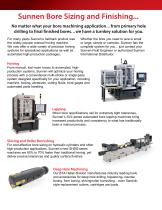
Sunnen Bore Sizing and Finishing... No matter what your bore machining application…from primary hole drilling to final finished bores…we have a turnkey solution for you. For many years Sunnen’s hallmark product was the widely popular manual honing machine. We now offer a wide variety of precision honing systems for specialized applications as well as automated high-production packages. Whether the bore you need to size is small or large, simple or complex, Sunnen has the complete system for you... just contact your Sunnen Field Engineer or authorized Sunnen International Distributor. From manual,...

 Open the catalog to page 4
Precision Honing Supplies_2020-5

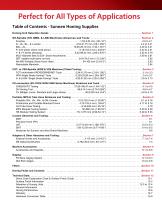
PERFECT FOR ALL TTypes F APPLICATIONS Perfect for All YPES O of Applications Table of Contents - Sunnen Honing Supplies Honing Unit Selection Guide: . . . . . . . . . . . . . . . . . . . . . . . . . . . . . . . . . . . . . . . . . . . . . . . . . . . . . . . . . . . . . . . Section 1 SH-Spindle (SH, MBB, & LBB Machines) Abrasives and Tools: . . . . . . . . . . . . . . . . . . . . . . . . . . . . . . . . . . . Section 2 D-series . . . . . . . . . . . . . . . . . . . . . . . . . . . . . . . . . . . . . . . . . 1,52-2,54 mm (.06-.10"). . . . . . . . . . . . . . . . . . . . . . . . . . . . 2.0 to...

 Open the catalog to page 5
Precision Honing Supplies_2020-6

Honing Unit Selection Guide How To Select A Honing Unit CUSTOM ABRASIVES & TOOLING PORTABLE, MPS & TUBE HONE ABRASIVES CYLINDER HONING (SV-15/30/2400 MACHINES PLATED TOOLING (KGM & VSS MACHINES) HONING UNIT SELECTION GUIDE The honing unit best suited to any particular job depends on the type and dimension of the bore, material to be honed and tolerance required. The honing unit group can be selected from the table below. Specific mandrels and honing stones are selected from pages indicated in the table. For complete information on honing stones and surface finish see pages 12.1 and 12.2. BORE...

 Open the catalog to page 6
Precision Honing Supplies_2020-7

To Select A Honing Unit, Follow These 2 Steps 1. Identify sketch most closely resembling bore to be honed. 2. See page listed for selection of most suitable honing unit. NOTE: Be sure stone length fits general requirements discussed with the sketches, and that mandrel shank is long enough if a counterbore is present. Dimensions are given on each page. bore diameter HONING UNIT PEDESTAL MACHINES PLATED TOOLING CYLINDER HONING PORTABLE, MPS & TUBE CUSTOM ABRASIVES SELECTION GUIDE (SH, ML, EC, MBB, & LBB) (KGM & VSS MACHINES) (SV-15/30/2400 MACHINES HONE ABRASIVES & TOOLING

 Open the catalog to page 7
Precision Honing Supplies_2020-8

D2 Honing Units Diameter Range: 1,52 .060"-.100" Adaptor Wedge Adaptor Stone Truing Sleeve CUSTOM ABRASIVES PORTABLE, MPS & TUBE CYLINDER HONING PLATED TOOLING PEDESTAL MACHINES HONING UNIT & TOOLING HONE ABRASIVES (SV-15/30/2400 MACHINES (KGM & VSS MACHINES) (SH, ML, EC, MBB, & LBB) [SELECTION GUIDE Order 1-5 For Complete D2 Honing Units Diameter Range 1,52 mm - 2,54 mm .060" - .100" Mandrel Options S = Steel Mandrel w/ soft shoes, for honing most materials. H = Steel Mandrel w/ hardened shoes for production honing or hard, rough parts, carbide, ceramic, glass. * 1st choice "* 2nd choice. Use...

 Open the catalog to page 8
Precision Honing Supplies_2020-9

Standard Length Shank Length Cffipf Mandrels Extended Length Reach Length D2A thru D2E (S or H) Shank Lenth - 27.5 mm (1.08") Reach Lenth - 38.6 mm (1.52") D2F (S or H) Shank Lenth - 27.5 mm (1.08") Reach Lenth - 40.2 mm (1.58") In some cases, stones other than the RECOMMENDED STONES may hone faster or last longer. For long or repetitive production runs, it may be economical to choose a stone slightly harder or softer, coarser or finer. As a general rule, hard materials require soft stones; soft materials require hard stones; rough holes require hard stones. Additional abrasive specifications...

 Open the catalog to page 9
Precision Honing Supplies_2020-10

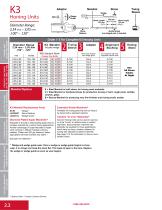
K3 Honing Units Diameter Range: 2,54 mm — 3,05 mm .100”-.120” Truing Sleeve CUSTOM ABRASIVES PORTABLE, MPS & TUBE CYLINDER HONING PLATED TOOLING PEDESTAL MACHINES HONING UNIT & TOOLING HONE ABRASIVES (SV-15/30/2400 MACHINES (KGM & VSS MACHINES) (SH, ML, EC, MBB, & LBB) [SELECTION GUIDE Order 1-5 For Complete K3 Honing Units Diameter Range 2,54 mm - 3,05 mm .100" - .120" Mandrel Options S = Steel Mandrel w/ soft shoes, for honing most materials. H = Steel Mandrel w/ hardened shoes for production honing or hard, rough parts, carbide, ceramic, glass. B = Bronze Mandrel for producing very fine finishes...

 Open the catalog to page 10
Precision Honing Supplies_2020-11

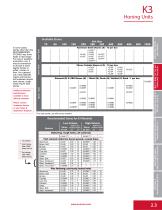
Grit Size In some cases, stones other than the RECOMMENDED STONES may hone faster or last longer. For long or repetitive production runs, it may be economical to choose a stone slightly harder or softer, coarser or finer. As a general rule, hard materials require soft stones; soft materials require hard stones; rough holes require hard stones. Additional abrasive specifications available to hone difficult materials. Please contact Customer Service or your Sales & Application Engineer. tFor best results, use with bronze mandrel. * 1st choice '* 2nd choice. Use if A65 does not cut. '* 3rd choice....

 Open the catalog to page 11
*Prices are pre-tax. They exclude delivery charges and customs duties and do not include additional charges for installation or activation options. Prices are indicative only and may vary by country, with changes to the cost of raw materials and exchange rates.